
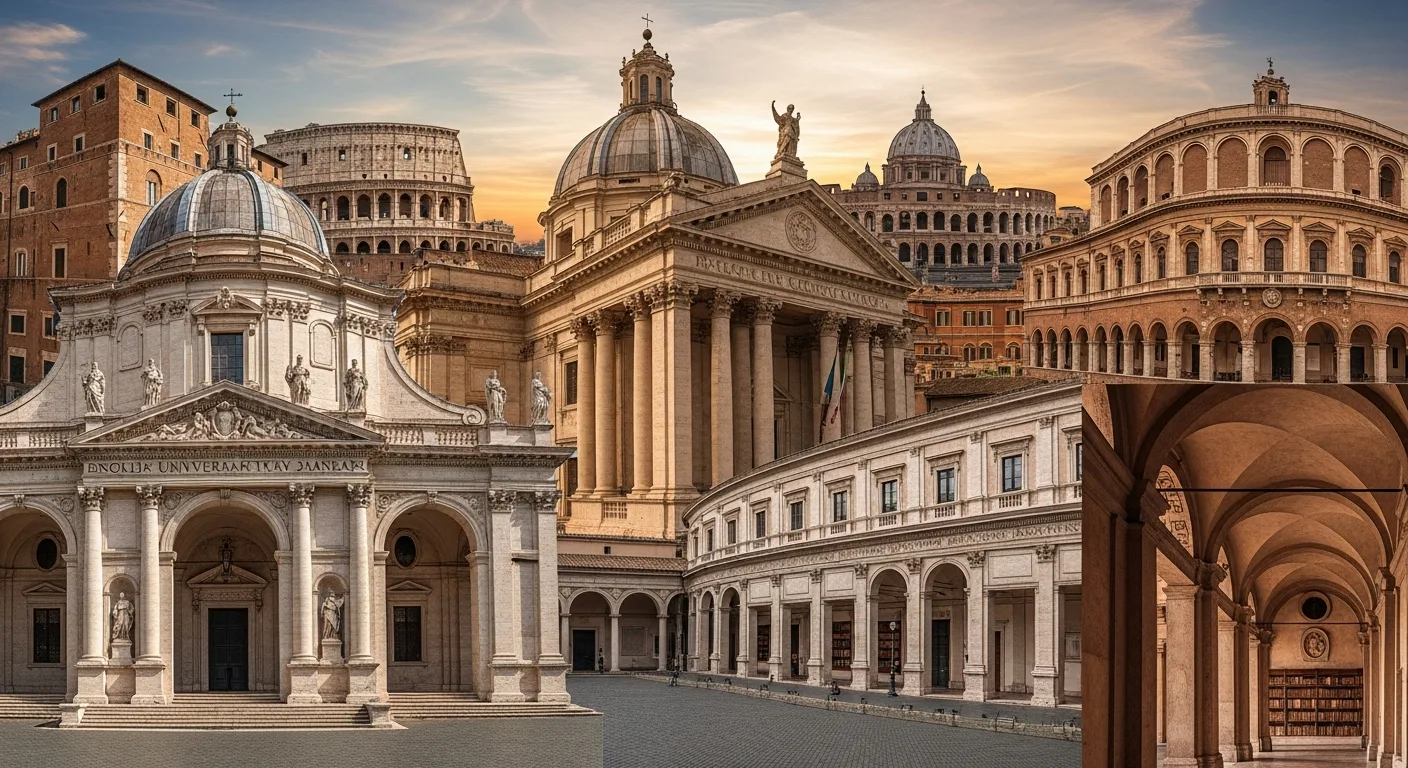
You’re sitting on the steps of Piazza della Signoria in Florence, surrounded by the tourist chatter of five continents, while your friend from Bologna explains that his annual tuition fee is exactly 156 EUR – because the Italian public system calculates fees based on family income, and his parents are teachers. You sip an espresso for 1.20 EUR (standing at the bar, like a true Italian; sitting costs twice as much) and wonder why no one ever told you that Europe’s oldest universities offer an education for a fraction of the price of many private universities elsewhere. This isn’t fiction – it’s the daily reality for hundreds of thousands of students in Italy.
Italy is an absolute game-changer for prospective students looking to study abroad. It combines something no other country in Europe offers in such a package: tuition fees from 0 to 4,000 EUR per year at public universities (thanks to the income-based ISEE system), a growing number of English-taught programs, universities with centuries of academic tradition, and, let’s be honest – a lifestyle where lunch lasts two hours, aperitivo starts at 6 PM, and the word “stress” has a completely different meaning than in Warsaw or London. If you’re looking for quality education at a reasonable price, with the SAT as your ticket to top universities, Italy should be high on your list.
In this guide, I’ll walk you through six universities that offer the most interesting options for international applicants: Bocconi (prestigious business in Milan), Politecnico di Milano (Europe’s leading polytechnic), Sapienza (Italy’s largest university in Rome), Università di Bologna (the world’s oldest university), Padova (the pearl of Veneto), and Università Cattolica del Sacro Cuore (Europe’s largest private university). I’ll show you the ISEE system, TOLC exams, the role of the SAT in admissions, living costs in various cities, and – most importantly – why Italy probably offers the best value for money in European higher education.
Study in Italy – Key Statistics 2025/2026
Source: QS World University Rankings 2025, Universitaly.it, MIUR 2025
Rankings and Italy’s Position in European Higher Education
Italy has something no other country in Europe possesses: the longest uninterrupted academic tradition in the world. Università di Bologna (founded in 1088) is literally the Alma Mater of all universities. But tradition isn’t the only argument; contemporary Italian universities regularly appear at the top of global rankings, often outperforming institutions with ten times their budgets.
In the QS World University Rankings 2025, Politecnico di Milano ranks 111th globally, and in the Engineering & Technology category – top 20 worldwide. This places Polimi higher than many British and American universities charging 30,000–50,000 EUR in annual tuition. Bocconi in the Business & Management category ranks in the top 15 in Europe; on par with LSE and just behind Cambridge, but at a fraction of their price. Università di Bologna and Sapienza consistently hold positions in the top 150 globally, and Padova (founded in 1222, where Galileo taught) is in the top 250 QS.
What truly sets Italy apart is its quality-to-price ratio. Compare: Imperial College London charges over 38,000 GBP per year for engineering, ETH Zurich – though affordable for Switzerland – still costs 1,460 CHF/year plus Zurich’s high living expenses. Polimi? A maximum of 3,726 EUR per year, and with the ISEE system, many EU students pay below 1,000 EUR. At Sapienza or Bologna – tuition is often literally zero. Add to this living costs 30–50% lower than in London, Zurich, or Amsterdam, and you get an offer whose math is simply unbeatable.
Italian universities also have a unique characteristic: they are surprisingly open in their admissions. While Oxford accepts 15% of applicants and UCL – 40%, Italian public universities have acceptance rates of 50–80%. This doesn’t imply low quality; it means the Italian system believes in selection during studies (exams are difficult, and the completion rate is around 55%), rather than at the admissions stage.
Italian University Admissions Timeline 2026/2027
SAT and TOLC Paths – Key Dates
Source: Universitaly.it, official university admissions portals, academic year 2026/2027
Step-by-Step Admissions – The TOLC System and the Role of the SAT
The Italian admissions system for public universities is based on TOLC (Test OnLine CISIA) exams – these are standardized entrance tests organized by the CISIA consortium, taken online or at examination centers. Several variants exist: TOLC-I (engineering; mathematics, logic, science), TOLC-E (economics and social sciences), TOLC-S (natural sciences), TOLC-SU (humanities), and TOLC-F (pharmacy). Each variant tests different competencies, but the format is similar – multiple-choice questions, limited time, scores from 0 to 50 points.
For prospective students, however, there’s a much more convenient option: the SAT as an alternative to TOLC. Many Italian public universities accept SAT scores instead of TOLC for English-taught programs. This is a huge simplification – instead of taking a test in Italian (TOLC-I and TOLC-E have English versions, but are less popular), you can simply submit your SAT score obtained from a standard CollegeBoard exam. Practice for the SAT on okiro.io – the platform offers full practice tests with score analysis, allowing you to systematically improve your result.
SAT thresholds at Italian universities are among the lowest in Europe. Università di Bologna accepts scores from just 950 points, the lowest threshold in all of Europe. Sapienza in Rome – from 960 points. Politecnico di Milano requires 1,240 points (620 from each section). Padova accepts from 1,000 points. The only exception is Bocconi, where the formal minimum is 1,040, but the realistic average for admitted students is 1,400–1,450, a level comparable to Oxford.
Beyond SAT/TOLC, you will need:
- High school diploma – officially translated into Italian or English (depending on the university)
- Language certificate – IELTS 6.0+ or TOEFL iBT 80+ for most public universities; Bocconi requires IELTS 6.5+ or TOEFL 93+. Prepare with prepclass.io – the platform offers full TOEFL and IELTS practice tests with AI feedback.
- Dichiarazione di Valore or Attestato di comparabilità; a document confirming the equivalence of your education, issued by the Italian embassy or CIMEA.
- ISEE application (public universities) – necessary for tuition calculation based on income.
Remember to consider converting your Polish Matura exam results; our separate guide explains how your scores translate to foreign systems.
Admissions Requirements – 6 Italian Universities Compared
SAT/TOLC | IELTS | Tuition | Difficulty – English-taught programs
| University | SAT (minimum) | TOLC | IELTS / TOEFL | Tuition EU/year | Difficulty |
|---|---|---|---|---|---|
| Bologna | 950 | TOLC-E / TOLC-I | 6.0 / 80 | 0–3 500 EUR | Achievable |
| Sapienza (Rome) | 960 | Varies by program | 6.0 / 80 | 0–2 900 EUR | Achievable |
| Padova | 1 000 | TOLC-I / TOLC-E | 6.0 / 80 | 0–2 700 EUR | Achievable |
| Polimi (Milan) | 1 240 | TOL (own test) | 6.0 / 80+ | 0–3 726 EUR | Medium |
| Cattolica (Milan) | Not accepted | Own entrance exam | 6.0 / 80 | 3 500–8 500 EUR | Medium |
| Bocconi (Milan) | 1 040 (min) / ~1 450 (average) | Bocconi's own test | 6.5 / 93 | 5 800–14 000 EUR | High |
Source: official university admissions portals, academic year 2025/2026. Tuition fees depend on ISEE.
Fields of Study – What to Study in Italy?
Italian universities offer over 600 English-taught programs at Bachelor’s and Master’s levels – and this number grows every year. But it’s not just about quantity. The key question is: what are Italy’s true strengths? The answer: engineering and design, economics and business, humanities and fine arts, and natural sciences. In these fields, Italian universities compete with the absolute global leaders.
Politecnico di Milano; world-class engineering and design. Polimi is a university that regularly educates engineers who go on to work at Ferrari, Lamborghini, Pirelli, Enel, STMicroelectronics, and the Italian branches of McKinsey. The Engineering of Computing Systems program is one of the best in Europe – graduates land jobs at Google, Amazon, Microsoft, and tech startups in Milan. Architecture & Design at Polimi is top 10 globally in the QS ranking; Milan, alongside London and Tokyo, is a global design hub. Engineering programs are taught in English from the first semester, and Polimi offers Double Degree programs with universities such as TU Munich, EPFL, and Tsinghua University.
Università Bocconi – Europe’s Harvard of Business. Bocconi is a brand that needs no introduction in the European finance and consulting world. The International Economics and Management (BIEM) program is its flagship English-taught course; it combines economics, finance, management, and quantitative analysis methods in a program whose intensity resembles American Ivy League schools. The average SAT score for admitted students at Bocconi is 1,400–1,450 – comparable to Oxford or Cambridge. Bocconi graduates are heavily recruited by Goldman Sachs, McKinsey, Bain, and JP Morgan. Tuition is higher than at public universities (5,800–14,000 EUR per year, depending on income), but Bocconi offers generous merit-based scholarships covering up to 100% of costs.
Università di Bologna; Alma Mater Studiorum. The world’s oldest university (founded in 1088) doesn’t just live on history. Bologna has one of Europe’s strongest programs in political science, law, philology, and economics. The English-taught Business and Economics (Rimini campus) and Genomics programs are attracting an increasing number of international students. Bologna accepts SAT scores from just 950 points – the lowest threshold in Europe. The city of Bologna itself is a legendary student hub; 25% of its population are students, creating an atmosphere you won’t find in any other Italian city.
Sapienza Università di Roma – the colossus of the Eternal City. Sapienza is Italy’s largest university (over 110,000 students) and one of the largest in Europe. It ranks number one globally in Classics and Archaeology (QS), holds a strong position in Physics (co-contributors to CERN research), and offers a growing range of English-taught programs: Applied Computer Science and AI, Economics, Philosophy and AI. SAT scores from 960 points and zero tuition fees make Sapienza one of the most accessible universities in the QS top 150 worldwide. And the campus in the San Lorenzo district – surrounded by trattorias, bars, and historic churches – is Italian student life in its purest form.
Università di Padova – Galilean research tradition. Padova (founded in 1222) is the university where Galileo taught and where Copernicus earned his doctorate in canon law. Today, Padova ranks in the top 250 QS and is strong in medicine, engineering, natural sciences, and psychology. English-taught programs are growing; Molecular Biology, Astronomy, and Computer Engineering attract students from all over the world. Padova is significantly cheaper than Milan, and the city itself – with its arcaded streets, Prato della Valle (one of Europe’s largest squares), and proximity to Venice (30 minutes by train) – is charming.
Università Cattolica del Sacro Cuore – Europe’s largest private university. Cattolica, with campuses in Milan, Rome, Brescia, and Piacenza, is a university with over 100 years of tradition, specializing in economics, medicine, political science, and communication. Tuition is higher than at public universities (3,500–8,500 EUR/year), but still a fraction of the price of British universities. The main campus in Milan, located in a former monastery with cloisters designed by Bramante, is one of Europe’s most beautiful academic settings.
Top 6 Universities in Italy – Specializations and Strengths
Source: QS World University Rankings 2025, official university websites
Study and Living Costs – Why Italy is a Financial Game-Changer
This is the section where Italy starts to look like a legitimate hack of the European education system. Italian public universities use the ISEE system (Indicatore della Situazione Economica Equivalente); tuition is not fixed, but calculated based on your family’s income and assets. For EU students – whose families typically have incomes lower than the Italian average – this means very low or even zero tuition fees.
How does it work in practice? You apply for ISEE parificato (a version for international students) at one of Italy’s CAF centers (Centri di Assistenza Fiscale) or online. You’ll need your parents’ income documents translated into Italian. Based on the ISEE, the university assigns you to a fee bracket:
- ISEE up to 13,000 EUR – tuition: 0–200 EUR/year (practically free)
- ISEE 13,000–30,000 EUR, tuition: 200–1,500 EUR/year
- ISEE 30,000–50,000 EUR – tuition: 1,500–2,500 EUR/year
- ISEE above 50,000 EUR, tuition: 2,500–4,000 EUR/year (maximum)
Most EU families with average incomes (e.g., both parents earning a combined 8,000–12,000 PLN net, which is approximately 1,800–2,800 EUR per month) qualify for the 0–1,500 EUR per year brackets. Compare this to LSE at 24,000 GBP, Warwick at 28,000 GBP, or even KU Leuven at 1,000 EUR – Italy wins mathematically in almost every scenario.
Living costs in Italy vary significantly between cities; Milan is by far the most expensive, Rome is moderate, and Bologna, Padova, and Turin are surprisingly affordable by Western European standards.
Annual Cost of Study – Italy vs. European Alternatives
Tuition (low ISEE bracket) + Living Costs – EU students, 2025/2026
Source: official university websites 2025/2026. Living costs – averaged estimates. 1 EUR ≈ 4.28 PLN, 1 GBP ≈ 5.30 PLN (February 2026).
A detailed breakdown of monthly costs in individual cities is as follows. Milan (Polimi, Bocconi, Cattolica) is definitely the most expensive; a room in a shared apartment costs 500–750 EUR, food 200–350 EUR, student transport 22 EUR (Milano Card), totaling 850–1,150 EUR per month. Rome (Sapienza) is slightly cheaper – a room 400–650 EUR, food 200–300 EUR, transport 22–35 EUR, totaling 750–1,000 EUR. Bologna, a true student city – offers rooms for 350–550 EUR, food for 200–300 EUR, and transport for 27 EUR; totaling 650–900 EUR. Padova is even cheaper, a room for 300–500 EUR, totaling 600–850 EUR per month.
A crucial tip: in Italy, cooking at home is not only cheaper but also culturally normal and enjoyable. Mercato rionale (local markets) offer fresh vegetables, fruits, and cheeses for a fraction of supermarket prices. Lunch at a student mensa (university canteen) costs 2–5 EUR – a full meal with primo, secondo, contorno, and fruit. This is no joke; for the price of one lunch in London, you can eat five lunches at a mensa in Bologna.
Scholarships – DSU, Merit-Based, and Options for Polish Students
Italy offers a comprehensive system of financial support for students, especially those with low incomes. The key program is DSU (Diritto allo Studio Universitario) – a system of regional scholarships managed by agencies such as ER-GO (Emilia-Romagna, i.e., Bologna), DiSCo (Lazio, i.e., Rome), EDISU (Piedmont), EDiSU Pavia, ARDISS (Friuli), and others. EU students can apply for DSU on exactly the same terms as Italians.
What does a DSU scholarship cover? It’s a package, not a single amount:
- Full tuition fee exemption (esonero totale)
- Living cost grant: 2,000–5,500 EUR/year, depending on the region and category (whether you live away from home or commute)
- Free accommodation in a student dormitory (casa dello studente), subject to availability
- Free meals at the mensa or a meal card for a symbolic fee
- Discounts on transport, materials, and sports
DSU eligibility criteria are based on ISEE (the threshold varies between regions – typically ISEE below 24,000–26,000 EUR) and academic performance (you must earn a certain number of ECTS credits annually to maintain the scholarship). For EU students from average-income families, the chances of receiving DSU are realistic; timely application (usually July–August) is crucial.
Bocconi has a separate system: it offers merit-based scholarships (ISU Bocconi) covering up to 100% of tuition + a living grant of up to 5,200 EUR/year. At Bocconi, about 20% of students receive some form of financial support. Polimi offers performance-based scholarships (DSU Polimi + Collegi di Merito), and Bologna – Unibo Action 1 and Action 2 for non-Italian students.
For Polish students specifically, external options include: the NAWA (National Agency for Academic Exchange) program, which offers grants for studying abroad, and Erasmus+ Mundus, which provides scholarships for joint Master’s programs. It’s also worth checking local foundations and Polish diaspora organizations in Italy.
Polimi vs. Bocconi vs. Bologna – The Big Comparison
Three Pillars of Italian Higher Education – Key Differences for International Applicants
| Criterion | Polimi (Milan) | Bocconi (Milan) | Bologna |
|---|---|---|---|
| QS Ranking 2025 | #111 (Top 20 Engineering) | #18 (Business & Mgmt) | #133 (Top 150) |
| University Type | Public Technical | Private Business | Public Generalist |
| Tuition (EU, low ISEE) | 0–3,726 EUR | 5,800–14,000 EUR | 0–3,500 EUR |
| SAT (minimum) | 1,240 | ~1,450 (average admitted) | 950 |
| Strengths | Engineering, architecture, design, AI | Finance, consulting, management | Law, humanities, economics, natural sciences |
| English-taught BSc | Several engineering programs | 4 programs (incl. BIEM, BAI) | Growing number (~10+) |
| Living Costs (monthly) | 850–1,150 EUR (Milan) | 850–1,150 EUR (Milan) | 650–900 EUR (Bologna) |
| Atmosphere | Technical, international, innovative | Elite, intensive, ambitious | Student-centric, artistic, la dolce vita |
| Students | ~47,000 | ~14,000 | ~90,000 |
| Ideal for | Engineers, architects, designers | Future bankers, consultants | Humanities scholars, economists, scientists |
Source: QS Rankings 2025, official university websites, data for academic year 2025/2026
Student Life in Italy – Dolce Vita, Italian Style
Italy is a country where student life is not a separate world from “real” life – it’s an integral part of it. There are no closed Oxbridge-style campuses or sterile academic parks here. Italian universities are woven into the urban fabric: a faculty building is located on a piazza where grandmothers drink coffee, and a trattoria next to the library serves pasta e fagioli for 6 EUR. This integration with the city means that from day one, you are part of Italian life, not observing it from behind a wall.
Bologna is probably the best student city in Italy – and one of the best in Europe. 25% of the population are students, which creates a unique atmosphere: porticoes (arcaded streets stretching 40 km through the city), Piazza Maggiore as a natural meeting point, Via Zamboni (a street of faculties, bars, and bookstores), the market at Mercato delle Erbe, and the legendary ragù bolognese; tagliatelle al ragù (never say “spaghetti bolognese” in Italy if you don’t want to be ostracized). Bologna also has the strongest political and artistic scene among Italian student cities – murals, concerts, debates, demonstrations. It’s a city that pulsates with energy.
Milan offers a completely different vibe; it’s the European capital of fashion, design, and business, more cosmopolitan and dynamic than the rest of Italy. Polimi and Bocconi students live at a pace that more closely resembles London than Italian stereotypes. Navigli (the canal district) is the epicenter of aperitivo – from 6 PM, bars serve Spritz and Negroni with free snacks (an aperitivo buffet for 8–12 EUR is effectively a light dinner). Weekends are spent in Brera (the artistic district), at exhibitions at Fondazione Prada, or on day trips to Lake Como (an hour by train).
Rome needs no introduction; Sapienza is surrounded by literally the densest concentration of historical monuments per square meter in the Western world. The student district of San Lorenzo – just outside the campus walls – offers affordable bars, pizzerias al taglio (pizza by the slice for 2–3 EUR), street art, and concerts in centri sociali. Trastevere, on the other side of the Tiber, is perfect for an evening aperitivo with views of church domes. And on weekends – the beaches of Ostia (30 minutes by metro) or Naples (an hour by Frecciarossa train).
Italian student culture has several unique features worth knowing. The Mensa, the university canteen – is an institution. A full lunch (primo, secondo, contorno, frutta, acqua) costs 2–5 EUR with a student card. Aperitivo, the ritual of an afternoon drink with snacks – is Italy’s answer to the Scandinavian Fredagsbaren, but daily and al fresco. Festa di laurea, the tradition of celebrating graduation – is the most Italian thing you’ll see: the graduate in a laurel wreath, friends reading humorous speeches, and the whole family picnicking in the piazza.
For international students, there are often active Facebook groups (e.g., ‘International Students in Milan’, ‘Students in Italy’) that can be helpful for finding accommodation and navigating bureaucracy. For Polish students specifically, there’s a growing community, with over 3,000 Polish students studying here according to MIUR data, mainly in Milan, Bologna, and Rome. Facebook groups like ‘Polacy w Mediolanie’ (Poles in Milan) and ‘Studenci polscy we Włoszech’ (Polish Students in Italy) are active and helpful for finding accommodation and dealing with formalities.
Where Do Italian University Graduates Go?
Top Sectors and Key Employers – Polimi + Bocconi + Public Universities
Source: AlmaLaurea Graduate Survey 2024, Polimi and Bocconi employment reports. Indicative data.
Career Prospects After Italian Universities
It’s worth being honest: the Italian job market isn’t easy. Italy has one of the highest youth unemployment rates in Western Europe (around 22% for the 15–24 age group). But – and this is crucial – graduates from top universities are exempt from this. Graduates of Polimi have an employment rate of 94% within a year of graduation (AlmaLaurea 2024 data). Graduates of Bocconi – over 95%. These universities are “target schools” for the largest Italian and international employers.
Key information for EU students: after graduating from an Italian university, as an EU citizen, you have full right to work without additional permits. Milan is by far the best place to start a career in Italy; it’s home to the Italian stock exchange (Borsa Italiana), headquarters of banks (UniCredit, Intesa Sanpaolo), consulting firms (McKinsey Milan is one of the largest offices in Europe), and the fashion and luxury industry. Many graduates from Italian universities also move to London, Zurich, Frankfurt, or Amsterdam – an Italian degree from a top university is highly valued across Europe.
If you’re preparing to apply, practice for exams on prepclass.io (TOEFL/IELTS with AI feedback) and okiro.io (SAT – crucial for Polimi, Bocconi, and public universities). Also, check out our guide to SAT scores for studying in Europe – a comparison of thresholds in different countries.
Conclusion – Italy Offers the Best Value for Money in Europe
Italy is a country that combines something you won’t find anywhere else in Europe in such a package: universities in the global top 200 rankings, tuition fees from zero for EU citizens, a growing offer of English-taught programs, and a lifestyle where espresso costs 1.20 EUR, a mensa lunch 3 EUR, and the sun shines 300 days a year. If your budget doesn’t allow for 25,000 GBP annually for studies in the UK, but you want a diploma that will open doors at Goldman Sachs, McKinsey, or Ferrari, Italy is the answer.
For prospective students with SAT scores below 1,200 – Bologna (950) and Sapienza (960) offer literally the lowest thresholds in Europe and an education at the QS top 150 level. For those with SAT 1,200+; Polimi (engineering, design) and Bocconi (business, finance) are universities on par with Imperial and LSE, at a fraction of the price. And Padova and Cattolica complete the picture as solid, affordable alternatives.
Next Steps
- Decide on your path: SAT or TOLC – if you plan to apply to several universities, the SAT is more convenient (one exam, many universities). Practice on okiro.io.
- Take IELTS or TOEFL – most universities require a minimum of 6.0 IELTS / 80 TOEFL. Prepare with prepclass.io.
- Prepare your documents – translate your high school diploma, gather your parents’ income documents (for ISEE).
- Submit applications to 2–3 universities; each has its own portal (Apply@Polimi, Studenti Online, InfoStud, apply.unibocconi.it).
- Apply for ISEE and DSU upon arrival – this is key to low tuition and scholarships.
- Check other guides, compare with the Netherlands, Germany, Switzerland, and Scandinavia.
In bocca al lupo – good luck! (And the traditional response is: crepi il lupo, ‘may the wolf die’).