
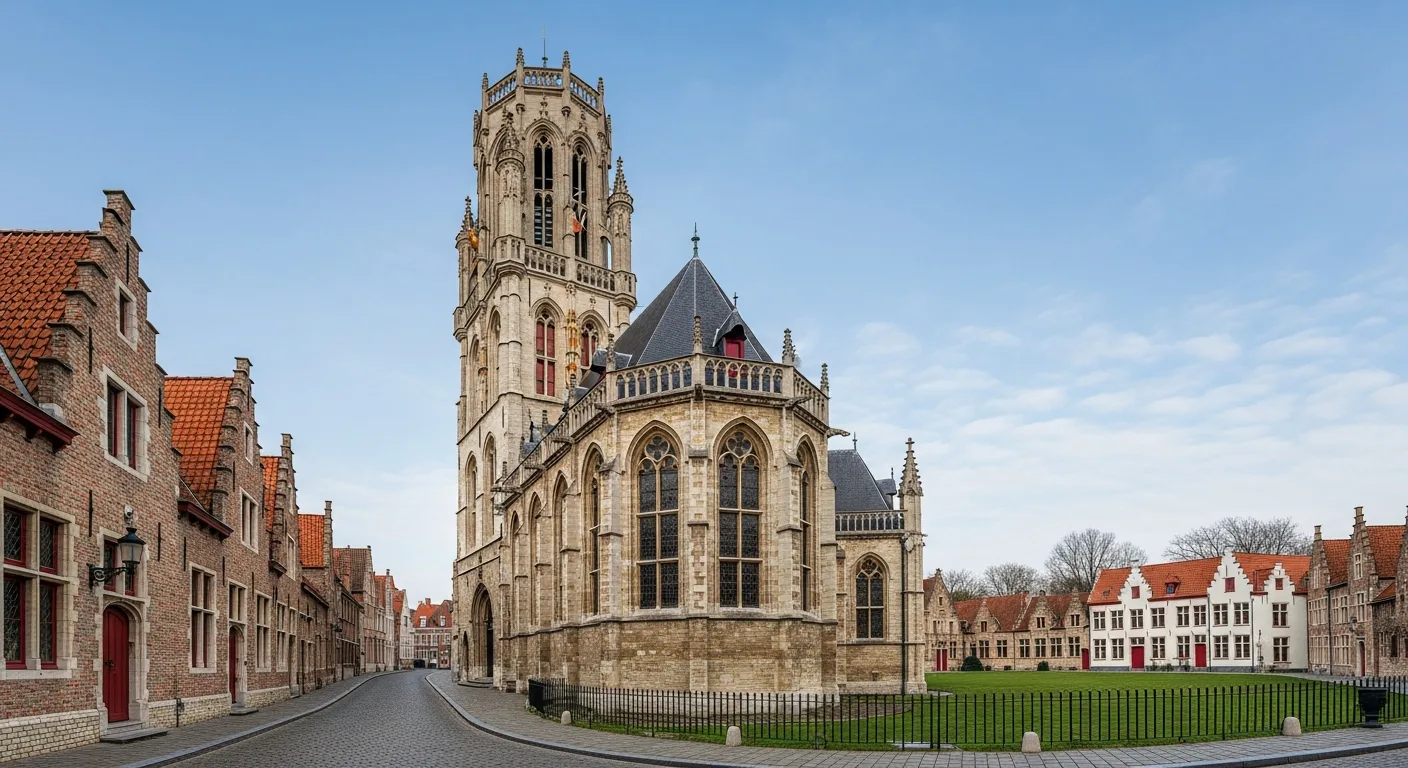
You step off the train at Leuven station and immediately feel it – hundreds of bicycles chained to the platforms, cobblestone streets leading to the Gothic town hall on Grote Markt, and groups of students with laptops heading to one of the countless cafes. The city has just over 100,000 inhabitants, but one in three is a student. This is no coincidence; KU Leuven, founded in 1425, literally defined this place. Nearly six centuries of academic tradition have ensured that every square meter of Leuven breathes academia, from the medieval university library (rebuilt after two world wars) to the ultra-modern laboratories of the IMEC research center, where the semiconductors of the future are being developed.
For many international students, KU Leuven is one of Europe’s most underrated options. Tuition fees for EU citizens start at just €1,000 per year – significantly less than at comparable universities in the Netherlands, the UK, or Switzerland. In the Reuters ranking, the university has repeatedly been named the most innovative university in Europe, and in the QS World University Rankings 2025, it ranks around 75th globally; the highest of all universities in Belgium. Brussels, the capital of the European Union, is just 25 minutes away by train, opening doors to internships at the European Commission, Parliament, and hundreds of international organizations.
In this guide, I will walk you step-by-step through the KU Leuven admissions process – from requirements for your secondary school leaving certificate, through living costs in Leuven, scholarships, top study programs, to career prospects and a comparison with other Belgian universities. If you’re looking for an alternative to expensive Anglo-Saxon education without compromising on quality, read on. Also, check out our guides to University of Amsterdam, Maastricht University, and ETH Zurich to see how KU Leuven compares to the continent’s best universities.
KU Leuven – Key Data 2025/2026
Source: KU Leuven, QS World University Rankings 2025, Times Higher Education 2025, Reuters Most Innovative Universities
Rankings and Reputation – Europe’s Innovation Champion
KU Leuven is a university that doesn’t just live on its six-century tradition – its 21st-century rankings truly showcase its strength. In the QS World University Rankings 2025, it ranks around 75th globally, making it by far the best university in Belgium and one of the highest-ranked on the European continent. In the Times Higher Education (THE) 2025 ranking, KU Leuven consistently places in the top 50 worldwide; on par with institutions like University of Edinburgh or LMU Munich. In the Academic Ranking of World Universities (ARWU, Shanghai Ranking), the university maintains a stable position in the 90–100 range, with strong recognition in exact sciences and biomedical fields.
What truly sets KU Leuven apart from its European competitors is its innovativeness. The university has repeatedly been named the most innovative university in Europe in Reuters and Clarivate rankings. This is not an abstract distinction – KU Leuven is at the heart of the Flemish technological ecosystem. Over 130 spin-offs operate on and around the campus, and the IMEC (Interuniversity Microelectronics Centre) research center, closely linked to the university, is one of the world’s most important hubs for semiconductor and nanotechnology research. Companies like Samsung, Intel, TSMC, and ASML conduct joint research projects at IMEC; and KU Leuven engineering students have direct access to this ecosystem.
In specific disciplines (QS by Subject 2025), the university’s position is even stronger: Theology and Religious Studies – top 10 globally (Catholic tradition dating back to the 15th century), Engineering and Technology – top 50, Biomedical Sciences and Medicine – top 50, Law – top 50 in Europe, and Artificial Intelligence and Computer Science are growing dynamically thanks to collaboration with IMEC. Simply put – KU Leuven plays in the first league of European universities, and in several fields, it is an absolute leader. Compare this with the tuition fees at Imperial College London (over £35,000 per year) or ETH Zurich (CHF 1,460 + living costs in Zurich); and you’ll begin to understand why KU Leuven offers one of the best quality-to-price ratios in Europe.
KU Leuven Admissions Timeline 2026/2027
Deadlines vary by program – key dates below
Source: KU Leuven Admissions 2025/2026. Deadlines may vary by program – always verify on kuleuven.be.
Admissions Step-by-Step – How to Apply
The KU Leuven admissions process differs fundamentally from what you might know from British universities. There is no central system like UCAS or the Danish Optagelse.dk – you apply directly through the university’s platform on kuleuven.be. This simplifies things but also means you must keep track of deadlines for each program individually, as dates can vary significantly.
Let’s start with a crucial distinction: Bachelor’s programs at KU Leuven are primarily taught in Dutch (Flemish). If you don’t have B2 proficiency in Dutch, your realistic path is either a one-year preparatory Dutch course at KU Leuven, or, what many international students do – completing a Bachelor’s degree in their home country and applying for English-taught Master’s programs, of which the university offers over 80. These Master’s programs are the main entry point for international candidates, and I will focus on them in this guide.
Applying for a Master’s program involves: creating an account on the KU Leuven admissions platform, selecting a program, filling out the online form, and attaching the required documents. The list of documents depends on the program, but typically you’ll need your Bachelor’s degree certificate (or confirmation of expected completion), academic transcript, language certificate, a motivation letter, and, for some programs, academic references or a portfolio. The application fee is usually €50–€100, depending on the program.
Application deadlines are something you need to pay close attention to. The most popular English-taught programs – Master of Artificial Intelligence, Master of Business Engineering, Master of European Studies – close admissions as early as March 1st. Other programs accept documents until May, or even June. Decisions are issued on a rolling basis, so the earlier you submit your application, the sooner you’ll receive a response; and the better your position when applying for scholarships and accommodation.
Step-by-step:
- Check program requirements on kuleuven.be – each program has its own page with specific entry requirements, deadlines, and a list of documents.
- Have your documents officially translated; your Bachelor’s degree certificate and academic transcript into English (or Dutch). Obtain an apostille from the relevant authority in your country.
- Take a language exam – IELTS Academic 7.0 overall (min. 6.0 in each component) or TOEFL iBT 94. Prepare with prepclass.io – the platform offers full practice tests with AI feedback.
- Write a strong motivation letter – KU Leuven values a clear justification for choosing the program, a connection to your previous experience, and well-defined academic goals.
- Submit your application online and pay the application fee (€50–€100).
- Await a decision, typical processing time is 4–8 weeks.
Remember to consider converting your secondary school leaving certificate results – our separate guide explains how your grades translate to foreign systems. If you’re also considering British universities, check out our guide to studying in the UK, and if you’re interested in comparing exams, our article TOEFL vs IELTS.
KU Leuven Admissions Requirements – Popular Master's Programs
Language, academic requirements, and competition level
| Program (MSc) | IELTS / TOEFL | Required Bachelor's Degree | Deadline | Competition |
|---|---|---|---|---|
| Artificial Intelligence | 7.0 / 94 | CS, engineering, mathematics | March 1st | High |
| Business Engineering | 7.0 / 94 | Economics, management, engineering | March 1st | High |
| European Studies | 7.0 / 94 | Political science, law, humanities | March 1st | Medium |
| Biomedical Sciences | 7.0 / 94 | Biology, chemistry, biomedical sciences | May 1st | Medium |
| Laws (LL.M.) | 7.0 / 94 | Law (Master's in Law equivalent) | May 1st | Medium |
| Engineering: Energy | 7.0 / 94 | Engineering, physics | March 1st | Medium-High |
Source: KU Leuven Admissions 2025/2026. Requirements and deadlines may vary by specialization – always verify on kuleuven.be.
Study Programs – What to Study at KU Leuven
KU Leuven offers over 200 Master’s programs, of which approximately 80 are taught entirely in English. This represents immense diversity – from engineering and artificial intelligence, through biomedical sciences, to European law and theology. Here are the programs that truly distinguish this university from its European competitors.
The Master of Artificial Intelligence is KU Leuven’s flagship program and one of the oldest of its kind in Europe; it has been running continuously since 1988, long before AI became a buzzword. The program covers machine learning, natural language processing (NLP), computer vision, robotics, and multi-agent systems. Students have direct access to the research laboratories of the DTAI (Declarative Languages and Artificial Intelligence) group, whose work is cited in the most important scientific publications worldwide. Graduates go on to work at Google DeepMind, Microsoft Research, AI startups in Brussels and Leuven, and IMEC. Competition for this program is high – strong foundations in mathematics, statistics, and programming are required; but for an international student with a solid Bachelor’s degree in computer science or mathematics, the chances are real.
Engineering Science and Engineering Technology are two distinct engineering programs united by one thing – close cooperation with industry and the IMEC center. Engineering Science is a more theoretical profile, with an emphasis on research and innovation (nanotechnology, advanced materials, renewable energy), while Engineering Technology is more applied and practice-oriented. Students in both programs benefit from some of the best engineering laboratories in Europe, and the connection with IMEC provides access to technologies that other universities can only dream of. If you’re considering engineering on the continent, compare KU Leuven with TU Munich and EPFL; these are three universities that play in the same league.
Biomedical Sciences and Medicine are another pillar of KU Leuven. The university is closely integrated with UZ Leuven University Hospital – one of the largest academic hospitals in Europe, with over 2,000 beds and a leading position in oncology, neurosciences, and genomics. Bachelor’s level medical studies are taught in Dutch and require passing the Flemish entrance exam (toelatingsexamen arts en tandarts), which presents a significant language barrier. However, at the Master’s level, programs such as the MSc in Biomedical Sciences are English-taught and accessible to graduates of biology, chemistry, or biotechnology from universities in their home countries.
European and International Law (LL.M.) is a program that benefits immensely from Leuven’s location; 25 minutes by train from Brussels, home to the European Commission, the Council of the EU, the European Parliament, and dozens of law firms specializing in EU law. An LL.M. from KU Leuven opens doors to careers in EU institutions, international law firms (Freshfields, Linklaters, Allen & Overy have offices in Brussels), think tanks, and non-governmental organizations. If you’re considering European law, KU Leuven’s competitors include Sciences Po and the College of Europe in Bruges.
Business and Economics at KU Leuven combine the faculty’s Leuven School of Business and Economics with a partnership with Vlerick Business School – one of the highest-ranked business schools in Belgium (Triple Crown: AACSB, EQUIS, AMBA). Master of Business Engineering, Finance, Economics; these programs provide solid analytical foundations and access to the Belgian job market, which is surprisingly strong in the financial sector (Brussels is a hub for banking and insurance). Compare with Copenhagen Business School – CBS offers free tuition, but KU Leuven is stronger in business engineering and provides access to a wider range of programs.
Theology and Religious Studies are a historical pillar of the university; KU Leuven is, after all, the oldest Catholic university in the world. The program ranks in the top 10 globally in QS by Subject and offers a unique blend of intellectual tradition with a modern research approach. Even if you don’t plan a career in theology, courses in philosophy and ethics at KU Leuven have an excellent reputation.
Top 6 KU Leuven Departments
Source: KU Leuven, QS World University Rankings by Subject 2025
It’s also worth mentioning a few other outstanding programs. Architecture at KU Leuven (Faculty of Architecture with campuses in Leuven, Brussels, and Ghent) is one of Europe’s leading centers. The Master of European Studies is an ideal choice for those interested in European politics – with a mandatory internship component at EU institutions in Brussels. Psychology and Educational Sciences have a strong research tradition, with English-taught Master’s programs. And Physics and Astronomy offer participation in major international research projects, including collaboration with CERN.
Study and Living Costs – Surprisingly Affordable
One of KU Leuven’s greatest advantages, compared to universities in the UK, the Netherlands, or Switzerland, is its low costs. Belgium treats EU students on the same terms as Belgians, which translates into tuition fees that are almost symbolic by European standards.
Bachelor’s programs cost around €1,000 per year (basic rate). Master’s programs range from €1,000 to €4,000 per year, with most programs falling within the €1,000–€2,500 range. The only exceptions are advanced programs like Advanced Masters and MBAs at Vlerick Business School, where prices can reach €35,000–€40,000 for the entire program. Non-EU students pay €3,500–€8,000 per year – still significantly less than at comparable universities in the UK.
Leuven is a city where one in three residents is a student, and prices reflect this. Accommodation (€400–€600/month for a room in a kot – as the Flemish call student housing) is the largest single expense. KU Leuven has its own dormitories, but the private market is well-developed. Food costs €200–€300 per month; cooking at home plus university cafeterias (Alma), where a meal costs €3–€5. Transport is practically free – a bicycle is the absolute standard in Leuven, and KU Leuven has its own rental system. Health insurance; as an EU citizen, you are entitled to an EHIC (European Health Insurance Card), but it’s worth registering with a Belgian mutual health insurance fund (mutualiteit), which costs €0–€150 per month and provides access to a full range of benefits. Materials and personal expenses add another €100–€150.
The total monthly budget for a student in Leuven is €800–€1,100, which amounts to €9,600–€13,200 annually (including tuition: approx. €11,000–€17,000). Compare this with Cambridge (over €41,000 per year for international students), UCL (over £30,000 tuition + London living costs), or even University of Amsterdam (approx. €17,000); and you’ll see that KU Leuven offers one of the best value-for-money propositions in Europe.
Monthly Student Costs in Leuven
Realistic budget – academic year 2025/2026
Source: KU Leuven Student Services, estimated living costs 2025/2026.
Scholarships and Funding
Although tuition fees at KU Leuven are low by European standards, living costs in Belgium still represent a significant expense. Fortunately, there are several realistic funding avenues worth exploring before you even apply.
The KU Leuven Scholarship for International Students is the university’s main scholarship for non-Belgian Master’s students. It covers tuition fees plus a monthly living allowance – totaling approximately €10,000 per year. Competition is high; excellent academic results (typically top 10% of your cohort) and strong motivation are required. The application is usually integrated into the admissions process, so you don’t need to submit a separate application.
The Science@Leuven Scholarship is dedicated to MSc students in exact sciences and engineering. It covers tuition fees plus a living grant and is particularly relevant for candidates in the IMEC ecosystem programs. Outstanding academic results are required. Individual faculties also offer their own scholarships and research assistantships – Engineering, Science, and Biomedical Sciences have the most options, so check the faculty websites.
The Belgian system also offers a Flemish student grant (studietoelage); EU students studying in Flanders can apply for funding based on family income. Amounts can reach several thousand EUR per year, and it’s worth applying even if you don’t expect a full grant – the procedure is straightforward and online.
Erasmus Mundus Joint Master Degrees are programs in which KU Leuven participates as a partner; they offer full scholarships covering tuition, living costs, and travel. If you are studying at a partner university in your home country, you can also benefit from an Erasmus+ exchange (grant approx. €600–€700/month).
From Polish sources, it’s worth considering NAWA (Polish National Agency for Academic Exchange) – scholarship and mobility programs for Poles studying abroad; and the Educational Foundation for Entrepreneurship (FEP). Note: These are specific to Polish students. Apply for scholarships in parallel with the admissions process – many of them have earlier deadlines than the admissions itself.
Let’s be realistic; most students do not receive a scholarship. But with tuition fees ranging from €1,000–€2,500 per year and living costs lower than in Amsterdam, London, or Zurich, KU Leuven is one of the few European universities at this level where studies are realistically accessible without a scholarship.
KU Leuven vs Ghent University vs VUB Brussels
Three best universities in Belgium – key differences
| Criterion | KU Leuven | Ghent University (UGent) | VUB Brussels |
|---|---|---|---|
| QS Ranking 2025 | ~75 | ~135 | ~200–250 |
| Year Founded | 1425 | 1817 | 1970 |
| Number of Students | 65,000+ | 50,000+ | 20,000+ |
| EU Tuition (Master's) | €1,000–€4,000 | €1,000–€1,500 | €1,000–€1,500 |
| English-taught Programs (MSc) | 80+ | 60+ | 30+ |
| Innovation | #1 in Europe (Reuters) | High | Good |
| Location | Leuven (student city) | Ghent (beautiful, student-friendly) | Brussels (EU capital) |
| Atmosphere | Catholic tradition, student energy | Liberal, artistic | Cosmopolitan, urban |
| Strongest Fields | Engineering, AI, biomedicine, theology | Biotechnology, veterinary medicine, humanities | Social sciences, European studies |
| Living Costs (monthly) | €800–€1,100 | €750–€1,000 | €900–€1,200 |
Source: QS World University Rankings 2025, official university websites, estimated living costs 2025/2026
KU Leuven vs Ghent: Ghent University is a strong alternative – slightly lower in global rankings (QS ~135 vs ~75), but with a beautiful city, slightly lower living costs, and a more liberal atmosphere. Ghent is particularly strong in biotechnology, veterinary medicine, and humanities. If you prioritize top international prestige, STEM, and innovation, KU Leuven wins. If you value an artistic atmosphere and slightly lower costs, Ghent is an excellent choice.
KU Leuven vs VUB: Vrije Universiteit Brussel (VUB) is the university for those who want to live directly in Brussels and benefit from the proximity to European institutions. VUB is significantly smaller (20,000 students) and lower in rankings, but it offers unique networking opportunities in the heart of Europe. KU Leuven combines both worlds; the campus character of a student town with Brussels accessible in 25 minutes by train.
Student Life – Oude Markt, Belgian Beer, and Cycling Culture
Leuven is one of Europe’s best student cities – and that’s not just a courtesy compliment. When one in three of the 100,000 residents is a student, the entire rhythm of the city revolves around the university. Infrastructure, gastronomy, entertainment, even shop opening hours, everything is adapted to the academic calendar.
The heart of student Leuven is the Oude Markt (Old Market Square) – a square surrounded by dozens of pubs, bars, and restaurants, which the Flemish proudly call “the longest bar in Europe.” This is no exaggeration; consecutive establishments stretch uninterrupted along all sides of the square, and on warm evenings, the terraces fill with students to their physical capacity. The atmosphere is festive, multilingual, and infectiously joyful. But Leuven is not just about parties on Oude Markt. The city offers dozens of atmospheric cafes where students study all day over cappuccinos and waffles, university cafeterias (Alma) with meals for €3–€5, as well as a rich cultural scene – from student theater to concerts at STUK Kunstencentrum.
Belgian beer is a separate topic that takes on special significance in Leuven. The city is home to the AB InBev brewery; the world’s largest brewing company, producer of Stella Artois, whose name literally comes from the star (stella) once awarded to the best KU Leuven students. The brewing tradition in Leuven dates back to the Middle Ages, and students can enjoy this heritage – from classic Belgian Trappist beers (Westvleteren, Rochefort, Chimay) to local craft beers. An adult student in Belgium has legal access to one of the richest beer cultures in the world, and locals take this seriously.
Leuven’s cycling culture is comparable to Copenhagen or Amsterdam. The city is flat and compact – you can cycle from one end to the other in 15 minutes. Most students use bicycles as their primary mode of transport; KU Leuven has its own rental system, and the cycling infrastructure (paths, parking, racks) is excellently developed. If you don’t have a bike, simply buy a used one on Marketplace for €50–€150 – it will pay for itself in the first month of saved transport costs.
KU Leuven has a rich tradition of student organizations: Student associations (Studentenkringen) organize events, mentoring, and networking, student councils (Studentenraden) are a self-governing body with real influence on university policy, and KU Leuven Sport offers dozens of disciplines for a symbolic fee. For international students, it’s good to know that Leuven has a diverse international community, making it easy to connect with peers from various backgrounds.
A huge advantage of Leuven is its location in the heart of Europe. Brussels is 25 minutes by train – the capital of the EU, NATO, home to the European Parliament, ideal for internships and cultural weekends. Antwerp (fashion and diamond center) is 45 minutes away, Amsterdam 2.5 hours, Paris – 2.5 hours by TGV from Brussels, Cologne – 2 hours. From Brussels-Zaventem and Brussels-Charleroi airports, Ryanair and Wizz Air fly to various European cities for €30–€80 return – the flight takes less than 2 hours. A weekend trip home is realistic and inexpensive.
Where do KU Leuven graduates go?
Top employment sectors and key employers
Source: KU Leuven Career Centre, graduate employment reports. Indicative data based on surveys and faculty reports.
Career Prospects After KU Leuven – Key Employers
A KU Leuven degree is recognized and valued throughout Europe, and its proximity to Brussels makes the university one of the main talent pools for European institutions and international corporations. In the technology sector, IMEC is by far the largest employer of engineering graduates; the center employs over 5,500 people, and its collaborating companies (Samsung, Intel, TSMC, ASML) actively recruit on campus. Google, Microsoft, and Amazon have engineering offices in Belgium and consider KU Leuven a target school.
In strategic consulting, McKinsey, BCG, and Bain conduct regular recruitment sessions at KU Leuven. The Belgian financial sector (KBC, BNP Paribas Fortis, ING) recruits economics and finance graduates, while pharmaceuticals and biotech (UCB, Janssen/Johnson & Johnson, Galapagos) recruit biomedical science graduates. Lawyers with an LL.M. from KU Leuven work in international law firms in Brussels and at the European Commission itself.
Important information for international graduates: Belgian law allows graduates of Flemish universities to search for work for 12 months after graduation (the so-called zoekjaar or job-seeking year), which provides time to find employment without visa pressure. As an EU citizen, you have the full right to work in Belgium without additional permits. Students during their studies can work up to 475 hours per year under preferential tax conditions (jobstudent), with an hourly rate of €12–€15 gross.
If you plan to prepare for exams before applying, check out prepclass.io for practicing TOEFL and IELTS with AI feedback. More on comparing tests can be found in our TOEFL vs IELTS guide.
Practical Information for International Students in Belgium
As an EU citizen, you do not need a visa or work permit in Belgium. However, you must register with the municipality (commune) in Leuven within 8 days of arrival and obtain a residence permit (bijlage 8/annexe 8); this is free and valid for 5 years. It is also advisable to register with a Belgian mutual health insurance fund (mutualiteit/mutuelle) – the European Health Insurance Card (EHIC) from your home country covers basic care, but the Belgian system provides access to a full range of benefits and is much more convenient for daily use.
Dutch; is it worth learning? If you plan to pursue an English-taught Master’s degree, knowledge of Dutch is not required. Flemish people speak excellent English, and you will have no problem communicating in an academic environment. However, even a basic knowledge of Dutch (A2–B1 level) will greatly facilitate daily life – shopping, administrative tasks, and integration with local students. KU Leuven offers free or very affordable Dutch courses for international students. It’s worth taking advantage of them; it’s an investment that pays off in both daily life and the job market.
Summary – Who is KU Leuven For?
KU Leuven is a university that combines the best of European higher education: nearly six centuries of academic tradition, world-class research, affordable costs, and the fantastic atmosphere of a true student city. For international students, it’s an option that deserves serious consideration, especially if you’re looking for an alternative to expensive Anglo-Saxon education without compromising on quality. Tuition fees from €1,000 per year, living costs lower than in Amsterdam or London, the best university in Belgium, Brussels 25 minutes by train – these are arguments that are hard to beat.
KU Leuven is not for everyone. If you’re looking exclusively for English-taught Bachelor’s degrees, you might consider Dutch universities (University of Amsterdam, Maastricht) or British ones. If you want free tuition and a Scandinavian lifestyle, check out CBS in Copenhagen. But if you’re looking for a top 50 THE university, with tuition fees below €3,000 per year, in a city that breathes academia, 25 minutes from the capital of the European Union; KU Leuven is one of the best options on the continent.
Next Steps
- Browse programs – the catalog of English-taught Master’s degrees on kuleuven.be. Pay attention to deadlines (March 1st for the most popular ones).
- Take IELTS (7.0) or TOEFL (94) – prepare with prepclass.io, which offers full practice tests with AI feedback. More on choosing a test in our TOEFL vs IELTS guide.
- Have your documents officially translated into English (degree, transcript) and obtain an apostille.
- Plan your budget – tuition + living costs are approximately €11,000–€17,000 per year.
- Apply for scholarships, KU Leuven Scholarship, Science@Leuven, Erasmus Mundus, NAWA (for Polish students).
- Visit Leuven – the university organizes open days for international candidates.
Also, check out our other guides to European universities: University of Amsterdam, Maastricht University, Sciences Po Paris, Copenhagen Business School, and ETH Zurich. Good luck!
Last updated: February 8, 2026. Information on tuition fees, requirements, and deadlines may change – always verify on the official KU Leuven website.