

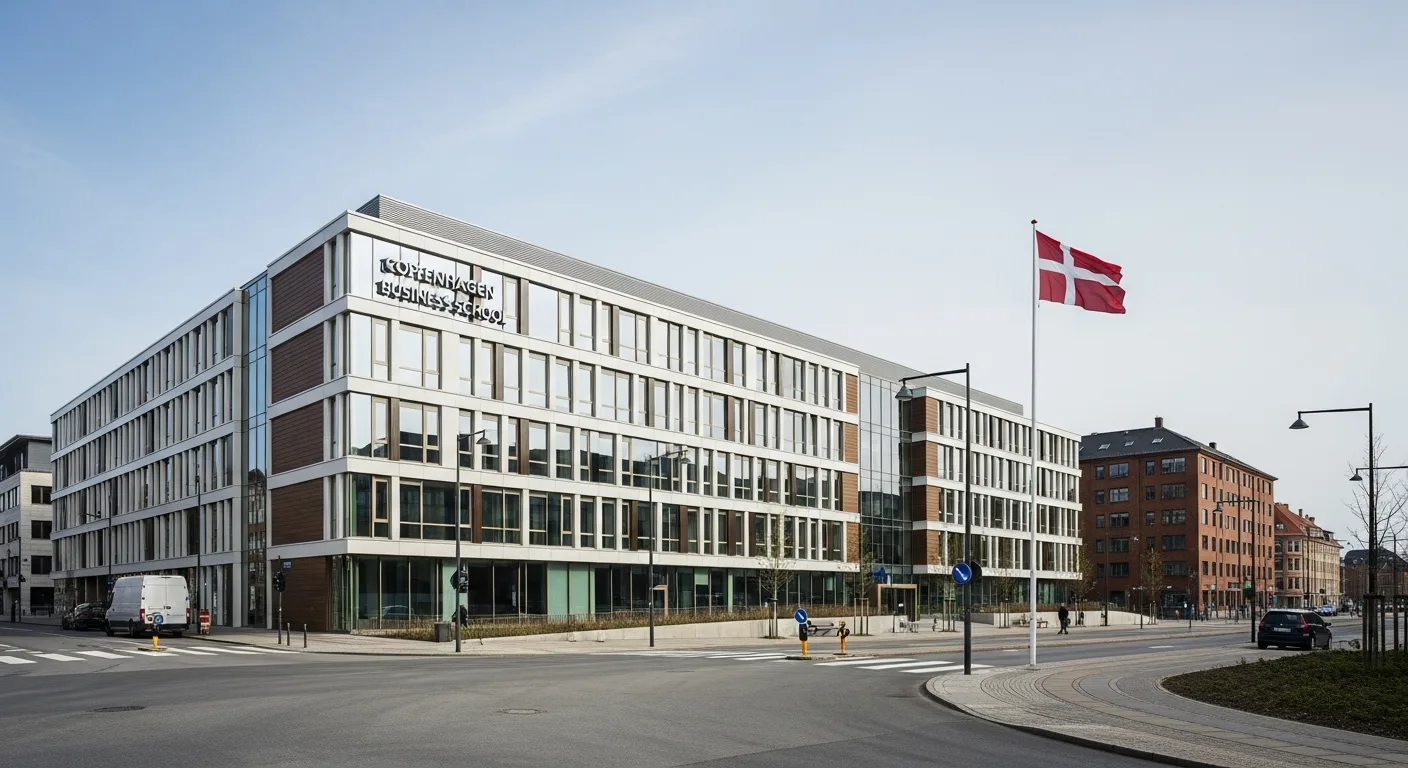
Imagine a Friday afternoon in December. Outside, a delicate frost covers Solbjerg Plads, and streetlights cast a golden glow on bicycles parked beneath the faculty building. Inside, in a lecture hall transformed into a Fredagsbaren, hundreds of students from forty countries drink 20-kroner beers, discuss this week’s case studies, and plan a weekend trip to Malmö. Someone plays Danish songs on a guitar, while another explains to a Polish student what exactly hygge is. This isn’t a recruitment brochure description; it’s a typical Friday at Copenhagen Business School.
CBS is a university that breaks the European rules of the game in business education. As the largest business school in Northern Europe, with over 20,000 students, it offers something you won’t find at any comparable institution on the continent: free tuition for EU citizens, combined with Triple Crown accreditation (AACSB, EQUIS, AMBA), held by only about 1% of business schools worldwide. Add to that Copenhagen, a city regularly chosen as the happiest, safest, and most livable in Europe, and you get an offer that simply cannot be ignored.
In this guide, I’ll walk you through everything you need to know to apply to CBS: from the specifics of the Danish admissions system (Quota 1 vs. Quota 2), to program requirements, living costs in Copenhagen, the Danish SU grant, career prospects, and a comparison with other top business schools in Europe – SSE in Stockholm, and RSM in Rotterdam. If you’re considering business studies on the continent, this article will give you a complete picture.
Copenhagen Business School: Key Stats 2025/2026
Source: Copenhagen Business School Official Data, Financial Times Rankings 2024
Rankings and CBS’s Position in Europe
Copenhagen Business School isn’t a university that wins rankings purely on brand prestige: CBS earns its place through the consistent quality of its research, academic programs, and graduate employment prospects. In the Financial Times European Business Schools 2024 ranking, CBS is placed in the top 20 on the continent, directly competing with institutions like Rotterdam School of Management, Warwick Business School, and ESCP Business School. This result is all the more impressive given that CBS is the only university in this group offering free tuition for EU students.
In the QS World University Rankings 2025 for Business & Management Studies, CBS ranks in the top 50 worldwide – surpassing many universities that cost ten times more. The Financial Times Masters in Management ranking regularly places CBS master’s programs (cand.merc.) in the top 15 in Europe, and the Eduniversal classification system awards CBS its highest 5 Palmes category, reserved for universities with “universal influence,” alongside INSEAD, HEC Paris, and London Business School.
What truly sets CBS apart from the competition is its value for money. Compare this: LSE in London costs over 24,000 GBP annually, Bocconi in Milan around 14,000 EUR, and even Maastricht University charges 2,500 EUR in tuition. CBS for EU citizens? Zero. Only about 120 business schools out of over 13,000 worldwide hold the Triple Crown accreditation (AACSB, EQUIS, AMBA simultaneously). CBS is one of them, and the only one in this group that does not charge tuition fees to European students. This is a fundamental argument that should place CBS high on your list, whether you’re also considering Sciences Po or Dutch universities from our guide to studying in the Netherlands.
CBS Admissions Timeline 2026/2027
Danish Quota system, two paths, different deadlines
Source: Optagelse.dk, Copenhagen Business School Admissions 2025/2026
CBS Admissions: The Danish Quota System Step-by-Step
Admissions to Copenhagen Business School are processed through the central Danish portal Optagelse.dk, which is similar to a national admissions system like the Polish IRK, but covers all universities in Denmark. The system is completely different from the British UCAS, Dutch Studielink, or direct Polish admissions. It is based on two paths – Quota 1 and Quota 2 – and understanding the difference between them is absolutely crucial for Polish applicants.
Quota 1 is an admissions path based solely on your upper secondary school GPA. There are no interviews, essays, or tests; only your average grade, converted to the Danish 7-point scale, matters. For Polish students, this means your Matura exam results (the Polish secondary school leaving exam) and school leaving certificate are converted to a Danish GPA according to official conversion tables. Minimum thresholds (cut-off scores) change annually and depend on the program’s popularity. For BSc in International Business, the Quota 1 threshold is typically 10.5–11.5 on the Danish scale, which corresponds to very good Matura exam results. The Quota 1 deadline is July 5.
Quota 2 is a holistic path, and this path is most important for Polish applicants. In Quota 2, CBS considers not only your grades but also work experience (internships, volunteering, employment), additional qualifications (language certificates, courses), and for some programs, a motivational letter. Quota 2 allows you to compensate for potential differences in grading systems; even if your Polish Matura exam, when converted, yields a lower GPA than the Quota 1 thresholds, strong additional qualifications can secure you a place. The Quota 2 deadline is March 15 – significantly earlier than Quota 1, so don’t delay.
Practical tip: submit applications for both Quota 2 (by March 15) and Quota 1 (by July 5). The system will automatically consider both paths. You can apply for up to 8 programs across Denmark (not just CBS), listing them in order of preference. If your first preference is BSc in International Business at CBS, and the second is BSc in Business Administration and IT (HA(it.)) at CBS, the system will automatically move you to your second choice if you don’t get into the first.
Step by step:
- Create an account on Optagelse.dk: as an EU applicant without a Danish NemID/MitID (a Danish digital ID, essential for official services), you use the path for international applicants.
- Submit translated documents: your high school diploma/school leaving certificate and Matura exam, certified translated into English (Danish, Norwegian, and Swedish are also accepted).
- Include a language certificate: IELTS Academic 7.0 or TOEFL iBT 91. Prepare with prepclass.io – the platform offers full practice tests with AI feedback.
- Complete Quota 2 documents (if applying) – CV, motivational letter, certificates of additional qualifications.
- Set your preferences and confirm your application.
- Await results (July 28: common decision date for all of Denmark). Remember our guide on converting Polish Matura exam results – it explains exactly how your grades translate to foreign systems, including the Danish one.
CBS Admissions Requirements: System Comparison
Polish Matura Exam | IB | A-levels, minimum requirements for 6 most popular programs
| Program | Polish Matura Exam (Converted GPA) | IB (Points) | A-levels | Mathematics | Difficulty |
|---|---|---|---|---|---|
| BSc International Business | 85–95% from extended level exams | 35–38 | ABB–AAB | Mathematics B (extended level) | High |
| HA(mat.) – Economics | 80–90% from extended level exams | 33–36 | BBB–ABB | Mathematics A (advanced level) | High |
| HA(it.) – IT & Business | 75–85% from extended level exams | 32–35 | BBB–ABB | Mathematics B (extended level) | Medium |
| BSc Business & Politics | 80–90% from extended level exams | 34–37 | ABB–AAB | Mathematics B (extended level) | Medium-High |
| BSc Business, Language & Culture | 70–80% from extended level exams | 30–34 | BBC–BBB | Mathematics B + foreign language | Achievable |
| HA(almen) – Sociology & Business | 70–80% from extended level exams | 30–34 | BBC–BBB | Mathematics B (extended level) | Achievable |
Source: CBS Admissions 2024/2025, Optagelse.dk Quota 1 thresholds. Indicative equivalents, thresholds change annually.
CBS Programs: What to Study?
CBS offers a dozen bachelor’s programs, several of which are taught entirely in English, and these are the most relevant for Polish applicants. This is not a typical business school with a single BBA program: CBS stands out for its interdisciplinary approach, combining business with politics, technology, culture, and social sciences. This means CBS graduates think more broadly than typical business school graduates, a quality valued by employers from McKinsey to Novo Nordisk.
BSc in International Business (IB) is the flagship English-taught program and by far the most popular choice among international students. The program covers strategic management, finance, global marketing, data analysis, and quantitative methods, all within an international context. In the third year, a mandatory exchange semester abroad (CBS has agreements with over 300 universities worldwide, including Wharton, NUS, HKU) provides experience that acts like a magnet on your CV. The Quota 1 admission threshold is typically 10.5–11.5 on the Danish scale, making it one of the most competitive programs at CBS. Graduates primarily go into strategic consulting (McKinsey Copenhagen is one of the firm’s largest offices in Europe), banking, and multinational corporations.
BSc in Business Administration and IT (HA(it.)) is a program that perfectly fits into the Danish tech ecosystem. Copenhagen is a European hub for digital transformation, with companies like Pleo, Trustpilot, and Unity Technologies creating an environment where HA(it.) graduates find jobs almost immediately. The program combines IT project management, digital transformation, data analytics, and UX design with solid business fundamentals. If you see yourself in product management, fintech, or digital consulting, this is your program.
BSc in Business and Politics is a program that has no true equivalent at most European business schools. It combines political science, international relations, and political economy with management and strategy. It prepares students for careers at the intersection of the public and private sectors, in international organizations (UN, EU, World Bank), think tanks, public affairs for large corporations, or NGOs. If you’re as interested in politics as you are in business, and you’re also considering Sciences Po in Paris, Business & Politics at CBS offers similar interdisciplinarity, but with a stronger business component and, crucially, without tuition fees.
BSc in Business, Language and Culture is a program for those fascinated by intercultural communication. You choose a language specialization (English, German, French, Spanish, Japanese, or Chinese) and combine language learning with marketing, management, and cultural studies. This is a unique program in Europe, preparing students for work in companies operating at the intersection of cultures, in economic diplomacy, and in international marketing.
BSc in Business Administration and Economics (HA(mat.)) is a program for those with a strong mathematical background. Advanced micro- and macroeconomics, econometrics, corporate finance, and game theory – this is a path to careers in investment banking, economic analysis, and research. The program requires Mathematics A (advanced mathematics), which corresponds to a very good result from the Polish extended-level Matura exam in mathematics. It is taught in Danish, but materials and textbooks are largely in English.
BSc in Business Administration and Sociology (HA(almen)) combines management with organizational sociology. If you are interested in HR, organizational culture, change management, or CSR, HA(almen) provides solid analytical and humanistic foundations. The program is somewhat less competitive than IB or HA(mat.), making it a good option for Polish applicants with solid, though not top-tier, Matura exam results.
Top 6 Programs at CBS
Source: Copenhagen Business School, Program Catalogue 2025/2026
Costs of Studying and Living in Copenhagen
This is the section where CBS starts to look like a hack for the European education system. The Danish university funding model means that as an EU/EEA citizen, you do not pay tuition fees at Copenhagen Business School. The only mandatory expense is an administrative fee of approximately 500 DKK per semester (approx. 67 EUR), which is less annually than the cost of a single dinner at a Copenhagen restaurant.
For students from outside the EU/EEA, the situation is different: tuition fees range from 60,000 to 120,000 DKK annually (approx. 8,000–16,000 EUR), depending on the program. Students from Switzerland are treated like EU citizens and pay 0 DKK.
Where’s the catch? In the cost of living. Copenhagen is one of the more expensive cities in Europe, comparable to Amsterdam, more expensive than Milan or Rotterdam, though cheaper than London or Zurich. A realistic monthly budget for a CBS student is as follows:
Accommodation is by far the largest expense: 4,500–6,500 DKK (600–870 EUR) for a room in a shared apartment. CBS does not have a traditional campus with dormitories, but it cooperates with the Housing Foundation and the platform findbolig.nu, which help international students find housing. Key advice: start looking immediately after receiving your acceptance, as the rental market in Copenhagen is extremely tight. Groceries and food cost 2,000–3,000 DKK per month (270–400 EUR) – cooking at home is surprisingly affordable if you use discount supermarkets (Netto, Rema 1000, Lidl). Many CBS students buy lunch at student canteens for 30–50 DKK. Student transport is 350–500 DKK (but honestly, a bicycle is free after a one-time purchase of 500–2,000 DKK and covers 90% of your needs). Phone and internet: 200–300 DKK. Entertainment: 500–1,500 DKK.
Total monthly living cost: 8,000–11,000 DKK (approx. 1,070–1,470 EUR). Annually, this is 13,000–18,000 EUR – a significant amount, but remember: tuition is zero, and the Danish SU system (which we’ll discuss shortly) can cover a substantial portion of these costs. Compare this to LSE, where tuition alone is 24,000 GBP, plus London living costs of 1,500–2,000 GBP per month, bringing the total annual cost to over 40,000 EUR. At CBS, the realistic annual cost is 3–4 times less.
Annual Cost of Business Studies: CBS vs. European Alternatives
Tuition + living costs for EU students (academic year 2025/2026)
Source: Official university websites 2025/2026. Living costs, averaged estimates. 1 EUR ≈ 7.46 DKK, 1 GBP ≈ 1.17 EUR (February 2026).
Scholarships and Financial Support
SU, the Danish State Educational Grant (Statens Uddannelsesstøtte)
The Danish SU system is probably the most generous student support program in Europe and applies not only to Danes but also to EU citizens meeting specific conditions. As a Polish student at CBS, you are entitled to SU if you work legally in Denmark for a minimum of 10–12 hours per week (the so-called work requirement, or ‘arbejdskriterie’). The work must be registered, with a contract and taxes paid.
How much is SU? Approximately 6,400 DKK net per month (approx. 860 EUR after tax). SU is paid for a maximum of 70 months, which comfortably covers the entire period of bachelor’s and master’s studies. Additionally, you can take out a preferential SU student loan (SU-lån) for an extra 3,500 DKK per month, with very low interest, repayable only after completing your studies.
What does this mean in practice? If you find a job for 10–12 hours a week (and in Copenhagen, this isn’t difficult – cafes, shops, tech companies, academic assistantships), your total monthly income could be 10,000–13,000 DKK: salary for work (3,500–6,500 DKK, the Danish minimum wage is one of the highest in the world) plus SU (6,400 DKK). This covers most or all of your living costs in Copenhagen. As a result, you can complete your studies at one of Europe’s best business schools virtually debt-free. Compare this to an LSE graduate who leaves university with debt ranging from 60,000–80,000 GBP.
CBS Scholarships and Other Options
In addition to SU, CBS offers other forms of support:
- CBS Tuition Fee Waivers – partial or full tuition fee waivers for outstanding non-EU students (does not apply to Poles, who already have free tuition).
- Danish Government Scholarships – government scholarships for students from developing countries.
- Erasmus+ Scholarships – available when going on an exchange semester in the third year (CBS has over 300 Erasmus+ partners).
- Legater.dk – a Danish database of scholarships and grants, worth searching for options for international students.
- Polish scholarships – the Kosciuszko Foundation and the NAWA program can partially subsidize living costs.
For Polish students, the SU system is absolutely crucial – treat it as the main pillar of your funding. Virtually every Polish student at CBS I’ve spoken to funds their studies with a combination of SU + part-time work, without needing parental support.
CBS vs. SSE Stockholm vs. RSM Rotterdam
Three top business schools in Continental Europe: key differences
| Criterion | CBS Copenhagen | SSE Stockholm | RSM Rotterdam |
|---|---|---|---|
| Ranking FT Europe | Top 20 | Top 25 | Top 15 |
| Accreditations | Triple Crown (AACSB, EQUIS, AMBA) | EQUIS | Triple Crown (AACSB, EQUIS, AMBA) |
| Tuition (EU) | 0 DKK (free) | 0 SEK (free) | ~2,530 EUR/year |
| Number of students | ~20,000 | ~2,000 | ~12,000 |
| English-taught BSc | Several (IB, B&P, BLC) | BSc in Business & Economics | Many programs |
| Student grant | SU: ~860 EUR/month (for part-time work) | No equivalent | No equivalent |
| Living costs (monthly) | ~1,100–1,500 EUR | ~1,100–1,400 EUR | ~900–1,200 EUR |
| Atmosphere | Large, diverse, Fredagsbaren | Small, elite, intimate | Medium, international |
| Strengths | Interdisciplinarity, IT & Business, scale, SU | Finance, economics, Nordic networking | Finance, management, corporate careers |
| Startup scene | Very strong (Copenhagen) | Strong (Stockholm) | Moderate (Rotterdam) |
Source: Financial Times Rankings 2024, official university websites, data for 2025/2026
CBS vs. SSE: Stockholm School of Economics is more elite and intimate (400 bachelor’s students vs. 20,000 at CBS). SSE is better if your goal is pure finance and economics in a Nordic environment, and a small class size and intensive networking suit you. CBS wins on scale, program diversity, and, above all, access to the SU system, which SSE does not offer. You can find more about SSE and other Scandinavian universities in our guide to studying in Scandinavia.
CBS vs. RSM: Rotterdam School of Management ranks slightly higher in some rankings, but CBS wins on cost (0 tuition vs. 2,530 EUR annually) and access to SU. Rotterdam is cheaper than Copenhagen in terms of living costs, but the difference is largely offset by SU. RSM has more English-taught bachelor’s programs. If the Netherlands interests you, also check out our guide to the University of Amsterdam.
Student Life in Copenhagen
Copenhagen is a city that changes the way you think about daily life. Let’s start with the foundation: the bicycle. Over 60% of Copenhagen residents commute to work and school by bike, on dedicated bike paths that are wide, lit, with their own traffic lights, and heated asphalt in winter. As a CBS student, a bicycle isn’t an option; it’s a necessity. You can buy a used bike for 500–2,000 DKK (70–270 EUR) on DBA.dk (the Danish equivalent of OLX) and it will pay for itself within a week of saved transport costs. When you’re speeding along a bike path by the canals in the morning, with a cup of coffee in your handlebar holder, you start to understand why Danes are statistically the happiest people in Europe.
CBS’s main campus, Solbjerg Plads – is located in the Frederiksberg district, a calm, green part of the city with parks (Frederiksberg Garden, where peacocks roam), cafes, and an atmosphere that feels more like a university town than a metropolis. The second campus – Dalgas Have, is closer to Amager, a district with a beach (Amager Beach Park) accessible by bike in 15 minutes. Between classes, CBS students eat lunch in canteens (30–50 DKK), sit with laptops in cafes on Gammel Kongevej, or exercise in public (free!) gyms in the parks.
Fredagsbaren, the Tradition that Defines CBS
Fredagsbaren (literally: “Friday bar”) is the most iconic tradition of CBS and Danish universities in general. Every Friday afternoon, typically from 3:00 PM, individual study programs organize a bar within the university buildings. Each program has its own Fredagsbaren: International Business has one, HA(it.) has one, Business & Politics has one. Beer costs 15–25 DKK (2–3.50 EUR), music plays, and the atmosphere is the best of the whole week.
But Fredagsbaren isn’t just about partying. It’s a key networking hub at CBS. Here you make connections with classmates from other programs, with alumni returning to campus, and with employees from partner companies who regularly attend. Many CBS students say that Fredagsbaren was the moment they truly felt part of the community: when CBS stopped being just a university and became a home.
Danish Hygge and Life Beyond Campus
Danes are famous for the concept of hygge (pronounced “hoo-gah”) – a feeling of coziness, warmth, and enjoying simple pleasures. In practice, hygge means: candlelit gatherings with friends, coffee in a Scandinavian cafe with a Danish pastry (wienerbrød), cooking together in a student apartment kitchen, long walks along the canals on a Saturday afternoon. Copenhagen is a city that encourages slowing down; the Danish work-life balance isn’t a slogan, but a way of life.
Neighborhoods worth exploring: Nørrebro – multicultural, artistic, with the cheapest apartments and best bars; Vesterbro – hipster, with the Meatpacking District (clubs and restaurants in former slaughterhouses); Indre By – the historic center with Nyhavn (colorful canal houses), Strøget street, and Tivoli Gardens, the world’s oldest amusement park; Christiania – the famous “Freetown Christiania” with street art and alternative culture.
CBS has over 100 student organizations, from the CBS Consulting Club (preparation for case interviews at McKinsey and BCG) and CBS Entrepreneurial (idea incubator, hackathons) to the CBS Wine Club, CBS Surf, CBS Running, and dozens of others. The Polish student community in Copenhagen is small but active; it’s worth joining a Facebook group before you even leave. Danes might seem reserved and private at first (Scandinavian reserve is a real thing), but student organizations and Fredagsbaren are the best ways to break the ice.
Where Do CBS Graduates Go?
Top Employment Sectors and Key Employers
Source: CBS Career Services, Graduate Employment Reports 2024/2025. Indicative data based on surveys.
Prospects After CBS, Key Employers
CBS is a target school for many of the largest employers in Scandinavia and Europe. McKinsey & Company has one of its largest offices in Europe in Copenhagen and actively recruits from CBS. BCG, Bain, Deloitte Strategy, Accenture all conduct regular recruitment sessions on campus. In the financial sector, Danske Bank, Nordea, and Saxo Bank treat CBS as a primary source of talent.
But it’s the Danish industrial and technological sectors that truly distinguish CBS from other European business schools. Novo Nordisk – the largest company in Scandinavia and one of the world’s largest pharmaceutical manufacturers – recruits CBS graduates en masse. Maersk (global logistics), LEGO Group, Carlsberg, Vestas (wind energy), Ørsted (green energy) are companies that treat CBS as their talent pool.
After graduation, you are entitled to an Establishment Card – a 3-year residence permit for job seeking (for graduates of Danish universities). Knowledge of Danish is a huge asset in the job market, although international companies (Novo Nordisk, Maersk, LEGO) operate in English. CBS Career Services actively assists with job searching and interview preparation.
If you’re planning exam preparation before applying to CBS, check out prepclass.io for TOEFL and IELTS practice with AI feedback, and okiro.io for SAT preparation. Although CBS does not require the SAT, a strong SAT score can strengthen your Quota 2 application.
Conclusion: Who is CBS For?
Copenhagen Business School is a university that combines something that seems impossible in European business education: the prestige of a top 1% business school worldwide with zero tuition fees for EU citizens. Add to that the Danish SU system, which pays you to study (provided you work part-time), Copenhagen as one of the best cities to live on the planet, and interdisciplinary programs combining business with politics, technology, and culture, and you get an offer that is unparalleled in Europe for its value.
CBS is not for everyone. If you’re solely looking for a CV name that opens doors to global investment banking – LSE or Oxbridge would be better choices (though at a significantly higher price). If you want an intimate, elite school with a 400-person class, check out SSE in Stockholm. But if you’re looking for real value – top-quality education without student debt, in a city that genuinely wants you to stay after graduation, with access to the Scandinavian job market and global corporations: CBS is one of the best options you have.
Next Steps
- Check the requirements on Optagelse.dk for your chosen program, paying attention to the mathematics level and the Quota 2 deadline (March 15).
- Take IELTS (7.0) or TOEFL (91): prepare with prepclass.io, which offers full practice tests with AI feedback. More about choosing a test can be found in our TOEFL vs. IELTS guide.
- Get your documents certified translated into English (Matura exam + school leaving certificate).
- Submit your Quota 2 application by March 15; don’t wait for Quota 1.
- Look for accommodation immediately after acceptance; register on findbolig.nu and with the Housing Foundation.
- Buy a bicycle upon arrival; it will be your best investment in Copenhagen.
Also check out our other guides to European universities: KU Leuven, University of Amsterdam, Sciences Po Paris, and our guide to studying in Scandinavia. Good luck!