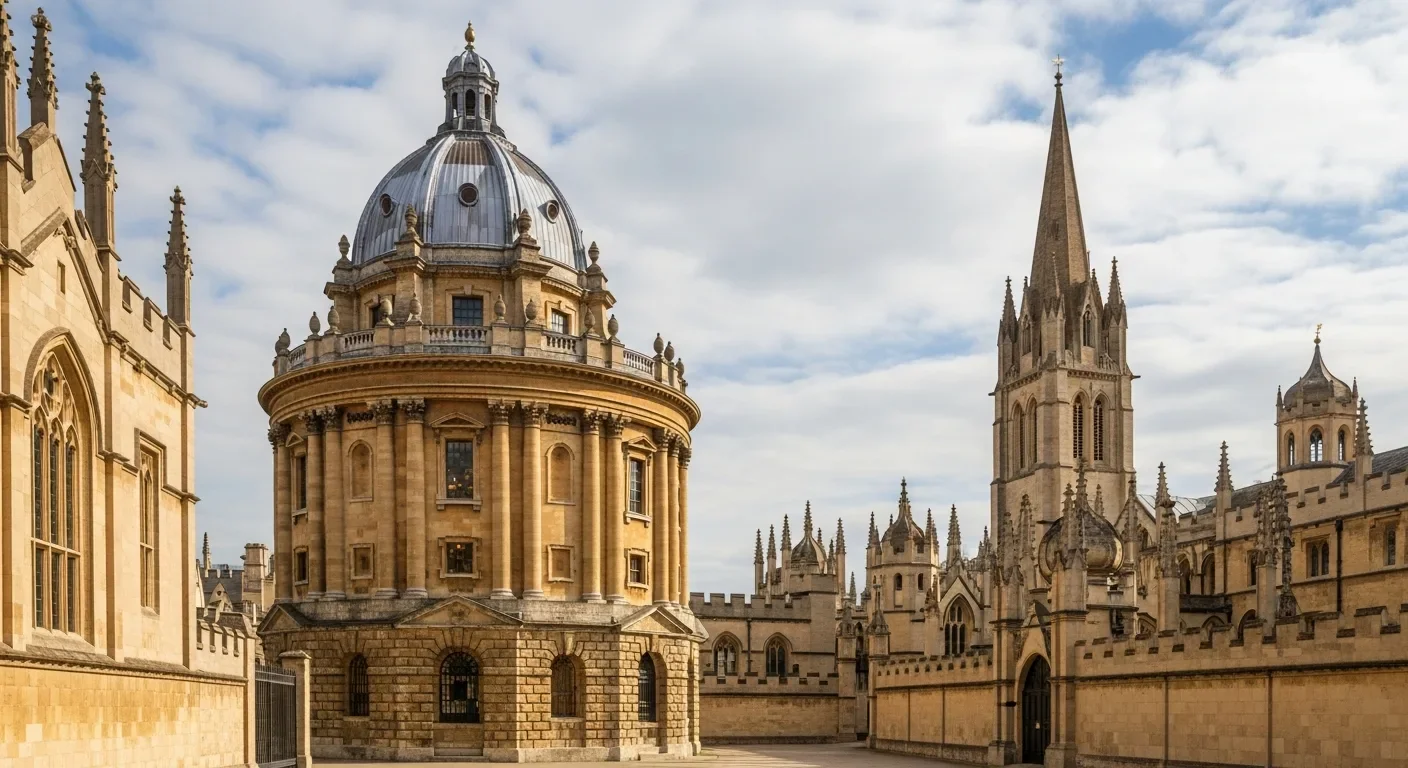

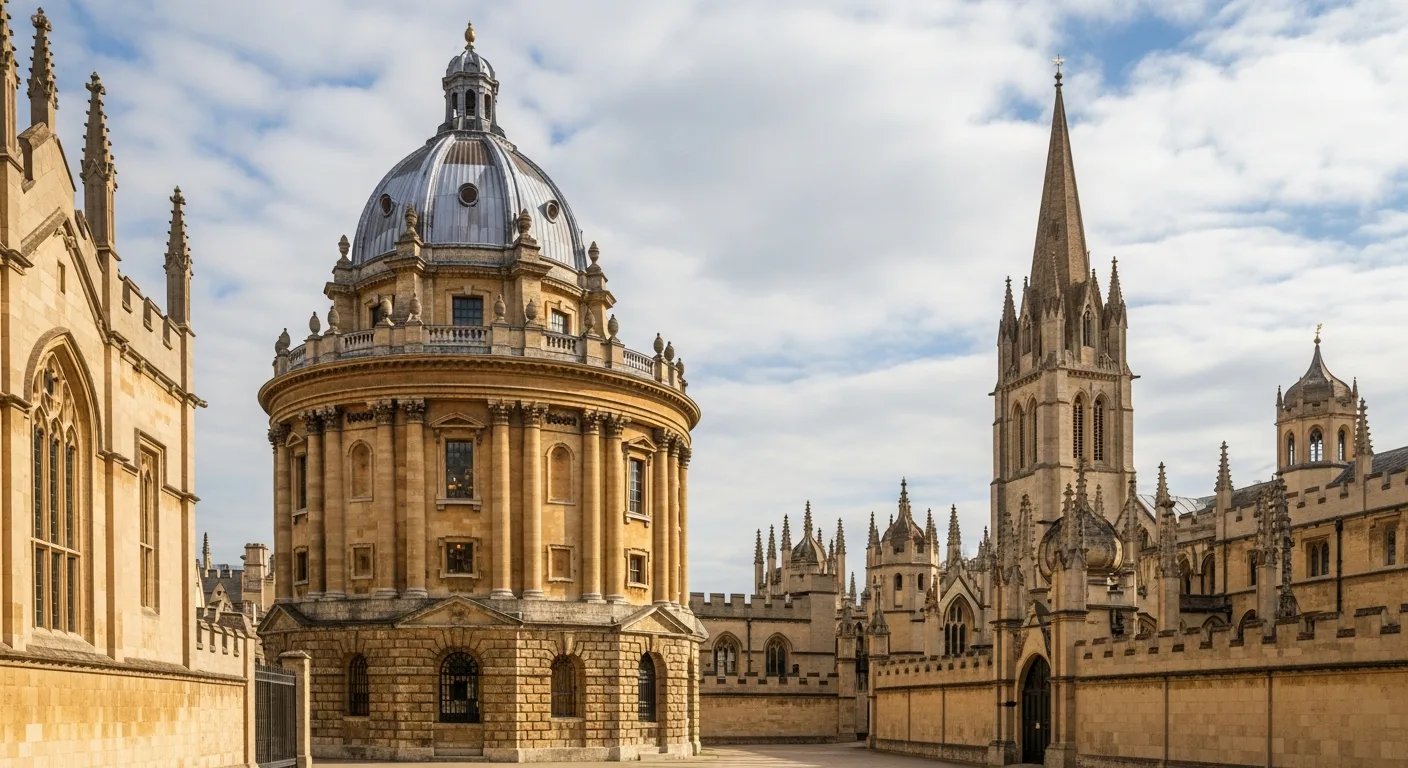
When you walk through the gates of the Bodleian Library, you pass walls that remember the 15th century. Light streams through stained-glass windows onto stone floors worn by millions of footsteps – the same corridors walked by Tolkien, Oscar Wilde, Margaret Thatcher, and Stephen Hawking. In the Radcliffe Camera courtyard, a group of students in sub fusc gowns return from an exam, while their friends wait with champagne bottles and confetti to “trash” them, in accordance with a centuries-old tradition. In the Christ Church dining hall, the very one that inspired the Great Hall in Hogwarts, students dine by candlelight as the choir from Magdalen College tower rehearses for May Morning.
This isn’t a scene from a movie. This is an ordinary Tuesday at the University of Oxford; the oldest English-speaking university in the world, which for over 800 years has shaped people who change the course of history. Oxford isn’t just a university with a good ranking. It’s an intellectual ecosystem where every week you sit one-on-one with a world-class professor and discuss an essay you’ve written – a tutorial system you’ll find virtually nowhere else. It’s 73 Nobel laureates, 30 UK Prime Ministers, the creator of the World Wide Web, and the author of “Harry Potter” all on one campus scattered across a picturesque city on the Thames.
In this guide, I will walk you through everything you need to know to apply to Oxford with the Polish Matura (high school leaving exam): from the UCAS system and admissions tests, through the famous interviews with tutors, requirements for specific courses, tuition fees after Brexit (and how to fund them), to life within the system of 39 colleges. If you are also considering Cambridge, read our guide to the University of Cambridge. And if you want to get a broader picture of studying in the UK, check out the guide to studying in the UK.
University of Oxford – Key Data 2025/2026
Source: University of Oxford Annual Admissions Report 2024, QS World University Rankings 2025, Times Higher Education 2025
Rankings and Reputation – Why Oxford is Oxford
Oxford consistently ranks first or second in every major academic ranking in the world; and has done so for decades. In Times Higher Education (THE), Oxford has held the #1 position globally continuously since 2017, making it the longest-reigning leader of this ranking in history. In the QS World University Rankings 2025, it ranks #3 globally (behind MIT and Imperial), and in the Academic Ranking of World Universities (Shanghai) – #7. In THE subject rankings, Oxford is #1 globally in humanities, social sciences, and clinical medicine.
But rankings are just numbers; Oxford’s true prestige lies in something harder to measure. It is an institution that has shaped 30 UK Prime Ministers (from Tony Blair to Rishi Sunak), gave the world Tolkien, Oscar Wilde, Lewis Carroll, and Aldous Huxley, and in the sciences, educated Stephen Hawking, Tim Berners-Lee (inventor of the World Wide Web), and Malala Yousafzai (the youngest Nobel Prize laureate). The Oxford Union – the world’s most famous debating society – hosts presidents, prime ministers, and Nobel laureates every week. An Oxford degree opens doors in the worlds of finance, law, politics, and science that simply do not exist for graduates of other universities.
What truly distinguishes Oxford from its rivals – including Cambridge, Imperial, or UCL – is its tutorial system. At most universities, you learn in lectures with hundreds of students. At Oxford, the heart of education lies in weekly meetings of 1–3 students with a professor (tutor). For an hour, you sit with a world-class expert and discuss an essay you’ve written for the week, or solve a mathematical problem with them on a whiteboard. You can’t hide in the crowd, you can’t “coast” through anything – each week demands deep, original thinking. The result? Oxford graduates emerge with analytical skills and intellectual confidence that cannot be acquired in any lecture for 300 people.
Oxford Admissions Timeline 2026/2027
From preparation to Freshers' Week – key dates for international applicants
Source: University of Oxford Admissions 2026, UCAS 2025/2026
Oxford Admissions – UCAS, Exams, and Interviews Step-by-Step
Admissions to Oxford are processed through the central UK system, UCAS (Universities and Colleges Admissions Service), but it is significantly more extensive than a typical application to a British university. Where most universities only require a UCAS application with a Personal Statement and predicted grades, Oxford adds three additional filters: admissions tests, written work, and interviews. This system is designed to identify not just the best students, but the most interesting minds. And this is a fundamental difference you must understand as an international applicant.
The first step is choosing your course – and there’s no room for indecision here. At Oxford, you apply for one specific program (e.g., PPE, Medicine, Law), not “Oxford generally.” You also need to decide whether you want to choose a specific college (one of 39) or submit an open application and let the system assign you automatically. The choice of college does not significantly affect your chances of admission; if your chosen college doesn’t accept you, your application automatically goes into the “winter pool,” where other colleges may make you an offer. Through UCAS, you can submit a total of 5 applications to UK universities, but if one of them is for Oxford (or Cambridge) – you cannot apply to the other. Oxford or Cambridge, never both in the same year.
The Personal Statement is a single text (max 4,000 characters, approx. 600 words) that goes to all five universities. For Oxford, it’s crucial that 80% of the content relates to your interest in the course: what you’ve read outside the curriculum, what problems fascinate you, what questions you ask. Oxford isn’t looking for a list of extracurricular activities. It’s looking for deep intellectual engagement – one topic explored seriously, not five topics superficially. Concrete examples of readings, projects, and reflections are key. If you wrote “I’ve been fascinated by science since childhood,” start over.
Almost every course requires an admissions test taken in October or November, before the interview. This is the main selective filter – based on exam results (plus the UCAS application), Oxford decides who to invite for an interview:
- MAT (Mathematics Admissions Test) – Mathematics, Computer Science, joint honours with Mathematics
- PAT (Physics Aptitude Test) – Physics, Engineering Science
- TSA (Thinking Skills Assessment) – PPE, Psychology, Geography, Economics & Management
- LNAT (Law National Aptitude Test) – Law (Jurisprudence)
- UCAT (University Clinical Aptitude Test) – Medicine (taken earlier, July–September)
- ELAT (English Literature Admissions Test) – English Language and Literature
Preparation for these exams is absolutely crucial. Past papers are available free of charge on the Oxford website – solve as many as you can. If you need to improve your English to the required level, prepare with prepclass.io, and you can read about choosing between TOEFL and IELTS in our TOEFL vs IELTS comparison guide.
The most important, and most daunting, element of the process is the interview. Approximately 30–40% of candidates are invited for 2–3 interviews, each 20–30 minutes long, with tutors from their chosen course. But this is not a job interview. It’s an academic discussion where the tutor gives you a problem you haven’t seen before and observes how you work through it. It’s not about the right answer; it’s about how you arrive at it. The tutor will help, ask additional questions, and guide your thinking – it’s a simulation of a tutorial. Silence is your enemy: think aloud, respond to prompts, don’t be afraid to make mistakes. For international candidates, interviews are conducted online.
Oxford Admissions Requirements – System Comparison
Polish Matura | IB | A-levels – minimum requirements for 6 most popular programs
| Course | Polish Matura (extended level) | A-levels | IB (points) | Admissions Test | Competition |
|---|---|---|---|---|---|
| PPE | 90–95%+ (Math + Humanities) | AAA | 39 (HL 766) | TSA | Very High (~8:1) |
| Medicine | 90–95%+ (Bio, Chem, Math) | A*AA | 39 (HL 766) | UCAT | Very High (~10:1) |
| Law (Jurisprudence) | 90–95%+ (from Humanities) | AAA | 39 (HL 766) | LNAT | Very High (~7:1) |
| Computer Science | 90%+ (extended Math) | A*AA | 39 (HL 766) | MAT | Very High (~7–8:1) |
| History | 90%+ (from Humanities) | AAA | 39 (HL 766) | HAT + written work | High (~5:1) |
| Engineering Science | 90%+ (Math, Physics) | A*A*A | 40 (HL 776) | PAT | High (~5:1) |
Source: University of Oxford Admissions Statistics 2024, UCAS. Matura thresholds are indicative – conditional offers may vary.
Courses of Study – What to Study at Oxford
Oxford offers over 40 undergraduate courses, but a few of them hold a special status; global recognition, unique structure, and exceptional career prospects. Here are those worth considering as an international applicant.
PPE (Philosophy, Politics and Economics) is a legendary course with no true equivalent anywhere else in the world. This three-year program combining analytical philosophy, political theory, and advanced economics has been completed by many UK Prime Ministers (David Cameron, Tony Blair), political leaders from around the world (Benazir Bhutto, Aung San Suu Kyi), and heads of global corporations. PPE at Oxford is one of the highest-rated social science programs on the planet – but also one of the most competitive, with approximately 8 applicants for every 1 place. It requires taking the TSA and achieving high marks in extended-level Mathematics on the Matura. If you are interested in politics and economics but are looking for something more affordable, also check out Sciences Po in Paris or LSE.
Medicine at Oxford is a six-year program (3 years pre-clinical + 3 years clinical), valued for its foundations in biomedical science and strong preparation for research work. The acceptance rate is approximately 10%, making it one of the most selective medical programs in the world. It requires taking the UCAT (taken in the summer, July–September, before submitting UCAS) and achieving 90–95%+ in extended-level Biology, Chemistry, and Mathematics on the Matura. In the interview, expect medical scenarios, ethical questions, and scientific problems to solve on the spot.
Law (Jurisprudence) – a three-year program considered the best law course in Europe. Oxford Law does not require any prior legal knowledge; it seeks analytical abilities, precision in argumentation, and the ability to work with text. It requires taking the LNAT (verbal reasoning + argumentative essay). Graduates go on to Magic Circle law firms (Clifford Chance, Freshfields, Linklaters), international law firms, and organizations such as the UN or the EU Court of Justice.
Computer Science is a three- or four-year program that requires taking the MAT (Mathematics Admissions Test). Oxford’s CS is strong in computational theory, algorithms, machine learning, and information security. The acceptance rate is only about 7–8%, making it one of the most selective CS programs in Europe – comparable to Imperial College London in terms of competition. It requires an outstanding extended-level Mathematics Matura result.
Engineering Science is a unique four-year MEng program where, for the first two years, you study broadly across mechanics, electronics, computer science, materials, and chemical engineering – specializing only in the third year. This model offers immense flexibility and prepares generalist engineers who can combine disciplines. It requires taking the PAT and achieving high marks in extended-level Mathematics and Physics on the Matura. If you prefer earlier specialization, consider Imperial or Cambridge Engineering.
History at Oxford is one of the most prestigious history programs in the world; a three-year program requiring the HAT (History Aptitude Test) and written work (a historical essay). In the interview, you will be given a historical source fragment to analyze live. Oxford History is renowned for its depth of approach – you learn not chronology of dates, but interpretation, argumentation, and working with primary sources.
Top 6 Oxford Departments – World Rankings
Source: QS World University Rankings by Subject 2025, University of Oxford
Cost of Study and Living in Oxford
Let’s be honest; studying at Oxford after Brexit is a serious financial investment. As a Polish citizen, you are treated as an international student, which means significantly higher tuition fees than for UK students. Below, I break down the real costs so you know what to prepare for.
Tuition fees at Oxford depend on the course of study and for the 2025/2026 academic year are:
- Humanities and Social Sciences (PPE, Law, History): £33,050 annually (approx. $41,300 USD / 163,000 PLN)
- Sciences (Computer Science, Mathematics): £37,510 annually (approx. $46,900 USD / 185,000 PLN)
- Laboratory Sciences (Chemistry, Physics, Biochemistry, Engineering): £40,640 annually (approx. $50,800 USD / 200,000 PLN)
- Medicine (clinical years): £44,240 annually (approx. $55,300 USD / 218,000 PLN)
In addition to tuition, there are living costs, which Oxford officially estimates at £12,580–£17,380 annually (approx. $15,700–$21,700 USD / 62,000–86,000 PLN). A realistic budget is about £15,000 annually (approx. $18,750 USD) – accommodation in college (£7,000–£8,500 annually, usually guaranteed for the first year, often longer), catering in the college dining hall and self-catering (£3,000–£3,500, approx. $3,750–$4,400 USD), books and materials (£600, approx. $750 USD), transport and travel (£1,200, approx. $1,500 USD; bicycle around town, train to London, flight to Poland), and daily living (£2,500, approx. $3,100 USD). College accommodation has a huge advantage: it’s cheaper than private rental and eliminates the need to search for housing in a brutal market.
The total annual cost for a science student is approximately £52,000–£55,000 (approx. $65,000–$68,750 USD / 257,000–272,000 PLN). For three years of humanities studies: £144,000–£155,000 (approx. $180,000–$193,750 USD / 710,000–765,000 PLN). For four years of Engineering or Physics: £222,000–£234,000 (approx. $277,500–$292,500 USD / 1,090,000–1,155,000 PLN). These are huge sums – which is why the scholarships section below is so important. For comparison: studying at the University of Edinburgh costs approximately £25,000–£30,000 (approx. $31,250–$37,500 USD) less annually for tuition, while continental universities like ETH Zurich, KU Leuven, or CBS in Copenhagen are many times cheaper or even free.
Annual Cost of Studying at Oxford
Estimate for a science student (international, 2025/2026)
Source: University of Oxford Fees & Funding 2025/2026, Oxford Living Costs Breakdown. 1 GBP ≈ 4.94 PLN (February 2026), approx. 1.25 USD.
Scholarships and Funding – How to Finance Oxford
The figures from the previous section can be daunting, but there are realistic ways to finance your studies at Oxford, provided you apply on time and meet the criteria. However, let’s be honest: most scholarships are extremely competitive, and not everyone will receive one. Treat them as an opportunity, not a guarantee.
The Reach Oxford Scholarship is the scholarship that should interest you most as an international undergraduate applicant. It covers full tuition fees, a living grant (approx. £17,000 annually / $21,250 USD), and an airfare ticket – meaning the total cost of study drops to zero. Poland is an eligible country. It requires applying to Oxford by October 15th and a separate scholarship application. It is extremely competitive; awarded to only a few students annually from all eligible countries – but if you have outstanding results and a strong application, it’s worth a try.
The Clarendon Fund is Oxford’s most important scholarship program, but it is primarily for postgraduate students (Master’s and PhD). It covers full tuition fees plus a living grant (approx. £18,600 annually / $23,250 USD). It is considered automatically based on your application; you do not need to submit a separate application. If you plan to continue your studies after your Bachelor’s, Clarendon can fund your Master’s.
The Rhodes Scholarship – the most prestigious scholarship in the world, established in 1902. It covers full tuition fees + a living grant for postgraduate studies. Available to students from approximately 60 countries (Poland is eligible). It boasts a strong alumni community (alumni include Bill Clinton and Rachel Maddow). The Oxford-Weidenfeld & Hoffmann Scholarships are for postgraduate students from transition countries, including Poland – and cover full tuition fees and a living grant.
Other funding options:
- College-specific bursaries; many colleges have their own funds for students in financial need, awarded based on means-testing.
- Part-time work – on a student visa, you can work up to 20 hours a week, but in practice, the intensity of Oxford’s tutorial system leaves little time for work during term.
- Polish scholarships; NAWA and Kościuszko Foundation programs sometimes offer support for studying abroad.
- Government-backed loans – unfortunately, after Brexit, these are unavailable to Polish citizens (only UK domiciled students).
Oxford vs Cambridge vs Imperial
Three top UK universities – key differences for international applicants
| Criterion | Oxford | Cambridge | Imperial College London |
|---|---|---|---|
| QS Ranking 2025 | #3 | #2 | #2 (ex aequo) |
| THE Ranking 2025 | #1 | #5 | #8 |
| Teaching System | Tutorials (1–3 students) | Supervisions (1–3 students) | Lectures + labs (traditional) |
| Strengths in | Humanities, Law, PPE, Medicine | STEM, Mathematics, Natural Sciences | Engineering, STEM, Business, Medicine |
| Colleges | 39 colleges + 6 PPH | 31 colleges | No collegiate system |
| Tuition (int'l, humanities) | £33,050/year (approx. $41,300 USD) | £27,462 + £10,500 college fees (approx. $34,300 + $13,100 USD) | £36,700/year (approx. $45,900 USD) |
| Acceptance Rate | ~15% | ~18% | ~14% |
| Location | Oxford (~155k), ~60 min from London | Cambridge (~130k), ~50 min from London | London (South Kensington) |
| Atmosphere | Political, debating, Oxford Union | Scientific, STEM-focused, intimate | International, intense, urban |
| Can combine applications? | NO with Cambridge, YES with Imperial | NO with Oxford, YES with Imperial | YES with Oxford or Cambridge |
Source: QS Rankings 2025, THE Rankings 2025, official university websites, data for 2025/2026
When to choose Oxford instead of Cambridge: if your passion is humanities, law, PPE, philosophy, politics; Oxford is the undisputed leader. If you prefer a larger, more vibrant city and value the debating scene (Oxford Union), Oxford will be a better choice. Remember: you cannot apply to both in the same year. If you are torn between them, read our detailed guide to Cambridge. However, you can apply to Imperial simultaneously with Oxford – and many candidates do, as Imperial offers excellent STEM programs without the collegiate system and in the heart of London.
Student Life – Collegiate System, Traditions, and 450 Societies
Life at Oxford revolves around the system of 39 colleges; autonomous communities that are your home throughout your studies. This is something you won’t experience at any other university in continental Europe. Every student belongs to one college, which provides accommodation (usually guaranteed for the first year, often longer), catering in the college dining hall, a library, common room, garden, chapel, bar, and – most importantly – tutorials led by college tutors. A college is not just a dormitory. It’s your academic family, your network, and your identity at Oxford.
The oldest and most famous colleges have histories that could fill a book themselves. Christ Church (1546) – the largest college with a cathedral, a Great Hall inspiring Hogwarts, and an alumni list including 13 UK Prime Ministers and Lewis Carroll. Magdalen College (1458) – with its famous tower from which, on May 1st at 6 AM, the choir sings Latin hymns to welcome spring, a deer park, and a garden by the River Cherwell. Balliol College (1263) – one of the oldest, with a reputation for intellectual rigor and a debating tradition (alumni include Adam Smith). University College (1249) – Oxford’s oldest college, home to Stephen Hawking and Bill Clinton.
The choice of college is important but not decisive for admission chances. You can choose a specific college (e.g., due to its tradition in your field, location, or atmosphere) or submit an open application and let the system assign you automatically.
Oxford is full of traditions that may seem archaic but create an atmosphere you won’t find anywhere else. Sub fusc – academic dress (dark suit, white shirt, black gown) worn for exams and formal occasions. Formal dinners – candlelit dinners in the college hall, with Latin prayers. Matriculation – a ceremonial admission to the university in the Sheldonian Theatre. May Morning – on May 1st, the Magdalen College choir sings from the top of the tower, and students celebrate the arrival of spring. Torpids and Eights Week – rowing races on the River Isis (Thames). Trashing – after your last exam, friends douse you with champagne, confetti, and foam. It’s not normal – and that’s the point.
Oxford has over 450 societies; from the famous Oxford Union (the world’s most famous debating society, regularly hosting prime ministers, presidents, and Nobel laureates) to sports clubs (rowing is Oxford’s “national sport,” but there’s also rugby, cricket, ultimate frisbee, and quidditch), student media (The Oxford Student, Cherwell, OUFF Film Festival), theatre (Oxford Playhouse, Burton Taylor Studio), and academic societies for every course. Sport is an integral part of life – The Boat Race (the annual Oxford vs Cambridge rowing race on the Thames, since 1829) is one of the most important sporting events in the UK. Oxford has produced over 160 Olympians, including Roger Bannister, the first person to run a mile in under 4 minutes.
The city of Oxford itself – 155,000 inhabitants, picturesque stone buildings, 17th-century pubs, the River Cherwell perfect for punting – is smaller than London but vibrant with the energy of 26,000 students. A train ride to London takes about 60 minutes, and low-cost airlines from nearby London airports (Luton, Stansted) connect you to Poland for a small fee.
Where do Oxford graduates go?
Top employment sectors and key employers (15 months after graduation)
Source: University of Oxford Careers Service, Graduate Outcomes Survey 2024. Data is indicative.
Student Visa and Practical Matters After Brexit
After Brexit, Polish students need a Student Visa (formerly Tier 4) to study in the UK. Oxford will send you a CAS (Confirmation of Acceptance for Studies) after you meet the conditions of your offer – this document is essential for the visa application. The visa fee is £490 (approx. $610 USD), and the mandatory Immigration Health Surcharge (IHS) is £776 annually (approx. $970 USD annually), which provides full access to the NHS. You must prove that you have funds for the first year’s tuition plus £1,334 per month (approx. $1,670 USD per month) for living costs (for 9 months = £12,006 / approx. $15,000 USD in your bank account). Processing time: 3–4 weeks; apply no earlier than 6 months before the course start date. On a student visa, you can work up to 20 hours a week during term time and full-time during breaks.
You can read more about converting the Polish Matura to foreign systems in our Polish Matura guide, and about language requirements in our TOEFL vs IELTS comparison. Prepare for language exams with prepclass.io, and if you are also considering universities that accept SAT – practice on okiro.io.
Conclusion – Is Oxford for You?
Oxford isn’t for everyone – and that’s okay. It’s for individuals who have a genuine intellectual passion: they read beyond the curriculum, ask difficult questions, aren’t afraid of discussions with experts, and want to be intellectually challenged every week by the tutorial system. Oxford isn’t looking for candidates with the longest list of extracurricular activities. It’s looking for people who think deeply about one thing and can discuss it with enthusiasm and precision.
If you recognize yourself in this description – apply. The process is demanding, but absolutely achievable with the Polish Matura. Every year, Polish students get into Oxford. You could be next.
If tuition costs are a barrier, remember: continental European universities offer world-class education for a fraction of the price. ETH Zurich (CHF 730/semester, approx. $820 USD/semester), KU Leuven (~1,000 EUR/year, approx. $1,080 USD/year), Sciences Po, or Copenhagen Business School (0 DKK tuition fees, approx. $0 USD tuition fees) are universities in the top 1% globally that don’t require taking on six-figure debt.
Next Steps
- Decide on a course – at Oxford, you apply for one program, not the university generally. Read, explore, find your passion.
- Take IELTS (7.0+) or TOEFL (100+) – prepare with prepclass.io, which offers full practice tests with AI feedback. More on choosing a test in our TOEFL vs IELTS guide.
- Prepare for admissions tests, MAT, PAT, TSA, LNAT – past papers are available free on the Oxford website. Start 6+ months before the exam.
- Write your Personal Statement; 80% about academic passion, specific readings and reflections, not generalities.
- Submit your UCAS application by October 15th – no extensions, no exceptions.
- Prepare for the interview; practice “thinking aloud” with a teacher, solve unfamiliar problems out loud.
- Apply for the Reach Oxford Scholarship – it covers full study costs.
Check out our other UK university guides: Cambridge, Imperial, UCL, LSE, Edinburgh, King’s College London, and Warwick. Good luck!