
Imperial College London
How international students apply to Imperial in 2026 - UCAS deadlines, ESAT/MAT/TMUA tests, A-Levels, GBP fees, scholarships and the four-faculty STEM model explained.

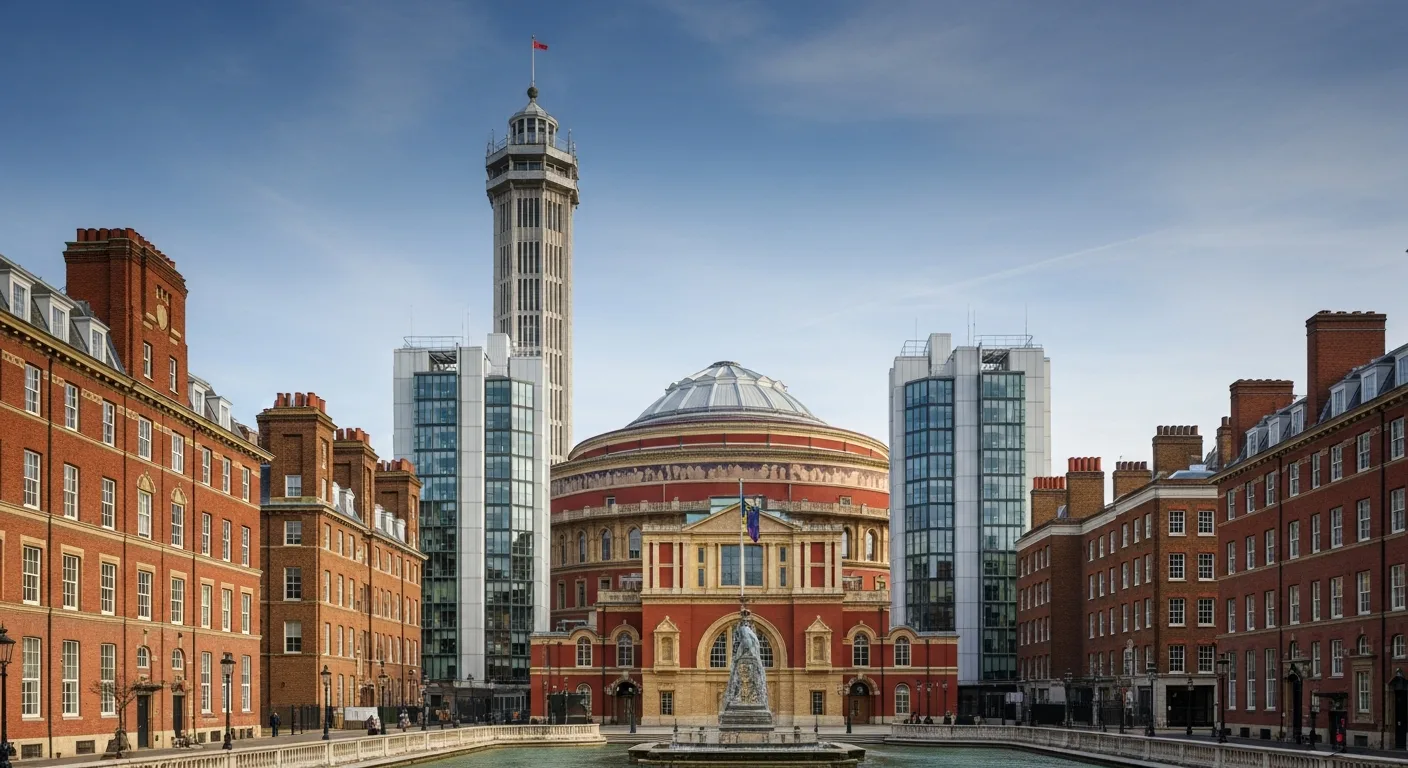
Lead image: Wikimedia Commons
You stand on Exhibition Road in South Kensington, flanked by three of Britain’s greatest museums - the Natural History Museum, the Science Museum and the Victoria & Albert. A few hundred metres away, behind the white stone facade of the Queen’s Tower, a lecture is in progress on the optimisation of neural networks; sitting in the third row is a student who, three years from now, will found a startup valued at £50 million. In a chemistry lab next door, a research team is testing materials for hydrogen storage. On the floor above, someone has just finished writing code that will be deployed tomorrow into NHS systems across London. This is not a recruitment brochure. This is an ordinary Tuesday at Imperial College London.
Imperial occupies a unique position in global higher education: the only fully autonomous university in the United Kingdom focused exclusively on science, engineering, medicine and business. There is no English literature here, no art history, no theology - Imperial has existed since 1907 to solve problems. Alexander Fleming discovered penicillin in St Mary’s Hospital, now Imperial’s medical school. Brian May wrote his PhD in astrophysics here (yes - that Brian May from Queen, who returned to finish the dissertation thirty years after Bohemian Rhapsody). Sir Patrick Vallance, the UK’s Chief Scientific Adviser through the COVID-19 pandemic, trained here. Sir Roger Bannister, the first man to break the four-minute mile, qualified as a doctor at St Mary’s. In QS World University Rankings 2026, Imperial ranks #2 in the UK and top 6 globally - ahead of Oxford in many engineering and computing subdisciplines.
This guide walks international applicants through everything you need to know to apply to Imperial from outside the UK: the UCAS process, admissions tests by faculty (ESAT, MAT, TMUA, UCAT), course-specific requirements, post-Brexit fees and how to fund them, the South Kensington campus, the new White City innovation district, and the post-study Graduate Route visa. If you are also weighing Oxbridge, see our Oxford guide for international applicants and Cambridge guide. For a wider picture of UK higher education, our studying in the UK guide covers Russell Group alternatives, the visa system, and graduate routes.
Why Imperial - rankings, reputation, and the STEM specialism
Imperial College London consistently sits in the global top 10, but the headline rankings undersell the university’s distinctiveness. In QS World University Rankings 2026 Imperial ranks #6 globally and #2 in the UK - behind Cambridge but ahead of Oxford in several STEM subdisciplines. Times Higher Education 2026 keeps Imperial in the global top 10. The Guardian University Guide 2025 places Imperial in the UK top three.
The subject rankings show the picture more clearly. In engineering and technology, Imperial sits #3 - #5 worldwide (QS Subject Rankings) - ahead of Stanford in several areas. In computer science, top 15 globally with a sharply rising trajectory driven by AI and machine-learning research and a direct pipeline to DeepMind. In medicine, top three in Europe, with one of the most research-intensive medical schools in the UK. Even Imperial College Business School - relatively young, founded in 2004 - already sits in the European top 10 by Financial Times rankings, with a unique profile combining finance, technology and analytics.
What sets Imperial apart from the rest of the top 10
What distinguishes Imperial from Oxbridge or the US Ivies? Total focus on STEM and applied research. Oxbridge spans everything from Classics to quantum physics. UCL is a full-spectrum university. Imperial is a surgical scalpel: precise, focused, uncompromising. That specialisation translates into a research budget exceeding £1 billion per year - one of the highest per-capita figures in European higher education. The output flows not into library shelves but directly into industry: renewable energy, robotics, biomedicine, AI.
The numbers that matter
- #6 in the world, #2 in the UK (QS World University Rankings 2026)
- 14 Nobel laureates affiliated with Imperial across all categories
- 60%+ international student body - one of the most globally diverse top-10 universities in the world (140+ countries)
- £1bn+ annual research income
- 93% graduate employment rate within 15 months (HESA Graduate Outcomes 2024)
- 22,000+ students: ~10,000 undergraduate and ~12,000 postgraduate
- Median graduate starting salary: £37,000 (engineering) to £55,000+ (Computing)
Common misconception: “Imperial is just engineering”
This is outdated. Imperial has a world-class medical school (the largest in Europe by research output), a top-three European business school, and a Department of Mathematics ranked top 10 globally. Its Department of Computing has trained engineers at DeepMind, Google, OpenAI and Meta. Imperial Business School’s MSc Finance regularly ranks #1 in Europe. The institution is monothematic only in the sense that everything is in service of science and applied research - from quantum physics to public-health epidemiology to financial modelling.
That said, Imperial is academically brutal. An A* in your strongest STEM subject is the floor. The combination of admissions test plus interview (for selected courses) selects ruthlessly for students who can solve technical problems quickly and cleanly. Imperial students average 25-35 contact hours per week - significantly more than humanities students at Oxbridge.
How does Imperial admissions work - UCAS, tests, and interviews
Imperial uses the standard UK admissions process, which differs fundamentally from US universities. There is no Common App, no holistic review, no demonstrated interest, and no SAT requirement. Instead, admission is built on four pillars: academic record, admissions test, Personal Statement, and (for some courses) interview.
The October 15 deadline - non-negotiable
Imperial’s UCAS deadline for most courses falls on the standard UCAS Equal Consideration deadline of late January - but for Medicine the deadline is 15 October at 18:00 UK time, the same as Oxbridge. International applicants targeting Medicine should treat this as 14 October at the latest. UCAS server load on deadline day has caused real submission problems in the past.
For Engineering, Computing and Natural Sciences, you can submit until late January - but realistically, you want your application in by early November so that admissions tutors review you while shortlisting decisions are still open. Late applications get reviewed when most offers have already been issued.
Step 1: Choose your course (and faculty)
Imperial undergraduate admission is course-specific. You apply to read one programme - Mechanical Engineering, Computing, Mathematics, Physics, Medicine, Economics Finance and Data Science - and you are evaluated for fit to that course. Switching faculty after enrolment is rare and difficult.
Most-popular courses and their approximate acceptance rates (2024 cycle):
- Computing (MEng): ~7-8%
- Medicine (MBBS/BSc): ~10%
- Mechanical Engineering (MEng): ~13%
- Mathematics (MSci): ~15%
- Aeronautical Engineering: ~16%
- Physics (MSci): ~18%
- Materials Science: ~22%
- Economics, Finance and Data Science (BSc): ~10%
Most engineering students choose between BEng (3 years) and MEng (4 years). The MEng leads directly to Chartered Engineer (CEng) status without additional postgraduate qualification - most international students opt for it because the marginal cost of one extra year is repaid quickly through higher graduate salaries and the option of a Year in Industry.
Step 2: Personal Statement (UCAS) - applied, not aspirational
The UCAS Personal Statement is 4,000 characters / 47 lines describing why you want to study this subject. Imperial does not want personal narrative or extracurriculars unrelated to STEM. Admissions tutors want to see:
- Engineering or scientific projects you have built - Arduino, CAD, robotics, programming, lab work
- Competition results - Maths, Physics, Chemistry or Informatics Olympiads (national, IMO, IPhO, IChO, IOI, EJOI)
- Reading beyond the school syllabus - specific books, papers, MOOCs with concrete takeaways (not “I read Feynman and was inspired” - say what you took from chapter 6 of QED)
- Internships, summer programmes, hackathons with measurable output
- Independent research - even unpublished work shows initiative
Roughly 80% of the statement should be technical and applied. The remaining 20% can cover relevant extracurriculars - debating for an applicant who wants to combine engineering with policy, music for someone applying to acoustic engineering. Anything that does not connect to the subject is wasted real estate.
Step 3: The admissions test - Imperial’s screening filter
From the 2024 cycle onwards, Imperial uses its own admissions tests for engineering and science courses. You must register separately through Pearson VUE - your school does not handle this. International candidates take the test at authorised test centres in their home country.
| Course | Test | Format | Date (2026) |
|---|---|---|---|
| Engineering (all departments) | ESAT (Engineering and Science Admissions Test) | 2.5h, multiple-choice, 5 sections | October 2026 |
| Natural Sciences (Physics, Chemistry) | ESAT | 2.5h | October 2026 |
| Mathematics, Maths with Statistics, Maths with Applied Maths | MAT (with Oxford) | 2.5h, MCQ + long-form | 30 October 2026 |
| Computing (MEng/BEng) | TMUA | 2.5h, problem-solving + reasoning | October 2026 |
| Medicine (MBBS/BSc) | UCAT | 2h, computer-based | July - September 2026 |
| Economics, Finance and Data Science | TMUA | 2.5h | October 2026 |
| Materials Science, Earth Science | ESAT | 2.5h | October 2026 |
These tests are designed to be hard. The MAT, for example, has a median score of around 50/100. The ESAT covers Mathematics 1, Mathematics 2, Physics, Chemistry and Biology - candidates choose three sections that match their course requirements. Past papers are published free on the official Imperial admissions site (and on the Cambridge Admissions Testing site for ESAT). Work through at least 5-7 years of past papers before sitting the live test.
Step 4: Shortlisting
Late November to early December, each department’s tutors review applications and shortlist candidates. The criteria are: predicted/actual grades, admissions test score, Personal Statement, and academic reference. The threshold varies by department - Computing and Medicine cut more aggressively than Materials Science or Earth Science.
Most Engineering departments do not interview - they decide on paper. Medicine and Computing do interview shortlisted candidates.
Step 5: The interview (for some courses)
- Medicine: mandatory MMI (Multiple Mini Interviews) - a series of short stations testing different competencies (ethics, communication, problem-solving, motivation). For international applicants, MMIs run online via Microsoft Teams.
- Computing: panel interview, 20-30 minutes, two or three faculty members, technical questions on logic, mathematics, programming reasoning. Online for international candidates.
- Most Engineering and Natural Sciences: no interview - admission is decided on academic record + admissions test + Personal Statement.
Step 6: Offers and results
Imperial issues conditional offers from January through March. Typical offers for international applicants:
- A-Level: AAA (Maths A* required for STEM; Maths and Physics A* for Engineering and Physics; Chemistry and Biology A required for Medicine). Some courses (Computing, Mathematics) issue AAA* offers.
- IB Diploma: 39-41 total with 7,7,6 or 7,7,7 at Higher Level. HL Mathematics Analysis & Approaches required for STEM (NOT Applications & Interpretation - a common mistake).
- Indian CBSE/ISC: 95%+ overall in five subjects; 95%+ in Mathematics and Physics for Engineering.
- US AP: 5,5,5 in three relevant APs (AP Calculus BC, AP Physics C, AP Chemistry) plus strong SAT II / ACT scores.
- French Bac Général: 16/20 with 17-18 in Mathématiques Spécialité; mention très bien.
- German Abitur: 1.0-1.3 GPA with strong Maths/Physics Leistungskurse.
- Italian Maturità Scientifica: 95/100+ overall with 9-10/10 in Maths and Physics.
- Spanish Bachillerato/EBAU: 9.0+ overall, with 9.5+ in Maths/Physics.
- Singapore A-Level: AAA with H2 distinctions in Maths, Physics, Chemistry/Computing.
- Chinese Gaokao: top 0.5-1% of provincial cohort; required UCAT / TMUA / MAT score.
- Russian Аттестат: 5.0 GPA + national Olympiad evidence.
International qualifications are evaluated on Imperial’s own equivalency tables - your grades are weighed against country-specific norms, not converted to a US-style GPA.
English language requirements
Imperial requires English certification at one of two levels:
- Standard: IELTS Academic 6.5 (minimum 6.0 in each component) or TOEFL iBT 92 (minimum 20 in each section). Applies to most STEM courses.
- Higher: IELTS 7.0 (minimum 6.5) or TOEFL iBT 100 (minimum 22). Applies to Medicine and selected programmes.
These thresholds are slightly lower than Cambridge (7.5 IELTS), which gives international applicants a bit of slack - but if your academic English is borderline, do not interpret a 6.5 IELTS as comfortable for engineering tutorials in London. Need to push your TOEFL or IELTS score? Try PrepClass adaptive English-test prep - the free trial lets you diagnose your weak skills before committing to a study plan.
What does Imperial teach? - faculties, departments, and where Imperial leads
Imperial is organised into four faculties: Engineering, Natural Sciences, Medicine, and the Imperial College Business School. Most undergraduate programmes are three-year BEng/BSc or four-year integrated Master’s (MEng, MSci). There is no liberal arts core, no general first year, no required courses outside your subject.
Faculty of Engineering - Imperial’s flagship
Faculty of Engineering is the largest and most prestigious faculty - and arguably the best engineering school in Europe. It covers ten departments:
- Aeronautics (top 3 globally for aerospace)
- Bioengineering
- Chemical Engineering
- Civil and Environmental Engineering
- Computing (technically a Department of Engineering)
- Design Engineering (Dyson School)
- Earth Science and Engineering
- Electrical and Electronic Engineering
- Materials
- Mechanical Engineering
Most programmes are available as 3-year BEng or 4-year MEng (integrated Master’s). The MEng leads directly to Chartered Engineer (CEng) status without further postgraduate qualification - most international students choose it. Specialisation begins in Year 2, and Year in Industry placements are available with Rolls-Royce, BP, Shell, Dyson, McLaren, BAE Systems, Siemens, ARM and hundreds of UK and European employers. Imperial has the highest engineering-graduate employment rate in the UK - many students sign full-time offers before they graduate.
Department of Computing - Europe’s quiet leader in CS
Imperial’s Department of Computing is one of the strongest CS departments in Europe. The four-year MEng is highly flexible: from Year 2 students specialise in artificial intelligence, machine learning, software engineering, cybersecurity or visual computing. The department has direct ties to Google DeepMind (which has offices on the South Kensington campus), Microsoft Research, Amazon and most major London tech firms and startups. The MEng includes a mandatory research or industry year.
Median starting salary for Imperial Computing graduates exceeds £55,000 per year in the UK and £100,000+ at top US firms (Citadel, Jane Street, Google). Imperial is a primary recruiting target for quantitative finance and big tech.
Faculty of Medicine - research-driven medical training
Imperial’s Faculty of Medicine offers a 6-year MBBS/BSc programme, combining preclinical science with clinical placements in NHS hospitals across London - including Hammersmith Hospital, Charing Cross and St Mary’s (where Fleming discovered penicillin). What distinguishes Imperial from other UK medical schools is the mandatory intercalated BSc year - every student completes a 12-month research project between Year 3 and Year 4. The result is graduates equipped for both clinical practice and research, with many combining both careers.
If you target research-driven medicine rather than purely clinical practice, Imperial is one of the best choices in Europe. Note: Medicine is by far the most expensive Imperial programme - international tuition exceeds £59,000 per year in clinical years.
Faculty of Natural Sciences
Comprises Physics, Chemistry, Mathematics, and Life Sciences. Each department offers three-year BSc and four-year MSci programmes, often with a Year Abroad option (Imperial has exchange agreements with MIT, ETH Zurich, École Polytechnique, NUS, University of Tokyo). The Department of Physics partners directly with CERN and ESA; physics undergraduates have access to one of the best lab facilities in the UK. Imperial’s Mathematics is more applied than Cambridge’s - strong emphasis on applied maths, statistics, and mathematical finance.
Imperial College Business School
Imperial College Business School is the only business school embedded in a top-tier purely technical university anywhere in the world. At undergraduate level, it offers BSc Economics, Finance and Data Science - a unique combination of finance, programming and analytics that you cannot find at LSE or Warwick. Most Business School programmes are postgraduate (full-time MBA, MSc Finance, MSc Business Analytics, MSc Climate Change Management & Finance). The MSc Finance has been ranked #1 in Europe by Financial Times.
White City - Imperial’s innovation campus
In addition to the historic South Kensington campus, Imperial has been building Imperial White City Campus - a 25-acre innovation district in West London. White City houses the Molecular Sciences Research Hub, Sir Michael Uren Hub (biomedical engineering), I-Hub (translational research and startup incubation), and the Scale Space accelerator. Many MEng final-year projects, MSci research years and PhD work happen at White City. By 2030 it will be one of the largest science-and-tech innovation districts in Europe.
How much does Imperial cost - fees, living costs, and Brexit’s impact
Brexit transformed the financial picture for European applicants. Until 2020, EU students paid the same fees as UK students (£9,250/year) and could borrow from Student Finance England. From 2021 onwards, EU students are classified as international (Overseas) and pay 4-6× more.
Tuition fees 2026/2027
| Course type | Home (UK) | International (Overseas) |
|---|---|---|
| Engineering (BEng/MEng) | £9,250 | £40,940 |
| Natural Sciences (Physics, Chemistry, Maths) | £9,250 | £40,940 |
| Computing (MEng) | £9,250 | £40,940 |
| Life Sciences | £9,250 | £40,940 |
| Business School (BSc EFDS) | £9,250 | £40,940 |
| Medicine (preclinical years 1-3) | £9,250 | £49,950 |
| Medicine (clinical years 4-6) | £9,250 | £59,400 |
There is no separate college fee at Imperial - unlike Oxford and Cambridge, where colleges charge an additional £8,000 - £10,000 per year for international undergraduates.
Living costs in London
Imperial’s official living-cost estimate for 2026/2027 is £15,000 - £18,000 per year (based on a 39-week academic year with vacation periods at home):
- Accommodation: £8,500 - £12,000. First-year halls cost £180 - £280 per week (Beit Hall on-campus is the most expensive; Pembridge Hall in Notting Hill is mid-range). Year 2+ private rentals: £1,000 - £1,400/month for a room in Earl’s Court, Hammersmith, Acton or Brixton.
- Food: £200/month if you cook, £300+ if you eat out regularly.
- Transport: £100/month (Zone 1-2 student Oyster card).
- Books, lab fees and personal: £1,500 - £2,500/year.
- Vacation living costs: £2,000 - £3,000 (most students go home, but if you stay in London for an internship, add £1,000/month).
Total annual cost for international undergraduates
- Engineering, Computing, Natural Sciences, Business: £55,000 - £60,000 (~USD 70,000-76,000 / EUR 65,000-71,000)
- Medicine preclinical: £65,000 - £68,000 (~USD 82,000-86,000 / EUR 77,000-80,000)
- Medicine clinical years: £74,000 - £78,000 (~USD 94,000-99,000 / EUR 88,000-92,000)
A three-year BEng in Mechanical Engineering will cost an international family approximately £165,000 (USD 209,000 / EUR 195,000) all-in. A four-year MEng in Computing: approximately £225,000 (USD 285,000 / EUR 265,000). A six-year MBBS/BSc: approximately £420,000 (USD 530,000 / EUR 495,000).
How does this compare?
Imperial is significantly cheaper than HYPSM total cost of attendance in the US (USD 91,000+ at Columbia, USD 95,000+ at Stanford). It is comparable to Oxford and Cambridge at international rates (Oxford £47,500 - £66,000, Cambridge £45,000 - £62,000), and somewhat more expensive than UCL (£35,000 - £45,000) or LSE (£30,000 - £38,000). Compared to continental Europe, Imperial is dramatically more expensive - ETH Zurich charges ~CHF 1,500/year, École Polytechnique ~€16,000/year for international students, German public universities €0 - €1,500/semester.
The financial argument for Imperial over a continental European peer rests on three things: graduate salary uplift, the post-study Graduate Route visa, and the global brand strength of an Imperial degree on a CV.
Currency strategy for international families
The £/USD and £/EUR rates have moved significantly since Brexit. Strategies to manage exchange-rate risk:
- Open a Wise or Revolut multi-currency account to hedge transfers across the academic year
- Lock fees in advance if your home currency strengthens against GBP - Imperial allows term-by-term payment but bank transfer fees add up
- Plan for a 5-10% buffer above the published cost of attendance to absorb currency volatility
- Consider a London-account split - pay tuition in GBP from a hedged account, keep day-to-day spending in a separate Revolut sub-account
How to fund Imperial - scholarships, awards, and external funding
Imperial does not offer need-based aid to international undergraduates the way HYPSM does. Most international students fund through a combination of family resources, government scholarships, and Imperial merit awards. The good news is that Imperial has more international scholarships at undergraduate level than Oxbridge does - the President’s Undergraduate Scholarship alone awards roughly 100 international scholarships per cycle.
Imperial-administered undergraduate scholarships
President’s Undergraduate Scholarship - the flagship merit award
- Coverage: £10,000 per year for the duration of the degree (3-4 years for BEng/MEng, 6 years for Medicine)
- Eligibility: open to all international applicants, awarded on academic merit and Personal Statement strength
- Number: ~100 per year for international undergraduates
- Application: automatic consideration on UCAS application - no separate form required for most courses; some require a short scholarship essay
Imperial Bursary
- Coverage: £5,000/year for students from low-income households
- Eligibility: means-tested; international applicants must submit family income documentation
- Number: ~300 per year across UK and international cohorts
Imperial Excellence Scholarship
- Coverage: up to £30,000 over the duration of the degree
- Eligibility: top-performing applicants in each faculty
- Application: automatic consideration; outstanding ESAT/MAT/TMUA/UCAT performers prioritised
Faculty- and department-specific awards
- Schlumberger Faculty for the Future (Engineering, women in STEM from emerging economies): up to USD 50,000/year
- Microsoft Imperial Computing Scholarship (Computing students)
- Google Imperial Scholarship (Computing, female and underrepresented applicants)
- Rector’s Scholarship for outstanding STEM applicants
- Dyson School Scholarship (Design Engineering)
Postgraduate scholarships
Imperial’s postgraduate scholarship pool is even larger than its undergraduate pool. Highlights:
- Imperial President’s PhD Scholarship: full fees + £25,000 stipend, ~50 per year
- Chevening Scholarships (UK government, postgraduate Master’s, all nationalities outside UK/EEA)
- Commonwealth Scholarships (Master’s and PhD, Commonwealth countries)
- Marshall Scholarship (US citizens)
- Fulbright UK (US citizens, one-year Master’s)
- DAAD (Germany)
- CSC China Scholarship Council
- Said Foundation (Jordan, Lebanon, Palestine, Syria)
- Felix Scholarship (Indian and developing-country postgraduates)
External funding by region
- India: Inlaks Shivdasani Foundation, KC Mahindra, JN Tata Endowment, Aga Khan Foundation
- China: China Scholarship Council (CSC), Chinese-British Academic Excellence Scholarships
- South Korea: Kwanjeong Educational Foundation
- Latin America: Fundación Carolina (Spain-affiliated), CONACyT (Mexico), Becas Chile, Fundação Estudar (Brazil)
- Africa: MasterCard Foundation Scholars Program, Mandela Rhodes
- EU (post-Brexit): DAAD (Germany), Erasmus+ (limited), national merit programmes (Italy’s INPS, Spain’s La Caixa)
- Middle East: Said Foundation, Saudi Aramco scholarships, UAE government schemes
- Southeast Asia: Singapore A*STAR, Khazanah (Malaysia), DOST (Philippines), Vietnam VEF
- Australia/NZ: Westpac Future Leaders, Robert Menzies Scholarship
Loans and alternative financing
International students cannot access UK Student Finance. Options:
- Prodigy Finance - no-cosigner loans for graduate study at Imperial, rates 8-14% APR
- MPower Financing - graduate loans for international students at top universities
- Country-specific student loan schemes (HDFC Credila in India, Sallie Mae in the US, Kreditech in Germany)
- Lendwise - UK-based, accepts international borrowers with UK guarantor
Realistically, strong international applicants who stack 2-4 funding sources can cover 30-50% of total cost. Few cover 100% without family support, given Imperial’s London cost base.
What is student life like at Imperial - campus, societies, and South Kensington
Imperial’s social life is organised around Imperial College Union (the students’ union), departmental societies, and the South Kensington campus itself. Unlike Oxbridge, Imperial has no college system - your community forms organically through your hall, your department, and the societies you join.
South Kensington - the central campus
The historic core of Imperial is in South Kensington - one of London’s most expensive and best-connected neighbourhoods. The campus sits between Hyde Park to the north, Exhibition Road (with the Natural History Museum, Science Museum, V&A Museum) to the east, and the Royal Albert Hall to the south. Three minutes by tube to central London. The campus itself is gated and compact - almost everything is reachable within a five-minute walk.
Key landmarks on campus:
- Queen’s Tower - the white stone tower visible from across London
- Sir Alexander Fleming Building - biomedical research centre named after the penicillin discoverer
- Skempton Building - civil and environmental engineering
- Royal School of Mines - Earth Sciences and Materials, the oldest building on campus
- Central Library - open 24/7 during term time, with one of the largest STEM collections in Europe
- Beit Quad - student services, the bar (Metric), and most society meetings
Accommodation - guaranteed for international first-years
Imperial guarantees a place in halls for all international first-year undergraduates. Main halls and 2026/2027 weekly rents:
- Beit Hall - on-campus, single ensuite, £230 - £280/week (most expensive, most central)
- Eastside Hall - 5 min walk from campus, £200 - £260/week, modern blocks
- Southside Hall - adjacent to Eastside, £200 - £260/week
- Woodward Hall - Notting Hill, £190 - £240/week, mid-priced
- Pembridge Hall - Notting Hill, £190 - £240/week, smaller and quieter
- GradPad / Wilson House - postgraduate halls, £230 - £300/week
From Year 2, most students rent flats with friends. Typical monthly rent for a private room in Earl’s Court, Hammersmith, Acton or Brixton: £1,000 - £1,400/month. Imperial’s housing portal helps Year 1 students form groups and secure leases for Year 2.
Imperial College Union - 380+ clubs and societies
Imperial College Union runs 380+ clubs and societies, ranging from the academic (RoboSoc, AISoc, IEEE Imperial, Imperial Investment Society, Imperial Quantum Society) to the cultural (Imperial College Symphony Orchestra, Drama Society, Cinema) to sport (Imperial Boat Club rowing on the Thames, Rugby, Football, ten martial arts clubs) to the diaspora (Imperial Indian Society, Chinese Society, Greek Society, German-Speaking Society - 100+ national societies in total).
Particularly relevant for international students:
- Imperial Indian Society, Chinese Society, African-Caribbean Society, Latin American Society, Singapore Society - large diaspora networks running dinners, speaker events, career mentoring
- Imperial Investment Society for finance and banking recruitment
- Imperial Entrepreneurs for tech and VC tracks
- Imperial Consulting Society for management consulting recruitment
- Imperial Robotics Society - competitions including RoboCup and BIRC
Academic terms and rhythm
Imperial runs three terms (Autumn, Spring, Summer), each roughly 10 weeks. The academic load is significantly higher than at Oxbridge humanities courses - typically 25-35 contact hours per week of lectures, problem classes, lab sessions and tutorials. Engineering students additionally complete major design projects in Years 2 and 3, and the MEng final-year project is a substantial individual or group research piece (often industry-sponsored). Computing and Mathematics students hand in problem sheets weekly and sit closed-book examinations in Summer term.
Imperial vs Oxbridge - the cultural difference
Imperial’s culture is technical, applied, and pragmatic. Students are nearly all STEM-focused and largely career-oriented - finance, tech, engineering, medicine. There is far less of the philosophical-debate, dressed-up-formal-hall, “Brideshead Revisited” atmosphere of Oxbridge. Formal events exist (Imperial College Union Ball, departmental dinners, the Imperial Festival) but they are not central to identity. If you want a tightly STEM-focused community where everyone is solving similar problems and hiring intersects with academic life, Imperial is the natural fit. If you want broad humanities exposure, formal traditions and a residential college identity, choose Oxford or Cambridge.
How does the UK student visa work after Brexit?
EU/EEA students need a Student visa (formerly Tier 4) to study at Imperial for any course longer than six months. The process is mature, fast and well-documented - Imperial’s International Student Support team guides applicants through it.
Student visa requirements
- Confirmation of Acceptance for Studies (CAS) from Imperial after you accept your offer (typically issued in May - July)
- Financial proof: cover the full first-year tuition + £1,483/month for nine months living costs (London). For 2026/2027 this is roughly £40,940 - £59,400 + £13,347 = £54,300 - £72,800 in your account for 28 consecutive days before applying
- English language proof: usually waived if your CAS confirms you met Imperial’s English requirement (IELTS 6.5/7.0 or TOEFL 92/100)
- TB test certificate for applicants from listed countries (most of Asia and Africa)
- Application fee: £490 for the visa + £776/year IHS (Immigration Health Surcharge - gives full NHS access)
Application timeline
- Apply up to 6 months before your course starts (so April for an October start)
- Decision typically within 3 weeks for standard applications; priority service available for £500 (5-day turnaround)
- After arrival in the UK, collect your Biometric Residence Permit (BRP) within 10 days at the designated post office
Working during studies
Student visa holders can work:
- Up to 20 hours per week during term time
- Full-time during vacations
- Internships and placements if part of the academic course (Year in Industry placements are explicitly permitted)
You cannot work as a freelancer, run a business, or take a permanent full-time post.
Post-study options - the Graduate Route
Since 2021, the UK has run the Graduate Route: a post-study work visa that allows international graduates to stay and work for 2 years after a Bachelor’s or Master’s (3 years after a PhD), without needing employer sponsorship. This makes Imperial significantly more attractive than it was 2010-2020, when international students had to leave within four months of graduating unless they had a job offer with sponsorship.
The Graduate Route is particularly valuable for Imperial graduates because the largest London employers - Goldman Sachs, JP Morgan, Citadel, Jane Street, Google, DeepMind, Meta, Palantir, McKinsey, BCG, Bain, Rolls-Royce, Jaguar Land Rover - all sponsor Skilled Worker visas freely for Imperial Computing, Engineering and Mathematics graduates after the Graduate Route expires.
After the Graduate Route, you can switch to a Skilled Worker visa (employer-sponsored, 5-year route to settlement) or to an Innovator Founder visa if you launch a startup - Imperial has its own Imperial Enterprise Lab supporting student entrepreneurs.
Is Imperial right for you? - a candid summary
Imperial is exceptional for a specific kind of student: someone who already knows their STEM subject deeply, wants intensive technical training, and values applied research and industry connection over breadth. It is a poor fit for students who:
- Want to explore multiple disciplines before specialising → consider Brown’s Open Curriculum or Columbia’s Core
- Want to combine STEM with humanities at an undergraduate level → consider Oxford, Cambridge, Stanford or MIT
- Need need-based financial aid as an international undergraduate → only HYPSM-tier US schools meet 100% of demonstrated need for internationals
- Want a campus-centric American college experience → Imperial is integrated into central London, not a self-contained campus
- Prioritise extracurriculars and “well-rounded” admissions → US schools weight this far more heavily
Who Imperial suits best
You’ll thrive at Imperial if:
- You have a specific STEM obsession that has driven your reading and projects beyond school
- You want direct industry exposure through Year in Industry, hackathons, and London’s tech and finance ecosystem
- You’re comfortable with academic intensity - 25-35 contact hours per week, weekly problem sheets, lab work, design projects
- You want a degree recognised globally by every major STEM employer
- You want post-study UK work options through the Graduate Route, which Imperial graduates monetise faster than students from any other UK university
Strong English required
Imperial does not offer foundation or pathway programmes for international undergraduates. You arrive at academic-native English level. If your IELTS is 5.5-6.0 you should plan a year of intensive English preparation before sitting the IELTS Academic 6.5 / TOEFL 92 required for entry - and consider 7.0 / 100 if you target Medicine. Need to push your TOEFL or IELTS score? Try PrepClass adaptive English-test prep - the free trial lets you diagnose your weak skills before committing to a prep plan.
Next steps
If Imperial is your target:
- Year before application (Year 12 / age 16-17): pick your subject, start building STEM portfolio (Olympiads, MOOCs, projects), identify your admissions test (ESAT/MAT/TMUA/UCAT)
- Summer before application: register for IELTS/TOEFL and admissions test; explore Imperial Open Days (June - September) - virtual tours and faculty Q&A available year-round
- September of application year: draft Personal Statement, finalise UCAS choices (max 5; you can apply to Imperial alongside one of Oxford or Cambridge), brief your reference writer
- Mid October: register for ESAT/MAT/TMUA before deadline (varies by test)
- 15 October 18:00 UK time: submit UCAS for Medicine (mandatory deadline)
- Late October / early November: sit admissions test (ESAT, MAT, TMUA in October; UCAT closes early September)
- Early November: submit UCAS for non-Medicine courses (technically late January is the deadline, but earlier submission gets earlier decisions)
- December - February: interview if invited (Medicine MMI, Computing panel)
- January - March: conditional offers issued
- Summer: meet conditional offer, apply for Student visa, prepare for October start
Want a structured plan? Book a free consultation with College Council - we work with international applicants on UK STEM admissions, including subject choice, Personal Statement strategy, ESAT/MAT/TMUA preparation, and UCAT/MMI training. Need to push your TOEFL or IELTS score before the application window? Try PrepClass adaptive English-test prep - adaptive question selection targets your weak skills first.
If Imperial doesn’t fit, our other guides will help you triangulate:
- Oxford guide - older, more humanities-balanced, tutorial-driven
- Cambridge guide - Imperial’s main UK STEM rival
- Studying in the UK overview - Russell Group alternatives (UCL, LSE, Edinburgh, KCL, Manchester, Warwick)
- Stanford guide and MIT guide - US STEM elite alternatives
Whatever you decide, give yourself 18+ months to prepare. Imperial rewards depth, not last-minute polish - and the candidates who succeed almost always started building STEM evidence (Olympiads, projects, MOOCs) at least a year before they sat their first admissions test.


