
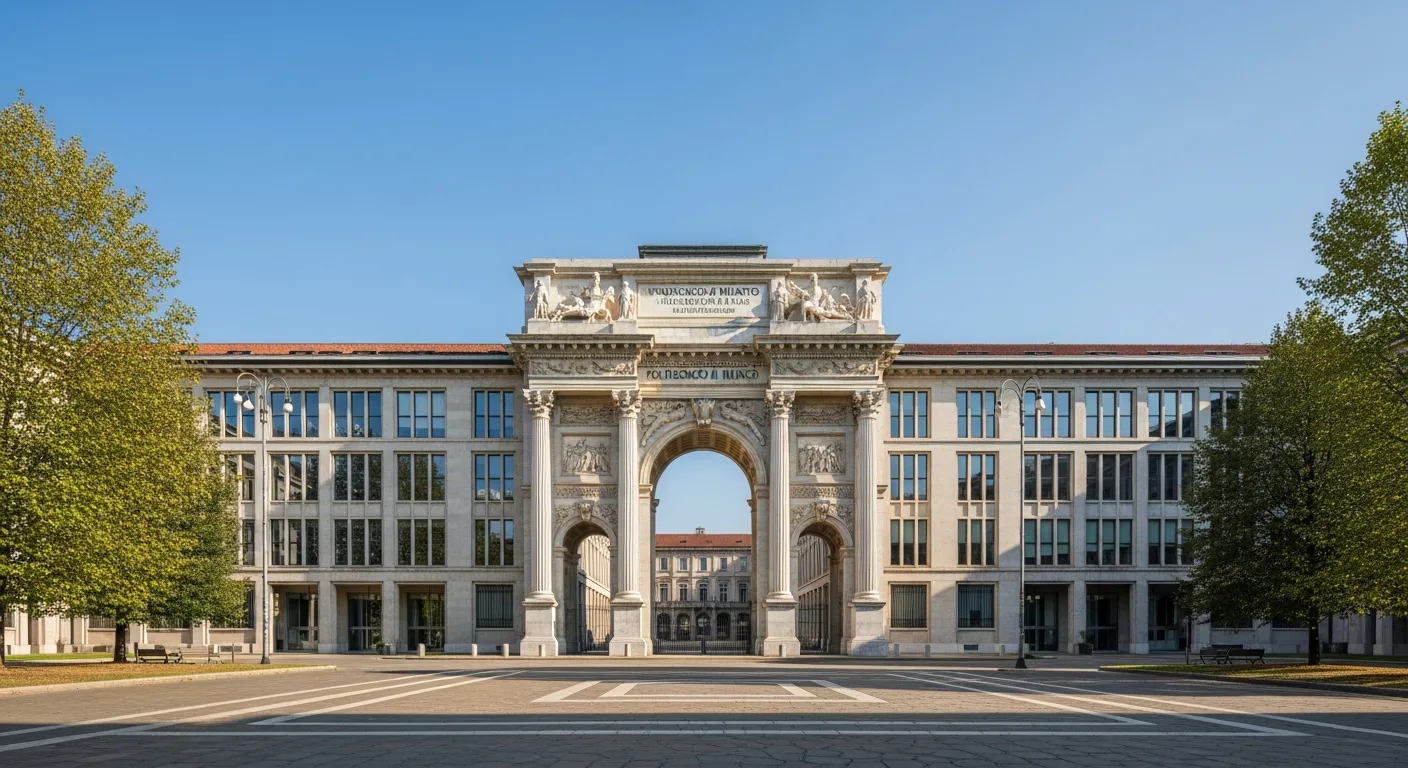
You stand in the square in front of the Leonardo campus in the Città Studi district. To your left – a historic building from 1927 where Giulio Natta conducted research that earned him a Nobel Prize in Chemistry. To your right; a glass laboratory where a group of students is testing a Formula SAE car prototype. On a bench in front of the entrance, two Italians and a student from Krakow are eating focaccia for 2.50 EUR and discussing a bridge project due on Friday. In the distance, you hear the sound of the tram line 19, which will take you to the Duomo in five minutes. This isn’t a postcard from a recruitment brochure – it’s a typical Tuesday at Politecnico di Milano.
PoliMi – as students affectionately call it – is Italy’s top technical university and one of the best in Europe. In the QS World University Rankings 2025, it holds the 111th spot globally, but this is its overall position – in subject-specific rankings, the situation looks much better: 7th worldwide in Art & Design, 7th in Architecture, and 23rd in Engineering & Technology. It’s a university that educates architects designing the world’s most famous buildings (Renzo Piano; The Shard in London, Centre Pompidou in Paris) and engineers building Ferrari engines. And tuition? For an EU citizen – from 900 to a maximum of 3,898 EUR per year, depending on family income. For low incomes, it can even be zero.
In this guide, I’ll walk you through the entire application process for Politecnico di Milano: from the TOL and ARCHED entrance exams, through program-specific requirements, cost of living in Milan, DSU and Excellence scholarships, all the way to career prospects and a comparison with ETH Zurich, TU Munich, and Imperial College London. If you’re considering engineering or design studies in Europe, this article will give you the full picture – straightforward and honest.
Politecnico di Milano: Key Data 2025/2026
Source: QS World University Rankings 2025, Politecnico di Milano Official Data 2025/2026
Rankings and Reputation; Why PoliMi?
Politecnico di Milano is a university that looks solid in overall rankings, but in subject-specific rankings, it shines like few other European polytechnics. In the QS World University Rankings by Subject 2025, PoliMi ranks 7th worldwide in Art & Design (surpassing MIT, Aalto, and Pratt Institute) and 7th in Architecture & Built Environment, just behind UCL and MIT. In the category Engineering & Technology, it holds the 23rd global position and a decisive 1st place in Italy. The THE World University Rankings 2025 places PoliMi in the top 200, and in Engineering & Technology, in the 76–100 range.
What truly sets Politecnico di Milano apart from other European polytechnics is the combination of engineering with design and architecture on one campus, within a single academic culture. ETH Zurich ranks higher in pure sciences, Imperial College dominates in biomedicine, TU Munich has stronger industrial ties in Germany – but none of these universities offer such a strong design faculty within a polytechnic. PoliMi is the only place in Europe where you can study Aerospace Engineering on the same campus as Fashion Design, with both departments ranking in the global top 10.
PoliMi’s prestige is built on tangible achievements, not mythology. The list of alumni speaks for itself: Renzo Piano (Pritzker Prize, architect of The Shard and Centre Pompidou), Aldo Rossi (Pritzker Prize, postmodernism icon), Giulio Natta (Nobel Prize in Chemistry for polypropylene – a discovery that transformed modern industry). Collaborations with partners such as MIT, ETH Zurich, TU Delft, and Georgia Tech mean that a PoliMi degree is recognized and respected on every continent. For an EU high school graduate who wants to study engineering or design at a world-class level without paying 30,000 GBP annually like at Imperial College, PoliMi is one of the best options on the continent.
PoliMi Admissions Timeline 2026/2027
Two tracks: Engineering (TOL/SAT) and Architecture/Design (ARCHED)
Source: Politecnico di Milano Admissions 2025/2026. Dates are indicative – details on polimi.it/en
Step-by-Step Admissions; TOL, SAT, and ARCHED
The admission process for Politecnico di Milano is conducted entirely online through the university’s platform: there is no central Italian portal like the British UCAS or Danish Optagelse.dk. The process is relatively straightforward but requires careful attention to deadlines, as individual rounds have strict cut-off dates. Key point: PoliMi divides admissions into two distinct tracks – Engineering (TOL test or SAT score) and Architecture/Design (ARCHED test + portfolio).
For an EU high school graduate aiming for engineering programs, the most important element is passing the TOL (Test OnLine); a standardized exam assessing knowledge in mathematics, physics, logic, and text comprehension. The TOL is offered in several sessions between March and September, and international candidates can take it remotely. The TOL score determines your position on the ranking list – there’s no rigid threshold, but the higher your score, the better your chances of getting into your first-choice program. An alternative is an SAT score; PoliMi accepts the SAT in the first admission round (Early Session), requiring a minimum of 620 points in each section (1240+ total). If you’ve already taken the SAT (perhaps for Dutch or British universities), this gives you a time advantage: SAT scores allow you to apply earliest. Prepare for the SAT at okiro.io, which offers full practice tests in the Digital SAT format.
Architecture and design programs have a separate exam – the ARCHED test (Architecture Engineering Design). This is a more complex assessment: in addition to mathematics and logic, it covers spatial visualization and art/architecture history. The exam is available in English, which is crucial for international candidates. For design programs, a portfolio showcasing artistic works, graphic designs, and drawings is also required. The portfolio is scored separately and can be a decisive factor; it’s worth preparing it well in advance.
Language requirements: PoliMi requires proof of English proficiency for all programs – even those taught in Italian. The minimum is IELTS 5.5 or TOEFL iBT 80 (lower thresholds than at British universities or Copenhagen Business School). For English-taught programs, IELTS 6.0+ is recommended. Prepare for the exam with prepclass.io, which offers full TOEFL and IELTS practice tests with AI feedback. More about choosing a certificate in our TOEFL vs IELTS guide.
Formal steps:
- Create an account on the PoliMi admissions portal; available in English, registration opens in January
- Fill out the form and submit documents – school leaving certificate translated into English or Italian, language certificate, photo
- Register for the TOL/ARCHED test; choose your exam session, pay the application fee
- Take the test – TOL online or ARCHED (for architecture/design)
- Submit your secondary school leaving exam results; after results are announced in July/August
- Check the ranking list – and confirm admission by paying the first installment
The Polish Matura (or equivalent EU secondary school leaving certificate) is fully recognized in Italy – as an EU citizen, you do not need recognition of qualifications. A certified translation into English is sufficient. Details on converting Polish Matura results to foreign systems can be found in our separate guide.
PoliMi Admission Requirements – System Comparison
Polish Matura | IB | SAT; minimum requirements for 6 most popular programs
| Program | Entrance Exam | SAT (Alternative) | English | Language of Instruction | Competitiveness |
|---|---|---|---|---|---|
| Architectural Design | Test ARCHED + portfolio | N/A | IELTS 6.0 / TOEFL 80 | English | High |
| Design della Moda | Test ARCHED + portfolio | N/A | IELTS 5.5 / TOEFL 80 | Italian | High |
| Design degli Interni | Test ARCHED + portfolio | N/A | IELTS 5.5 / TOEFL 80 | Italian | Medium-High |
| Aerospace Engineering | TOL / TOLC-I | Min. 620+620 (1240) | IELTS 5.5 / TOEFL 80 | English | High |
| Computer Science & Engineering | TOL / TOLC-I | Min. 620+620 (1240) | IELTS 5.5 / TOEFL 80 | English | Medium-High |
| Civil Engineering | TOL / TOLC-I | Min. 620+620 (1240) | IELTS 5.5 / TOEFL 80 | English | Achievable |
Source: Politecnico di Milano Admissions 2025/2026. Competitiveness based on applicant and place data.
Programs of Study – What to Study at PoliMi?
Politecnico di Milano offers programs across three pillars: engineering (~36,000 students), architecture (~7,500 students), and design (~4,700 students). At the Bachelor’s level (Laurea, 3 years), dozens of programs are available, several of which are taught entirely in English. These English-taught programs are most relevant for international candidates, although the university also offers free Italian language courses for foreigners.
Aerospace Engineering is a program that places PoliMi in the same league as Imperial College London and TU Delft in the Netherlands. The program, taught entirely in English, covers aerodynamics, flight mechanics, engine design, and aircraft structures. Students have access to a wind tunnel and flight simulation center on the Bovisa campus. Graduates go on to Airbus, Leonardo Helicopters, Thales Alenia Space, and ESA; Milan is the heart of Italy’s aerospace sector. If you dream of building planes or rockets, and don’t want to pay 36,000 GBP annually at Imperial, PoliMi offers comparable quality for a fraction of the price.
Architectural Design is the flagship program of the School of Architecture – taught in English, combining modern design, urban planning, sustainable development, and architectural history. Milan as a city serves as an invaluable laboratory: from the Gothic Duomo, through the modernist Torre Velasca, to the ultra-modern CityLife designed by Zaha Hadid and Arata Isozaki. Students undertake projects in real urban spaces from their first year. In the QS Architecture ranking, PoliMi is 7th worldwide; higher than Harvard, Columbia, or UCL.
Computer Science and Engineering is a response to the expansion of the tech sector in Italy. The English-taught program covers algorithms, artificial intelligence, software engineering, and cybersecurity. Milan is home to European offices of Google, Amazon, Microsoft, and a growing number of fintech startups. PoliMi has research partnerships with IBM Research and STMicroelectronics, giving students access to projects with real industrial application. Computer science graduates from PoliMi are highly sought after – 97% find employment within a year of completing their Master’s degree.
Communication Design, Fashion Design, Interior Design; PoliMi’s School of Design is the 7th best design faculty in the world according to QS Rankings. It’s the only polytechnic in Europe where design is treated with the same academic rigor as engineering. Fashion Design in Milan (the fashion capital) is a natural choice: internships at Armani, Versace, Prada, and Zegna are the norm, not the exception. Design programs are mainly taught in Italian, but many materials are in English, and the university is actively developing English-taught pathways at the Master’s level.
Mechanical Engineering and Biomedical Engineering are other strong points of PoliMi. Mechanical engineering leads directly to the automotive sector (Ferrari, Maserati, Ducati, Stellantis have headquarters in Northern Italy), and biomedical engineering combines medical knowledge with technology: the growing medtech sector in Lombardy employs graduates locally. Both programs have English-taught tracks.
Top 6 Programs at Politecnico di Milano
Source: Politecnico di Milano, program catalog 2025/2026
Costs of Studying and Living in Milan
This is where PoliMi starts to look like one of the best deals in European technical education. Politecnico di Milano is a public university, meaning tuition fees are regulated by the state and depend on the student’s family income. As an EU citizen, you pay the same as an Italian; the system makes no distinction.
Maximum tuition for Bachelor’s studies is 3,898 EUR per year (2025/2026 data). But this is the maximum amount, applied to the highest incomes. The system is progressive: the university calculates tuition based on the ISEE document (Indicatore della Situazione Economica Equivalente) – the Italian equivalent of parental income tax declarations. For EU families with a net income below ~26,000 EUR per year, tuition can drop to 156 EUR per year (regional fee only). With incomes between 26,000–40,000 EUR, you’ll pay 500–1,500 EUR. Most EU students from average-income families pay 1,000–2,500 EUR annually. This is a fraction of what British universities cost; Imperial College charges 36,700 GBP annually for non-UK students.
The cost of living in Milan is higher than in Bologna or Turin, but lower than in London, Zurich, or even Copenhagen. A realistic monthly student budget looks like this:
Accommodation: 450–700 EUR for a room in a shared apartment. PoliMi student residences (managed by DSU Lombardia) cost 400–550 EUR per month with all utilities – this is the cheapest option, but places are limited, and scholarship recipients have priority. The Città Studi (near the Leonardo campus) and Bovisa (near the engineering campus) districts offer more affordable prices than the city center. Food: 200–350 EUR; university canteens serve full meals for 5–7 EUR, and cooking at home with groceries from Esselunga or Lidl is surprisingly affordable. The aperitivo tradition (a drink + snack buffet for 8–10 EUR) replaces dinner for many students. Transport: 22 EUR per month for a student pass for metro, trams, and buses (ATM pass). A bicycle is a popular alternative – BikeMi, the public bike-sharing system, costs 36 EUR per year. Phone and internet: 10–20 EUR (Italian operators like Iliad offer affordable plans). Entertainment: 100–200 EUR.
Total monthly cost of living: 800–1,300 EUR. Annually, this is 9,600–15,600 EUR (with average tuition of ~1,500 EUR: 11,100–17,100 EUR). Converting to USD (approx. 1.08 USD/EUR, Feb 2026): ~12,000–18,500 USD annually; for a three-year Bachelor’s degree, this is ~36,000–55,500 USD. For comparison: three years at Imperial College London would be over ~118,000 EUR, and at ETH Zurich – about ~58,000 EUR (including living costs in Zurich). PoliMi is one of the most affordable options among the top 100 technical universities worldwide.
Annual Cost of Engineering Studies; PoliMi vs Alternatives
Tuition + Living Costs for EU Students (Academic Year 2025/2026)
Source: Official university websites 2025/2026. Living costs – averaged estimates. 1 EUR ≈ 1.08 USD, 1 GBP ≈ 1.17 EUR, 1 CHF ≈ 1.05 EUR (February 2026).
Scholarships and Financial Support
DSU Lombardia; Means-Tested Scholarship
The most important source of funding for EU students at PoliMi is the DSU scholarship (Diritto allo Studio Universitario), awarded by the Lombardy region based on income criteria. The DSU scholarship can include full tuition fee exemption, a grant for living costs (approx. 5,000–6,000 EUR annually), a reduced-price place in student housing, and free meals in university canteens. The criterion is family income – for many EU families with net incomes in the 20,000–35,000 EUR range annually, the DSU scholarship is achievable. The application is submitted through the DSU Lombardia platform concurrently with the admissions process.
In practice, the DSU scholarship can mean your annual study costs drop to the level of living expenses only; zero tuition, student housing for 100–200 EUR per month, free meals in the canteen. This makes PoliMi one of the most affordable options for studying at a top 200 technical university worldwide – comparable in cost to TU Munich (where tuition is also close to zero) and significantly cheaper than even Dutch universities like Maastricht University or University of Amsterdam with their ~2,500 EUR tuition.
Excellence Scholarship
For the best international candidates, PoliMi offers the Excellence Scholarship; a prestigious award covering full tuition and providing an additional grant of 5,000 EUR annually for living costs. The Excellence Scholarship is automatically considered based on results in the admission process – no separate application is required. Specific criteria change each year, but typically a score in the highest percentile on the TOL/ARCHED test is required.
Other Options
- PoliMi Merit-Based Scholarships; tuition reductions for academic performance (maintaining a high GPA during studies)
- Erasmus+ – grants for exchange semesters (PoliMi has agreements with over 800 universities worldwide)
- National Scholarship Programs; various national scholarship programs may partially fund living costs abroad.
- Low-interest loans – Italian partner banks offer preferential conditions to PoliMi students.
Realistic assessment: most EU students at PoliMi fund their studies through a combination of DSU (partial or full) + family support + occasional part-time work. Italy allows EU students to work without restrictions, although the student job market in Milan is less developed than in Copenhagen or Amsterdam.
PoliMi vs ETH Zurich vs TU Munich vs Imperial College
Four Top Polytechnics in Europe; Key Differences
| Criterion | PoliMi Milan | ETH Zurich | TU Munich | Imperial London |
|---|---|---|---|---|
| QS Overall Ranking | #111 | #7 | #28 | #2 |
| Engineering & Technology | #23 | #4 | #19 | #6 |
| Architecture / Design | #7 / #7 | #4 / – | #25 / – | #20 / – |
| Tuition (EU) | ~900–3 900 EUR/year | ~1 460 CHF/year | ~300 EUR/year | ~36 700 GBP/year |
| Living Costs (monthly) | 800–1 300 EUR | 1 800–2 200 CHF | 1 000–1 300 EUR | 1 300–1 800 GBP |
| BSc Language of Instruction | English / Italian | German (mainly) | German / English | English |
| Entrance Exam | TOL / SAT / ARCHED | None (but foundation year) | Aptitude test (varies) | A-levels / IB |
| Atmosphere | Large, international, Italian lifestyle | Elite, intense | Large, practical, German order | Prestigious, London, cosmopolitan |
| Strengths | Design + engineering, low cost, Milan | Sciences, research, reputation | Industry, practicality, Bavaria | Ranking, London, global network |
| Climate and Lifestyle | Warm, aperitivo, dolce vita | Beautiful mountains, expensive | Biergarten, Alps, order | Rainy, metropolitan, expensive |
Source: QS World University Rankings 2025, official university websites, data for 2025/2026
PoliMi vs ETH Zurich: ETH Zurich is objectively higher in rankings and has a stronger reputation in pure sciences. However, Bachelor’s studies at ETH are conducted almost exclusively in German, living costs in Zurich are twice as high as in Milan, and the percentage of students completing their studies within the standard timeframe is alarmingly low (below 50% for some programs). PoliMi wins on accessibility (English-taught BSc programs), cost, and lifestyle. If you know German and want the highest prestige in physics or mathematics – ETH. If you want design, architecture, or English-taught engineering at a reasonable price; PoliMi.
PoliMi vs TU Munich: TU Munich offers comparable engineering quality for even lower tuition (~300 EUR/year). TUM’s advantage lies in stronger ties with German industry (BMW, Siemens, SAP) and more English-taught BSc programs. PoliMi’s advantages are design and architecture (TUM doesn’t have comparable departments), lower living costs than in Munich, and (let’s be honest) Milan is simply a cooler city to live in for a 19-year-old than Munich. Both are excellent choices; it depends on whether you prefer German practicality or Italian life.
PoliMi vs Imperial College London: Imperial College London is #2 worldwide in QS and has an unparalleled industry reputation. But – and this is crucial – studies at Imperial cost 4x more than at PoliMi, London is one of the most expensive cities in the world, and post-Brexit work permits for EU graduates are limited to 2 years. PoliMi, for a fraction of the price, offers a globally recognized degree, easier access to the EU job market, and a quality of life that London, at 1,800 GBP per month, cannot provide.
Student Life in Milan
Milan is a city that combines something you won’t find anywhere else in Europe: Italian life with Northern European efficiency. It’s not chaotic Rome or sleepy Naples; Milan is fast-paced, modern, international, and yet remains deeply Italian. In the morning, you drink an espresso for 1.20 EUR standing at the bar (yes, in Italy, coffee is drunk standing – and costs half as much as sitting down), at noon you eat risotto alla milanese in a student canteen for 5 EUR, and in the evening you sit with friends on the Navigli – a canal district transformed into the longest bar in the world, where aperitivo with an endless buffet of snacks costs 8–10 EUR.
The Leonardo campus in the Città Studi district is the traditional heart of academic Milan. The area is full of students, bars, pizzerias, and parks; it feels more like a university town than part of a four-million-strong metropolis. The Bovisa campus in the north of the city, in turn, is a modern technological hub – new laboratories, open spaces for group work, and the PoliHub startup incubator, where students can develop their own projects. You can travel between campuses by metro in 20 minutes; line M2 (green) connects both locations.
The student social scene at PoliMi is vibrant. The university has over 100 student organizations – from the PoliMi Motorcycle team, which designs and builds a racing motorcycle from scratch, through Skyward Experimental Rocketry (sounding rockets!), to debating clubs, choirs, and sports teams. ESN Politecnico Milano organizes integration trips, cultural exchanges, and legendary parties; Erasmus parties at PoliMi are among the most famous in all of Italy.
Outside campus, Milan offers something for everyone. The Duomo di Milano (Gothic cathedral with a rooftop viewing terrace) is a 15-minute tram ride from the Leonardo campus. Navigli (canals) is the epicenter of student nightlife. Brera – an artistic district with galleries, bookshops, and the coziest cafes in the city. CityLife; an ultra-modern district with Zaha Hadid’s skyscrapers and Milan’s largest urban park. Weekend? Lake Como is an hour by train, skiing in the Alps (two hours), Venice two and a half. Cheap flights from Bergamo (40 minutes by bus) can take you to Krakow for 25 EUR.
The Polish student community in Milan is sizable – Poles are one of the larger international groups at PoliMi. Facebook and WhatsApp groups help new students find accommodation, get to know the city, and navigate their first semester. Italians (especially in the north) might seem less outgoing than stereotypes suggest at first, but once you break through the initial barrier (aperitivo with lab mates, cooking together, football in the park), you form friendships that last for years. And yes; it’s worth learning Italian, even on an English-taught program. PoliMi organizes free courses for international students, and basic Italian transforms your quality of life in Milan from “tourist” to “resident”.
Where Do PoliMi Graduates Go?
Top Employment Sectors and Key Employers; 97% Employed Within a Year of Graduation
Source: Politecnico di Milano Career Service 2024/2025. Data based on MSc alumni surveys and AlmaLaurea report.
Career Prospects – Why Employers Love PoliMi Graduates
Politecnico di Milano is a target school for the largest employers in the engineering and design sectors in Europe. The data speaks for itself: 97% of Master’s graduates find employment within a year of completing their studies, with 93% working in a profession aligned with their field. The average salary for a PoliMi graduate is the highest among Italian universities and is growing; especially in the IT, aerospace, and consulting sectors.
Ferrari, Lamborghini, Ducati – legendary manufacturers recruit mechanical engineers from PoliMi almost exclusively. In the aerospace sector, Leonardo Helicopters, Thales Alenia Space, and Avio Aero treat PoliMi as their primary talent pool. Tech companies; Google, Amazon, Microsoft, STMicroelectronics – have growing offices in Milan and actively recruit from campus. McKinsey Milan is one of the firm’s largest offices in Italy and conducts regular recruitment sessions at PoliMi.
The university’s Career Service organizes job fairs, CV workshops, networking sessions, and an internship program with partner companies. PoliHub (PoliMi’s startup incubator) is one of the most active in Europe and collaborates with Deloitte, Microsoft, and ENI on acceleration programs. Many students begin internships during their studies; companies in Milan and Lombardy are keen to hire PoliMi students for part-time roles.
Key note: the Italian job market is more challenging than the German or Scandinavian ones, and starting salaries in Italy are lower than in Germany or Switzerland. But a PoliMi degree is a passport to work across Europe – many graduates move after studies to Germany, the Netherlands, Switzerland, or the UK, where their qualifications are valued on par with graduates from ETH or Imperial. If you plan to stay in Italy, Milan and Lombardy are by far the most dynamic region; with the lowest unemployment and highest earnings on the peninsula.
If you’re planning exam preparation before applying, check out prepclass.io for practicing TOEFL and IELTS with AI feedback. Our guide to studying in Italy also covers other Italian universities accepting the SAT – including Sapienza University of Rome and the University of Bologna.
Summary – Who is Politecnico di Milano For?
Politecnico di Milano is a university that combines something unique: a world-leading position in engineering, architecture, and design with tuition fees below 4,000 EUR per year – and often significantly less. Add to that Milan as one of Europe’s most exciting cities, the Italian lifestyle, strong ties to industry (from Ferrari to Google), and a globally recognized degree – and you get an offer whose quality-to-price ratio is hard to beat.
PoliMi isn’t for everyone. If you’re looking for the highest prestige in pure physics or mathematics; ETH Zurich will be a better choice (though at a higher price and in German). If you want to study in English in a global city with the strongest network of contacts – Imperial College is an option (at 4x the price). If the German job market is a priority; check out TU Munich. But if you’re looking for top-tier engineering or design at a reasonable price, in a city that offers a quality of life unavailable in London or Zurich on a student budget, and you want a degree that opens doors across Europe – PoliMi is one of the best options you have.
Next Steps
- Check requirements on polimi.it/en; choose your program and exam session (Early Session with SAT or standard with TOL)
- Take IELTS (5.5+) or TOEFL (80+) – prepare with prepclass.io, which offers full practice tests with AI feedback. More in our TOEFL vs IELTS guide
- Prepare for the TOL test (materials on the PoliMi website) or take the SAT for Early Session; practice at okiro.io
- Get documents certified translated into English or Italian (secondary school leaving certificate + transcript)
- Apply for the DSU scholarship through the DSU Lombardia portal – concurrently with your university application
- Start looking for accommodation upon acceptance; PoliMi student housing or Idealista.it
- Start learning Italian – even the basics will improve your quality of life in Milan
Also check out our guide to studying in Italy comparing Sapienza, Bologna, and PoliMi, and other guides to European polytechnics: ETH Zurich, EPFL Lausanne, TU Munich, and Imperial College London. Good luck – and see you for aperitivo on the Navigli!