
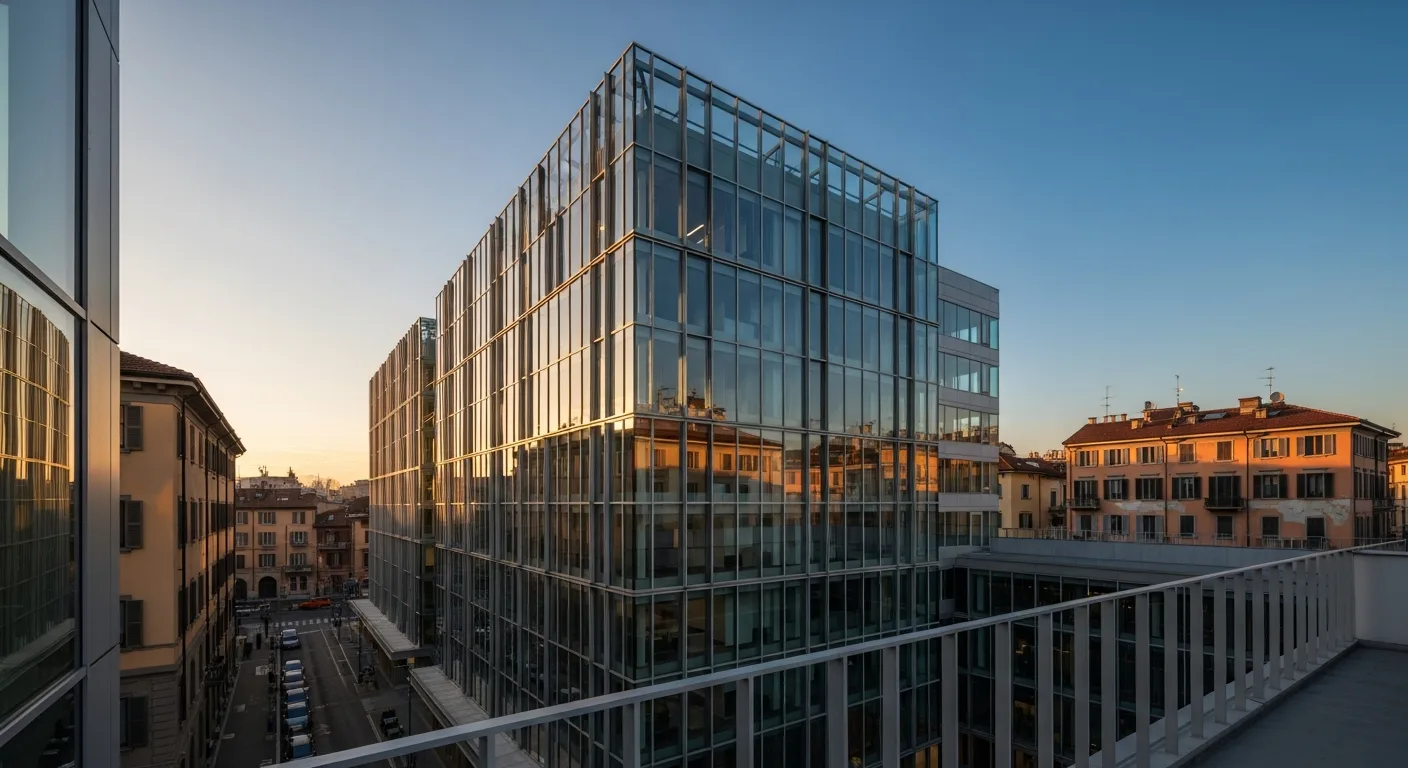
You’re sitting on the Line 9 tram, rumbling along Viale Bligny on a December morning. Outside, Milan slowly awakens – waiters set up tables in front of bars in Porta Romana, focaccia is pulled fresh from the oven at the bakery on Via Bocconi, and students in puffer jackets rush with coffee in hand towards the campus. Its modernist structure – designed by Pritzker laureates from the Irish firm Grafton Architects – rises above the rooftops like a manifesto of 21st-century architecture amidst 19th-century Milan. This is Bocconi University – a place where Europe meets Wall Street, and espresso is sipped between lectures on derivative valuation.
Bocconi isn’t “just another business school.” It’s the best business school in the European Union according to QS Rankings, number 6 in Europe in the Financial Times European Business Schools 2024 ranking, and the only Italian university that regularly appears in the global top 10 alongside Oxford, Cambridge, and HEC Paris in the categories of finance, management, and economics. Its graduates go on to Goldman Sachs, McKinsey, and the European Central Bank – yet Bocconi remains surprisingly financially accessible for international students, thanks to a progressive tuition fee system that can reduce fees to zero depending on your family’s income.
In this guide, I’ll walk you through everything: from the 1450+ SAT score requirement (yes, that’s not a typo – Bocconi has some of the highest expectations in Europe), through the three-round application process, the cost of living in Milan, the ISU Bocconi scholarship system, and even what aperitivo looks like in Navigli after a Thursday corporate finance lecture. We’ll compare Bocconi with CBS in Copenhagen and LSE in London, so you can make an informed decision. Let’s get started.
Bocconi University – Key Data 2025/2026
Source: QS World University Rankings by Subject 2025, Financial Times Rankings 2024, Bocconi Official Data
Bocconi Rankings and Reputation
Bocconi plays in a different league than most European business schools – and the rankings unequivocally confirm this. In the QS World University Rankings by Subject 2025, the university ranks 12th globally in Social Sciences & Management, 7th in Marketing (number 1 in the EU), and maintains a top 10 global position in Business & Management. This places Bocconi higher than the vast majority of European business schools – including many rivals that cost three times as much.
The Financial Times European Business Schools 2024 ranking places Bocconi at 6th in Europe – above Warwick Business School, ESCP, and Mannheim. The MBA program at SDA Bocconi ranked 3rd globally and 2nd in Europe in the FT Global MBA Ranking 2024 – just behind INSEAD. Masters in Management – 11th globally. Masters in Finance – 18th globally. These are not results achieved by chance.
What distinguishes Bocconi from its competitors is the combination of European prestige with Milanese pragmatism. Unlike LSE, which is strong in theoretical economics and politics, Bocconi focuses on a direct connection with business – Goldman Sachs, McKinsey, and BCG treat the campus on Via Sarfatti as their own recruitment hub. Unlike CBS Copenhagen, which offers free tuition but less global prestige, Bocconi costs more but opens doors at a completely different level – especially in Southern Europe, investment banking, and strategic consulting. If you’re comparing universities in Italy, Bocconi is unrivaled in business fields – the gap with Sapienza or Bologna is immense.
Bocconi Admissions Timeline 2026/2027
Three application rounds – the earlier, the better
Source: Bocconi Admissions 2025/2026. Check unibocconi.eu for exact session dates.
Bocconi Admissions – Step-by-Step
Admissions to Bocconi are handled through the My Application portal on the university’s website – it’s a dedicated platform, quite different from the British UCAS or Danish Optagelse.dk. Key feature: Bocconi conducts admissions in three rounds (Early, Winter, Spring), and each subsequent round has fewer available places and scholarships. The strategy is simple – apply as early as you can.
The evaluation of Bachelor’s (BSc) candidates is based on two elements: the admission test score (55% weighting) and the average grades (GPA) from 10th and 11th grade (45% weighting). This means your SAT or Bocconi Admission Test is more important than your school grades – which is unusual compared to most European universities but resembles the American system.
Let’s be honest about test requirements – Bocconi doesn’t joke around here. Officially, the minimum SAT is 1040 points (520 per section), but the realistic competitive threshold is 1450+. With a score below 1400, your chances drop dramatically, especially for the most popular programs like BIEM or BIEF. Bocconi is one of the universities in Europe with the highest SAT expectations – higher than Sciences Po, University of Edinburgh, or virtually any Dutch university. If you’re aiming for Bocconi, SAT preparation must be a priority – practice intensively on okiro.io, which simulates real exam conditions with an adaptive algorithm.
An alternative to the SAT is the Bocconi Admission Test – 50 multiple-choice questions (mathematics, reading comprehension, numerical reasoning, critical thinking) in 75 minutes. The test is described as “SAT-oriented,” so SAT preparation also helps here. A third option is the ACT (minimum composite 19, realistically 30+).
Language requirements: IELTS Academic 6.5 (minimum 6.0 in each section) or TOEFL iBT 88. This is a lower threshold than at CBS (7.0 IELTS) or LSE (7.0), but still requires solid preparation. Check out prepclass.io – the platform offers full TOEFL and IELTS practice tests with AI feedback, and our TOEFL vs IELTS guide will help you choose the right exam.
Step-by-step:
- Create an account on My Application – Bocconi’s application portal at unibocconi.eu
- Take the SAT (1450+) or Bocconi Admission Test – the score accounts for 55% of the evaluation. Prepare with okiro.io
- Obtain a language certificate – IELTS 6.5 or TOEFL 88. Prepare with prepclass.io
- Submit academic transcripts from 10th and 11th grade (officially translated into English)
- Pay the application fee – 100 EUR (non-refundable)
- Submit your application in the Early Session (October–November) – the best chance for a place and scholarship
Remember to check our guide on converting Polish Matura exam results – it explains how your grades translate to foreign systems. You can find more about SAT requirements at European universities in our article: What SAT Score for Study in Europe.
Bocconi Admissions Requirements – System Comparison
Polish Matura | IB | SAT – Minimum and Competitive Thresholds for 6 BSc Programs
| BSc Program | SAT (Competitive) | IB (Points) | High School GPA | IELTS / TOEFL | Difficulty |
|---|---|---|---|---|---|
| BIEM – International Economics & Management | 1450–1530 | 38–42 | Very High | 6.5 / 88 | Very High |
| BIEF – International Economics & Finance | 1450–1530 | 38–42 | Very High | 6.5 / 88 | Very High |
| BEMACS – Economics, Management & CS | 1420–1500 | 36–40 | High | 6.5 / 88 | High |
| BESS – Economic & Social Sciences | 1400–1480 | 36–40 | High | 6.5 / 88 | Medium-High |
| BIG – International Politics & Government | 1380–1460 | 35–39 | High | 6.5 / 88 | Medium-High |
| BEMACC – Arts, Culture & Communication | 1350–1450 | 34–38 | Good–High | 6.5 / 88 | Medium |
Source: Bocconi Admissions 2025/2026, indicative data. Bocconi does not publish official SAT thresholds – ranges provided are based on admitted student profiles and applicant forums.
Programs of Study – What to Study at Bocconi?
Bocconi offers eight Bachelor’s programs taught in English – from classical economics and management to artificial intelligence and international politics. This isn’t a university with just one BBA program – Bocconi deliberately diversifies its offerings, combining business with technology, social sciences, and culture. Each program lasts 3 years (180 ECTS), with the exception of WBB, which is 4 years.
BSc in International Economics and Management (BIEM) is Bocconi’s flagship program and simultaneously the most competitive course at the university. It combines macroeconomics, corporate strategy, finance, global marketing, and quantitative methods into a cohesive program preparing students for careers in strategic consulting and multinational corporations. A mandatory exchange semester at one of over 290 partner universities (including Wharton, NUS Singapore, HKU) gives the program a truly global character. BIEM is equivalent to the BSc in International Business at CBS, but with a distinctly higher entry threshold and a stronger emphasis on economics.
BSc in International Economics and Finance (BIEF) is a program for those aiming for investment banking and financial markets. Advanced microeconomics, econometrics, asset valuation, monetary policy – BIEF prepares you for Goldman Sachs and J.P. Morgan from a Bachelor’s level. If you’re considering finance at LSE or Imperial, BIEF at Bocconi is a comparable alternative in the heart of Milan and at a fraction of London’s costs.
BSc in Economics, Management and Computer Science (BEMACS) is a program at the intersection of business and technology – Bocconi’s answer to the growing demand for specialists combining data analytics with business knowledge. Programming, algorithms, machine learning, plus a solid foundation in economics and management. BEMACS graduates go into fintech, Big Tech, and business analytics. If you’re interested in data science in a business context, this program is a strong alternative to HA(it.) at CBS.
BSc in Economic and Social Sciences (BESS) combines economic theory with quantitative methods and public policy analysis. The program prepares students for careers in international organizations (World Bank, ECB, European Commission) and think tanks. If you’re considering Sciences Po or a BSc in Business & Politics at CBS, BESS offers similar interdisciplinarity but with a stronger economic foundation.
BSc in International Politics and Government (BIG) is a program in international politics, international relations, and public management – unique at Bocconi because it combines a political science perspective with the university’s business DNA. Graduates go into foreign ministries, international organizations, and public affairs. Bocconi also offers double MSc degrees with LSE and Sciences Po at the Master’s level.
BSc in Mathematical and Computing Sciences for AI (BMAI) is Bocconi’s newest program – advanced mathematics, computer science, and computational modeling for artificial intelligence. The program has a distinctly STEM character and attracts individuals who want to combine AI with business and economics knowledge. This is a response to the fact that major consulting firms are increasingly looking for people with a blend of data science and strategy.
Top 6 Bachelor's Programs at Bocconi
Source: Bocconi University, program catalog 2025/2026
Cost of Study and Living in Milan
Here, Bocconi surprises – and positively so. Although the nominal tuition fee for 2025/2026 is 16,700 EUR per year for BSc programs (18,200 EUR for MSc), Bocconi, as one of the few private universities in Europe, offers a progressive tuition fee system for EU students, dependent on family income. This means that if your family’s income falls below certain thresholds, your tuition fee can be reduced – even to zero.
The system operates through the Bocconi4Access to Education application – you fill out a form, document your family’s income (using the Italian ISEE/ISEEU parificato indicator), and Bocconi calculates your tuition fee. For families with average incomes (approximately 23,000–35,000 EUR gross annually), tuition often drops to 5,000–10,000 EUR instead of the full 16,700 EUR. For families with lower incomes – even less. This is a fundamental piece of information that many guides overlook: the full tuition fee at Bocconi is paid by a minority of EU students.
The cost of living in Milan is high, but not London-level. A realistic monthly student budget:
Accommodation is the biggest expense: a Bocconi student dormitory costs 630–680 EUR per month for a single room (approximately 2,000 places in 7 student residences – apply early!). In the private market, a room in a shared apartment costs 750–950 EUR in popular districts (Porta Romana, Navigli, Città Studi). Groceries: 200–300 EUR per month – cooking at home is affordable, and Italian discount supermarkets (Esselunga, Lidl, Eurospin) offer great quality at reasonable prices. Transport: just 22 EUR per month for an ATM student pass (metro, trams, buses) – this is one of the cheapest student transport systems in Europe. Espresso at a bar: 1.50 EUR. Takeaway pizza: 5–8 EUR. Aperitivo (drink + snack buffet): 8–12 EUR.
Total monthly cost of living (excluding tuition): 1,100–1,700 EUR. Annually, this is 13,000–20,000 EUR (plus tuition, which can range from 0 to 16,700 EUR). Compare: at LSE, tuition alone is over 24,000 GBP, plus London living costs of 1,500–2,000 GBP per month – a total annual cost exceeding 45,000 EUR. At CBS in Copenhagen, tuition is zero, but living costs (1,100–1,500 EUR) are higher than in Milan, although the Danish SU grant partially covers them. Bocconi with reduced tuition and Milanese living costs is realistically 20,000–25,000 EUR annually – a serious investment, but significantly cheaper than London.
Annual Cost of Business Studies – Bocconi vs Alternatives
Tuition + Living Costs for EU Students (Academic Year 2025/2026)
Source: Official university websites 2025/2026. Living costs – averaged estimates. 1 GBP ≈ 1.17 EUR (February 2026). Bocconi "reduced tuition" assumes an average ISU threshold (~8,000 EUR).
Scholarships and Financial Aid
Bocconi offers one of the most comprehensive financial aid systems among private universities in Europe – and for international students, this is crucial information, as it means the university’s prestige doesn’t necessarily lead to financial catastrophe.
ISU Bocconi Scholarship (Right to Study) is the main pillar of support – a social scholarship funded by the Lombardy Region budget and the university itself. It includes: full or partial tuition fee waiver, a cash scholarship of up to 8,000 EUR per year, dormitory discounts, and one free meal per day in university canteens. To qualify, you must submit the Bocconi4Access to Education application and document your family’s income (ISEE/ISEEU parificato indicator). For many families, the ISU income thresholds are achievable – it’s worth applying regardless of your situation, as the worst that can happen is a refusal.
Bocconi Scholarship for International Students – awarded automatically to the best candidates based on their application profile. It includes a full tuition fee waiver. You don’t need to submit a separate application – you are automatically considered during admissions. If your SAT exceeds 1500 and your GPA is outstanding, you have a real chance.
Bocconi Merit Award – a full tuition fee waiver awarded based on academic performance (automatically during admissions). Bocconi International Award – a 50% tuition discount for outstanding international students.
Additional options: Erasmus+ Scholarships for exchange semesters, corporate scholarships from Bocconi partner companies (especially for Specialized Masters), and national sources – programs like NAWA and the Kościuszko Foundation can partially subsidize living costs.
Key strategy: apply in the Early Session (October–November). Bocconi itself states that scholarships and tuition fee reductions are awarded “until funds are exhausted” – the earlier you submit a complete application, the greater your chances of financial support.
Bocconi vs CBS Copenhagen vs LSE London
Three Top Business/Economics Schools in Europe – Key Differences
| Criterion | Bocconi Milan | CBS Copenhagen | LSE London |
|---|---|---|---|
| Ranking (QS Business) | Top 10 (No. 1 in EU) | Top 50 | Top 5 |
| FT Europe Ranking | #6 | Top 20 | #3 |
| Tuition (EU) | 0–16,700 EUR (progressive) | 0 DKK (free) | ~24,000 GBP |
| SAT required? | Yes (1450+ competitive) | No (but strengthens application) | No |
| Acceptance rate | ~24% | ~30% | ~10% |
| Living Costs (monthly) | ~1,100–1,500 EUR | ~1,100–1,500 EUR | ~1,500–2,000 GBP |
| Student Grant | ISU: up to 8,000 EUR/year + 0 tuition | SU: ~860 EUR/month (for working) | Limited |
| Top Recruiters | Goldman Sachs, McKinsey, BCG, ECB | McKinsey CPH, Novo Nordisk, Maersk | Goldman Sachs, McKinsey, JP Morgan |
| Atmosphere | Intense, ambitious, dolce vita | Large, hygge, Fredagsbaren | Prestigious, academic, cosmopolitan |
| Best for | Finance, consulting, business in Southern Europe | Interdisciplinarity, Scandinavia, free tuition | Economics, politics, global prestige |
Source: QS Rankings 2025, Financial Times Rankings 2024, official university websites, data for 2025/2026
Bocconi vs CBS: CBS clearly wins on costs – free tuition plus the Danish SU grant is an unbeatable combination. But Bocconi wins on prestige, selectivity, and access to the global financial market. If your goal is strategic consulting at MBB (McKinsey, BCG, Bain) or investment banking in London – Bocconi opens those doors more effectively. CBS is a better choice if costs and a career in Scandinavia are priorities.
Bocconi vs LSE: LSE has a stronger global brand and is number 1 in theoretical economics. But it costs more than twice as much (post-Brexit, EU citizens pay full international fees), and London is drastically more expensive than Milan. Bocconi with reduced ISU tuition is 50–60% of LSE’s costs with comparable career prospects in continental Europe. LSE is better for a career in London; Bocconi is better for Southern Europe and the EU.
Student Life in Milan
Milan is a city that slowly wins you over – not with love at first sight like Rome or Florence, but with daily rituals that make you not want to leave after a few months. A morning espresso for 1.50 EUR at a bar on Via Bocconi, where the barista knows your name. A focaccia break at the bakery on the campus corner. An afternoon stroll along the Navigli – canals where barges once docked with marble stone for the cathedral’s construction, and today students sip Aperol Spritz for 7 EUR, sitting on stone walls.
The Bocconi campus is located in the Porta Romana district – one of Milan’s most vibrant areas, a 10-minute tram ride from the Duomo. The main building on Via Röntgen (designed by Grafton Architects, Pritzker Prize laureates 2020) is an icon of contemporary academic architecture – open spaces, light streaming through massive glass panels, terraces on every floor. The new campus south of Via Sarfatti, completed in 2019, includes SDA Bocconi, the Castiglioni dormitory, a modern sports center, and a public park.
Bocconi Library – over 600,000 volumes, one of the most important economic libraries in Europe – is open late and full of students both during and outside of exam sessions. The Bocconi Sport Center offers a gym, swimming pool, and sports fields – available to students for a symbolic fee.
Aperitivo, Navigli, and the dolce vita after lectures
Milan invented aperitivo – a tradition that has defined Italian social life after working hours since the 1960s. The rule is simple: you order a drink (Aperol Spritz, Negroni, prosecco) for 8–12 EUR and get access to a buffet of snacks – bruschetta, pasta, salami, cheese, olives. In the Navigli (canals – 10 minutes by bike from campus) and Brera districts, aperitivo starts at 6:00 PM and lasts until 9:00 PM. For a student, it’s a way to have dinner for the price of one drink. Thursday aperitivo after the last corporate finance lecture – that’s real life at Bocconi.
Districts worth exploring: Navigli – canals, bars, restaurants, street art, Milan’s most student-friendly district. Brera – galleries, cafes, Pinacoteca di Brera – the cultural heart of the city. Porta Romana – closest to campus, local atmosphere, great restaurants. Isola – hipster, with rooftop bars and street food. Città Studi – cheaper, close to Politecnico, with good access to Bocconi.
Student Organizations and International Community
Bocconi hosts over 110 student organizations – from the Bocconi Students Investment Club (preparation for case interviews) through the Marketing Society and AI & Neuroscience Student Association to the Opera Society and Wine Club. For Polish students, the Bocconi Polish Student Society is key – an organization uniting Poles at the university, organizing integration events, and supporting newcomers. Join their Facebook group even before you arrive.
As a student city, Milan has one huge advantage: geographical access to the rest of Europe. Flights from Malpensa and Linate to Polish cities (Warsaw, Krakow, Wroclaw) for 30–80 EUR with Ryanair/Wizz. Weekend trips to Lake Como (30 minutes by train), Florence (2 hours by Trenitalia), the Italian Alps (1.5 hours), or Cinque Terre (3 hours) – these are commonplace for Bocconi students.
Where Do Bocconi Graduates Go?
Top Employment Sectors and Key Employers (MSc Graduates)
Source: Bocconi Career Services, MSc Graduate Employment Reports 2024. 95.7% employed within one year of graduation.
Career Prospects – Goldman Sachs, McKinsey, and Beyond
Bocconi is a target school for major employers in Europe and beyond. McKinsey, BCG, and Bain – the “Big Three” of strategic consulting – conduct regular recruitment sessions on campus and treat Bocconi as one of their primary talent pools in Europe. Goldman Sachs, J.P. Morgan, and Morgan Stanley actively recruit from finance programs (BIEF, MSc in Finance). The European Central Bank and the European Commission are natural employers for BESS and BIG graduates.
The statistics are impressive: 95.7% of MSc graduates find employment within one year of graduation. 36.4% of them work abroad – mainly in London, Paris, Frankfurt, Zurich, and New York. MBA graduates from SDA Bocconi see a 135% salary increase within three years of graduation. The Career Services department organizes over 15 career fairs annually with 700+ employers, and the JobGate platform publishes over 10,800 internship and job offers per year.
What distinguishes Bocconi from CBS or Maastricht? Access to the Italian and Southern European luxury market – Milan is the world capital of fashion and design. BEMACC graduates go to LVMH, Gucci, Prada, and Ferragamo. The WBB program (World Bachelor in Business – 4 years across three continents: USC Los Angeles, HKUST Hong Kong, Bocconi) is one of the most prestigious BSc pathways in Europe.
As an EU citizen, after graduating from Bocconi, you can freely work throughout the Union – without additional permits. Milan, Frankfurt, Amsterdam, Paris – the doors are open. The Bocconi alumni network (Bocconi Alumni Association, founded in 1906) numbers tens of thousands of members worldwide and is one of the strongest alumni networks in Europe.
Summary – Who is Bocconi For?
Bocconi University is for those who aim high and are ready for serious admission requirements – SAT 1450+, an intensive study program, and Milanese living costs – in exchange for a diploma that opens doors to Goldman Sachs, McKinsey, and the European Central Bank. It’s not a “safe” or “cheap” option – but if your goal is a career in finance, strategic consulting, or top-tier management in Europe, Bocconi is one of the best investments you can make.
The progressive ISU tuition system makes Bocconi much more accessible than the nominal 16,700 EUR suggests. For many families, the real tuition fee is a fraction of that sum – and merit scholarships can reduce it to zero. Milan as a student city combines global prestige with an Italian lifestyle that’s hard to describe – you have to experience it.
If you’re looking for free studies with a solid reputation – check out CBS in Copenhagen. If academic prestige and London are priorities – consider LSE. But if you’re looking for the best prestige/quality/career-to-cost ratio in European business education – Bocconi is hard to beat.
Next Steps
- Score 1450+ on the SAT – this is key to Bocconi. Prepare on okiro.io, which simulates real exam conditions. Learn more about the SAT in our complete guide.
- Obtain IELTS 6.5 or TOEFL 88 – prepare with prepclass.io with AI feedback. Compare tests in our TOEFL vs IELTS guide.
- Submit your application in the Early Session (October–November) – the largest pool of places and scholarships.
- Complete the Bocconi4Access to Education application – even if you’re unsure if you qualify. The worst that can happen is a refusal.
- Apply for a student dormitory immediately after acceptance – 2,000 places for 14,000 students means time is critical.
- Learn basic Italian – “un caffè, per favore” is your first task upon arrival.
Also check out our other guides: study in Italy, Sciences Po Paris, University of Amsterdam, and our guide to studying in Europe with the SAT. Good luck – Milan awaits!