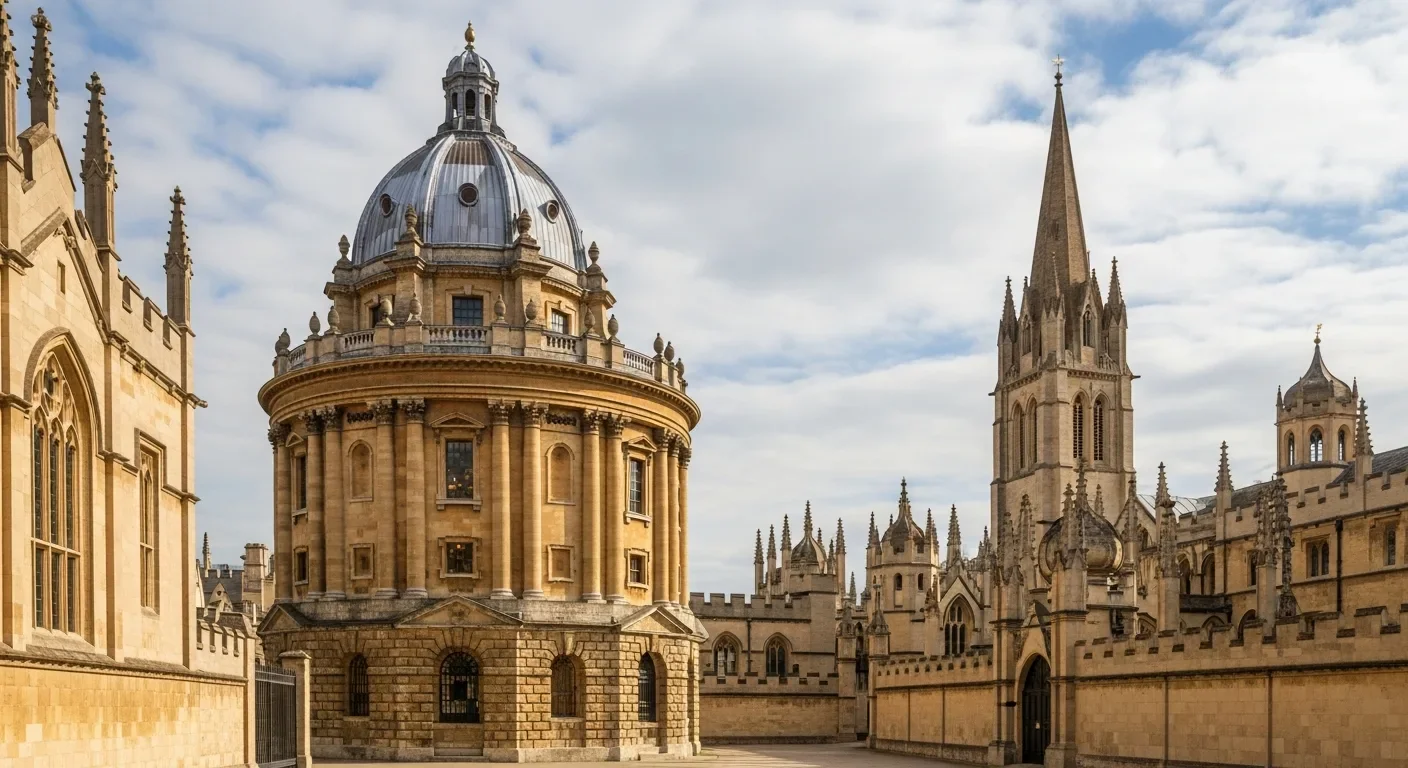


Walk east along North Street – where the medieval buildings give way and suddenly you see the sea. The wind from the North Sea carries the scent of salt and the cries of gulls, and to your right, a stone pier stretches out, where students in red academic robes stroll every Sunday. To your left; the ruins of a 12th-century cathedral, once the largest church in Scotland, overlooking East Sands Beach, where hundreds of people run into the icy water at dawn on the first of May. This isn’t a set from a period drama. This is the University of St Andrews – an institution founded in 1413, the third oldest in the English-speaking world, and the only one in the UK that regularly dethrones Oxford and Cambridge in national rankings.
St Andrews is a place full of paradoxes. The town has a population of just 20,000, over half of whom are students; yet its graduates go on to Goldman Sachs, McKinsey, and NATO. The university awards a Master of Arts degree instead of a Bachelor’s – but not because it’s a master’s program; it’s a tradition dating back to the 15th century when Scottish universities simply called their undergraduate degree by that name. It’s where Prince William and Kate Middleton met, where students avoid stepping on the initials of a Protestant burned at the stake, engraved in the pavement (because stepping on them brings bad luck), and the Guardian University Guide 2025 named St Andrews the best university in the UK; above Oxford, above Cambridge, above Imperial. For an international student seeking a world-class education in surroundings that feel more like a Harry Potter scene than a typical campus – St Andrews is an option that’s hard to ignore.
In this guide, I’ll walk you through everything: from admission requirements for national secondary school leaving exams (like the Polish Matura), through costs (and ways to reduce them), the Scottish 4-year degree model, the strongest courses, right up to the legendary traditions and the realities of life in a seaside town where you can walk everywhere in 15 minutes. If you’re also considering other UK universities, compare them with our guides to Oxford, Cambridge, and Edinburgh; but first, find out why St Andrews can be a better choice than any of them.
University of St Andrews – Key Statistics 2025/2026
Source: University of St Andrews, Guardian University Guide 2025, QS World University Rankings 2025
Rankings and Reputation – Why St Andrews Dethrones Oxbridge
For several years, the University of St Andrews has been achieving results that, a decade ago, seemed impossible for a university outside the Oxbridge group. In the Guardian University Guide 2025 – a ranking that measures student satisfaction, value added, spending per student, and employment prospects; St Andrews secured an unprecedented 1st place in the UK, surpassing both Oxford and Cambridge. This wasn’t a one-off surge: St Andrews has consistently ranked in the top 3 in this guide since 2021.
In the QS World University Rankings 2025, St Andrews is positioned at #96 globally. At first glance, this might seem modest – but it’s important to understand the context. QS favors large research universities with a broad spectrum of disciplines and multi-billion-pound research budgets. For an intimate institution with just 10,500 students, smaller than many large secondary schools – being in the global top 100 is an impressive achievement. For comparison: the University of Edinburgh, which has over 35,000 students, ranks #27; but the ratio of teaching quality to university size is significantly better at St Andrews.
In Times Higher Education, St Andrews consistently ranks in the global top 100, with exceptional results in student experience and teaching quality categories, where it regularly outperforms Oxbridge. In the Complete University Guide, it holds a stable top 3–5 position in the UK, with leading positions in Philosophy (#1 in UK), International Relations (#1 in UK), Physics (top 5), and Computer Science (top 10).
What truly sets St Andrews apart? The student-faculty ratio – there’s an average of 11 students per professor, meaning you won’t get lost in a lecture hall of 300. Seminars in groups of 8–15, direct access to research staff, and an atmosphere of intellectual community that you feel from day one; this experience is closer to Cambridge than any other university in the UK, but without the college system, interviews, and the pressure that comes with the Oxbridge name. Student satisfaction at St Andrews is one of the highest in the UK – regularly above 90% in the National Student Survey.
St Andrews Admissions Timeline 2026/2027
UCAS System – Key Dates for International Applicants
Source: UCAS, University of St Andrews Admissions 2025/2026
Admissions Step-by-Step – UCAS and the Scottish Degree Model
Admissions to St Andrews go through the central UCAS (Universities and Colleges Admissions Service) system; it’s similar to centralized application systems in many countries, but covers all universities in the UK and allows you to apply for a maximum of 5 programs simultaneously (at different universities or the same one). The application fee is just £28 – regardless of how many choices you make.
Before we delve into the details, you need to understand one fundamental difference: the Scottish 4-year degree system. In England and Wales, undergraduate degrees typically last 3 years and culminate in a Bachelor of Arts (BA) or Bachelor of Science (BSc). In Scotland, they last 4 years; and at St Andrews, they conclude with a Master of Arts (MA) or Master of Science (MSci/MPhys). This is not a master’s degree in the traditional sense; it’s a tradition dating back to the 15th century when Scottish universities simply called their undergraduate degree by that name. The Scottish MA is formally equivalent to an English BA, though the name certainly sounds more impressive on a CV.
This 4-year system has a huge advantage that no English university offers: flexibility. For the first two years (known as sub-honours), students can choose modules from various fields – philosophy, history, physics, computer science; before specializing in one or two subjects in their third year (honours). This means that if you apply for International Relations but discover a passion for Philosophy in your first year, you can change your course without losing a year. This system resembles the American liberal arts model – and is one of St Andrews’ biggest advantages over English universities, where you are assigned to a single course from day one.
The UCAS process is as follows:
- Register on UCAS Hub (September–January); you create an account, fill in personal details, education, and choose up to 5 programs.
- Personal Statement – a motivational essay (max 4,000 characters), common to all choices. This is an absolutely crucial part of the application, as St Andrews does not conduct interviews for most courses (Medicine is an exception).
- Reference; a teacher or school counselor submits a recommendation directly through UCAS.
- Predicted grades – your school provides your predicted national secondary school exam results.
- Offer; St Andrews issues a conditional offer (dependent on your exam results) or an unconditional offer.
- Confirmation – after your exam results in July/August, the offer is confirmed or withdrawn.
Key deadline: January 29; this is the deadline for all courses except Medicine (October 15). St Andrews is not Oxbridge – it is not subject to the October deadline, which gives you a few extra months to prepare your application. It also does not conduct interviews; the decision is based on your academic assessment, Personal Statement, and reference. This simplifies the process, but also means your PS must be truly strong, as you don’t get a second chance to make an impression.
Prepare for IELTS or TOEFL with prepclass.io – the platform offers full practice tests with AI feedback, which will help you achieve the required minimum score. You can find more about comparing tests in our TOEFL vs IELTS guide. And if you’re unsure how to convert your national secondary school exam results to the UK system, start with our guide on grade equivalencies.
St Andrews Admission Requirements – System Comparison
Polish Matura | IB | A-levels – Minimum Requirements for 6 Most Popular Courses
| Course | Polish Matura (Extended Level) | IB (Points) | A-levels | IELTS | Difficulty |
|---|---|---|---|---|---|
| International Relations | 85–90% in 3 Extended Level subjects | 36–38 | AAA | 7.0 (min 6.5) | High |
| Computer Science | 85–95% (incl. Extended Maths) | 36–38 | AAA (incl. Maths) | 6.5 (min 6.0) | High |
| Physics / Mathematics | 85–95% (incl. Extended Maths + Physics) | 36–38 | AAA (incl. Maths/Physics) | 6.5 (min 6.0) | High |
| Philosophy | 82–90% in 3 Extended Level subjects | 36–38 | AAA–AAB | 7.0 (min 6.5) | Medium-High |
| History | 80–88% in 3 Extended Level subjects | 36–38 | AAA–AAB | 7.0 (min 6.5) | Medium-High |
| Marine Biology | 80–88% (incl. Extended Biology/Chemistry) | 34–36 | AAB–ABB | 6.5 (min 6.0) | Achievable |
Source: University of St Andrews Admissions 2025/2026 entry, UCAS. Indicative equivalencies – requirements may vary year to year.
Courses of Study – What to Study at St Andrews
St Andrews is a university with a surprisingly broad spectrum of disciplines – from International Relations, through Quantum Physics, to Marine Biology. But a few courses stand out not only in the UK but across Europe; and it is these that attract students from over 140 countries.
International Relations is undeniably St Andrews’ flagship course and one of the best in the world. The IR department was founded in 1919 – as the first in the world; and for over a hundred years, it has educated diplomats, politicians, and analysts. The QS ranking regularly places it in the global top 10 for Politics & International Studies. Graduates work at NATO, the UN, Foreign Ministries of many countries, leading think tanks (Chatham House, IISS, Brookings), and organizations such as the EU or the World Bank. If you dream of a career in diplomacy or international security, St Andrews competes directly with LSE and Sciences Po – with the difference that it offers a much more intimate environment.
Philosophy at St Andrews is top 3 in the UK and top 50 in the world in QS rankings. The department is particularly strong in analytical philosophy, logic, philosophy of mind, and epistemology. A unique feature: St Andrews offers joint degrees in Philosophy & Economics and Philosophy & Psychology, which combine deep philosophical reflection with practical analytical skills. Seminars in groups of 8–12 people mean that professors know you by name; something you won’t experience in the Philosophy department at UCL with its 300-person lectures.
Computer Science at St Andrews is consistently in the top 10 in the UK (Complete University Guide), with a strong emphasis on artificial intelligence, human-computer interaction, and systems programming. The intimate size of the department – around 400 undergraduate students; means direct contact with research staff and easier access to research projects from the first year. CS graduates from St Andrews go on to Google, Amazon, Microsoft, startups, and further PhD research at MIT or Stanford.
Physics and Astronomy is one of St Andrews’ strongest science departments, with particular strengths in photonics, condensed matter physics, astrophysics, and theoretical physics. Students have access to modern laboratories and the university’s astronomical observatory. Results in the Research Excellence Framework (REF) – the main UK audit of scientific research – place the department in the top 10 in the UK.
History offers extraordinary depth in medieval history (which, in the context of a university founded in 1413, should come as no surprise), Scottish history, history of religion, and colonial history. Students have access to the university’s archival collections – manuscripts and documents dating back to the 15th century. The department regularly ranks in the top 10 in the UK and boasts an exceptionally strong student-faculty ratio.
Marine Biology; this is a course that takes on particular significance in the context of St Andrews. The university is located directly on the North Sea, and the Scottish Oceans Institute (SOI) – run jointly with the University of Dundee; is one of Europe’s leading marine research centers. Students conduct fieldwork on the local coast, in the Firth of Tay, and in the Orkney Islands. If marine biology is your passion, it’s hard to find a better location in Europe.
Top 6 Courses at the University of St Andrews
Source: QS Subject Rankings 2025, Complete University Guide, Research Excellence Framework 2021
Cost of Study and Living – What St Andrews Really Costs
After Brexit, students from Poland (and other EU countries) are treated as international (overseas) students – meaning you pay the same tuition fees as applicants from the USA, China, or Australia. This is a fundamental change compared to the situation before 2021, when EU citizens studying in Scotland paid no tuition fees at all.
Tuition fees at St Andrews for the academic year 2025/2026 are:
- Arts and Social Sciences courses: ~£28,350 per year
- Science courses: ~£33,000 per year
- Medicine: ~£33,000–£38,000 per year (6-year program)
For a 4-year degree program (remember; the Scottish model is one year longer than the English one), the total tuition cost is £113,400–£132,000 (approximately €133,800–€155,800 or $144,000–$167,600). This amount is comparable to Imperial College London or UCL – with the difference that living costs in St Andrews are significantly lower than in London.
And this is where St Andrews starts to look favorable compared to London universities. The town, with a population of 20,000, has no underground, no expensive districts, and none of the temptations of big city life. You can walk everywhere in 15–20 minutes, meaning zero transport costs. Rent for a room in student halls of residence or a shared flat costs £500–700 per month; compared to £800–1,400 in London. Weekly groceries at Tesco or Aldi are £30–40. A pint in a pub costs £3.50–£5.00. This isn’t London – and in this case, that’s an advantage.
Annual Student Budget at St Andrews (Arts)
Humanities/Social Sciences – Academic Year 2025/2026, in GBP (£)
Source: University of St Andrews Fee Schedule 2025/2026, Student Services, own estimates. (Approximate conversions: 1 GBP ≈ 1.18 EUR, 1 GBP ≈ 1.27 USD).
Scholarships and Financial Aid
Let’s be honest; the cost of studying at St Andrews for an international student after Brexit is high. But the university is aware of this and offers a range of financial support opportunities. However, it’s important to realistically assess your chances: a full scholarship is exceptionally difficult to obtain, and most students fund their studies through a combination of partial scholarships, family savings, and part-time work.
St Andrews Global Scholarship is the university’s most prestigious scholarship – it covers full tuition + living costs for the entire duration of studies. It is awarded to a dozen or so students annually from around the world, making it extremely competitive. To receive it, you need outstanding academic results, a strong Personal Statement, and distinguished extracurricular activities.
The International Excellence Award is a more realistic option; a tuition fee reduction of £3,000–£5,000 per year, awarded based on academic merit and renewable annually provided good results are maintained. This won’t cover everything, but over 4 years, it offers savings of £12,000–£20,000 (approximately €14,160–€23,600 or $15,240–$25,400).
School-specific Scholarships – individual departments (Schools) offer their own scholarships. The School of Computer Science, School of Physics and Astronomy, and School of International Relations have dedicated funds for the best international candidates. It’s worth contacting the department directly; not all options are advertised on the university’s main website.
Among external scholarships, consider: GREAT Scholarships (a UK program supporting students from selected countries, including Poland), and grants from organizations like the Kosciuszko Foundation. At a later stage – if you plan to pursue postgraduate studies, the Chevening program offers full funding for studies in the UK.
Also remember that a Student Visa allows you to work up to 20 hours per week during term time and full-time during holidays. In St Andrews, earning opportunities are more modest than in London – mainly cafes, golf hotels, on-campus work as a tutor; but £8–12/hour x 15 hours per week amounts to £120–180 weekly, which covers a significant portion of living costs.
St Andrews vs Edinburgh vs UCL
Three Popular UK Universities – Key Differences for International Students
| Criterion | St Andrews | Edinburgh | UCL London |
|---|---|---|---|
| UK Ranking (Guardian) | #1 | #14 | #9 |
| QS Ranking (World) | #96 | #27 | #9 |
| Acceptance Rate | ~8% | ~40% | ~15% |
| Number of Students | 10,500 | 35,000+ | 42,000+ |
| Intl. Tuition (Arts/year) | £28,350 | £26,500 | £28,500 |
| Duration of Study | 4 years (MA) | 4 years (MA) | 3 years (BA) |
| Living Costs (monthly) | £810–1,210 | £1,000–1,540 | £1,400–2,300 |
| Atmosphere | Intimate, traditional, seaside | Metropolitan, vibrant, festival-driven | Metropolitan, cosmopolitan, intense |
| Strongest Courses | IR, Philosophy, Physics, CS, Marine Bio | Medicine, AI, Literature, Linguistics | Architecture, Medicine, Economics, Law |
| Vibe | Harry Potter meets Scottish Highlands | Historic, yet vibrant | London cosmopolitanism |
Source: Guardian University Guide 2025, QS Rankings 2025, official university websites, data for 2025/2026
St Andrews vs Edinburgh: Both universities are in Scotland and offer a 4-year MA model – but the similarities end there. Edinburgh is a large city university with 35,000 students, world-class research in Medicine and AI, and the atmosphere of a vibrant, festival-filled city. St Andrews is an intimate counterpoint: 10,500 students, a seaside town, first-name relationships with professors, and significantly higher student satisfaction than in Edinburgh. If you’re looking for metropolitan intensity, choose Edinburgh. If you prefer intimacy and depth – St Andrews.
St Andrews vs UCL: UCL offers London; careers in the City, access to every industry, and the anonymity of a 42,000-student university. St Andrews offers the opposite – a town where everyone knows each other, but with surprisingly strong alumni networking and recruitment by top firms. The key difference: UCL is a 3-year BA, St Andrews is a 4-year MA; a year longer, but with a “master’s” title and flexibility in choosing your course.
Student Life – Traditions That Exist Nowhere Else
Student life at St Andrews is absolutely unique in the UK – and probably in Europe. The combination of medieval traditions, the intimate atmosphere of a small town, and a seaside location creates an experience you won’t replicate anywhere else.
Let’s start with what you see from day one: Red Gowns. First-year students; traditionally known at St Andrews as bejants (men) and bejantines (women) – receive scarlet academic robes, which they wear to lectures, to chapel, and for formal events. This tradition dates back to the 15th century; St Andrews is the only university in the UK outside Oxbridge where students regularly wear gowns. In their third year, the gowns turn black, and in their fourth – they return to red, but with an added velvet trim. When you see a line of students in red walking down North Street, you feel that this university takes its history seriously.
Raisin Weekend is St Andrews’ most iconic (and wildest) tradition. The academic parents system assigns “academic parents” to each first-year student; older students who act as mentors. Raisin Weekend (usually in October/November) is when this system explodes: “parents” organize parties for their “children,” who must wear absurd costumes and perform even more absurd tasks. The culmination is a massive foam fight on St Salvator’s Quad – hundreds of students covered in shaving foam, in costumes, shouting with laughter. It looks like madness, and it is madness – but it’s also one of the strongest community-building mechanisms at any university in the world.
Pier Walk; every Sunday after the service, students in full academic robes stroll along the medieval stone pier in the harbor. This tradition has continued unbroken for hundreds of years. When you stand at the end of the pier with a view of the North Sea, accompanied by dozens of people in red gowns, and the wind tugs at the fabric – you understand why St Andrews alumni are so loyal to their alma mater.
May Dip; on the first of May at dawn (around 5:00–6:00 AM), hundreds of students run into the icy North Sea at East Sands Beach. The water in May is 8–10°C – it’s not for the faint of heart. But tradition says that the May Dip symbolizes purification before exam season and brings academic good luck. After the swim; hot tea, blankets, and breakfast with friends. It’s one of those experiences you talk about for a lifetime.
And then there’s PH – the initials of Patrick Hamilton, a Protestant martyr burned at the stake in front of St Salvator’s College in 1528, engraved in the pavement. Every St Andrews student learns from day one: do not step on PH, or you’ll face academic bad luck. The only remedy is a swim in the sea during the May Dip. Absurd? Perhaps. But when you see 10,000 intelligent people avoiding the same patch of pavement, you’ll understand the power of tradition in this place.
Beyond traditions: St Andrews has over 150 student clubs and societies – from the Debating Union (one of the oldest in the UK), through theatre, choirs, to the Whisky Society and Cheese Society. Sport is an integral part of life; The Old Course (the world’s oldest golf course, 15th century) is literally around the corner, and students get discounted entry. Rowing, rugby, football, sailing, and – surprisingly, surfing at East Sands are also popular.
The weather? Let’s be honest – wind from the North Sea, rain, and short winter days are commonplace from November to March. But the Scottish summer (May–August) can be stunningly beautiful, and the dramatic landscapes of the coast, cliffs, beaches, and castle ruins – make up for every rainy day. St Andrews is 80 km from Edinburgh (1.5 hours by bus), and from Edinburgh Airport, Ryanair and Wizz Air fly directly to Poland.
Where Do St Andrews Graduates Go?
94% of graduates employed or in further education within 15 months
Source: University of St Andrews Careers Centre, Graduate Outcomes Survey 2024. Indicative data based on alumni surveys.
The St Andrews alumni network is one of the most loyal in the UK; in a small community, bonds are deeper, which translates into real career support. Many companies run dedicated recruitment programs at St Andrews, and the university’s Careers Centre actively helps with CV preparation, cover letters, and mock interviews. Upon graduation, you are eligible for a Graduate Visa – a 2-year post-study work visa in the UK (with no restrictions on industry). If you’re considering business studies in continental Europe instead of the UK, also check out CBS in Copenhagen, where tuition fees for EU citizens are €0, or our general guide to studying in the UK.
Summary – Who is St Andrews For?
The University of St Andrews is not for everyone – and that is its greatest strength. If you’re looking for a metropolitan lifestyle, thousands of students in your department, and the anonymity of a large university; choose UCL or King’s College London. If your priority is a global name on your CV and a college system – apply to Oxford or Cambridge.
But if you’re looking for a university that combines a #1 position in UK rankings with world-class teaching in an intimate environment, surrounded by dramatic Scottish coastline and traditions spanning over 600 years; St Andrews might be the best choice you make. It’s a place where professors know you by name, where your academic parents will drag you to a foam fight in October, and where you’ll run into the icy sea at dawn in May with hundreds of friends. This isn’t a typical university experience – this is the St Andrews experience.
Next Steps
- Check the requirements on the St Andrews website for your chosen course; pay attention to required extended-level subjects and grade thresholds.
- Take IELTS (6.5–7.0) or TOEFL (90–100) – prepare with prepclass.io, where you’ll find full practice tests with AI feedback. Compare tests in our TOEFL vs IELTS guide.
- Write a compelling Personal Statement – focus on your passion for your chosen subject, not just the university. 80% of your PS should be about academic interests, 20% about extracurricular activities.
- Submit your application via UCAS by January 29 (Medicine: October 15).
- Check available scholarships, including the International Excellence Award, school-specific scholarships, and GREAT Scholarships.
- Prepare for your national secondary school exam results – a conditional offer requires you to meet the thresholds. Check our guide to grade equivalencies.
Also check out our other guides to UK universities: Edinburgh, Warwick, Manchester, and our general guide to studying in the UK. If you’re also considering the SAT exam as an additional application component, practice on okiro.io. Good luck – and perhaps we’ll see you on the Pier Walk in a red gown.