
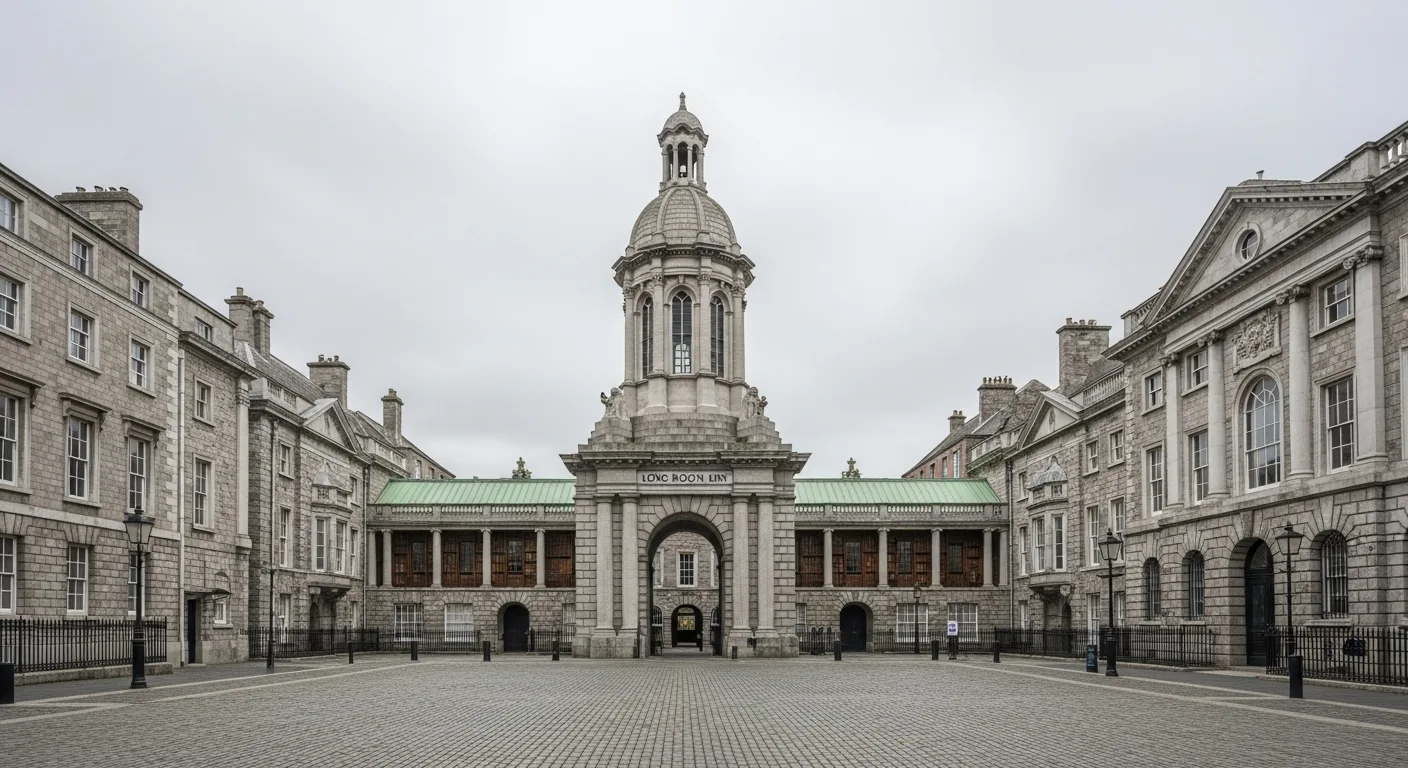
You pass through the stone gate at College Green, leaving Dublin’s traffic and double-decker buses speeding towards O’Connell Street behind you. Two steps, and you’re in another world: the cobbled Front Square, a Georgian campanile in the center, dark green lawns on both sides, and a silence as if someone turned down the city’s volume by fifty percent. To your left stands the Old Library, where on the upper floor, the Long Room, one of the most beautiful libraries on Earth, houses 200,000 of the university’s oldest volumes and the legendary Book of Kells, a 9th-century illuminated manuscript visited by over a million tourists annually. To your right, towards the Hamilton Building, computer science students return from workshops at the ADAPT Centre, where yesterday Google presented its latest research project in natural language processing. This is Trinity College Dublin, the university where Oscar Wilde wrote his first sonnets, Samuel Beckett began his path to the Nobel Prize, and Ernest Walton split the atom.
For an EU secondary school graduate looking for English-taught studies in the European Union, TCD is an offer that’s hard to beat. It’s a university ranked in the world’s top 100 (QS #81), the only Irish member of the prestigious LERU (League of European Research Universities: alongside Oxford, Cambridge, and ETH Zurich), with EU tuition fees around ~3,000 EUR per year, no visa required, full right to work from day one, and a location in Europe’s tech capital – where Google, Meta, Apple, Microsoft, and Stripe have their European headquarters literally a few minutes’ walk from campus. Compare this to a Russell Group university in the UK, where tuition is 9,250 GBP per year (over 40,000 PLN), you need a visa costing 490+ GBP, and you can work a maximum of 20 hours per week.
In this guide, I’ll walk you through everything: from the CAO system and converting the Polish Matura exam, through program-specific requirements, the cost of living in Dublin (which, I won’t hide, is expensive), scholarships, all the way to student life and career prospects. If you’re interested in studying in Ireland more broadly, read our guide to studying in Ireland. And if you want to compare TCD with UK universities, we have guides on the University of Edinburgh, King’s College London, and the University of Manchester.
Trinity College Dublin – Key Data 2025/2026
Source: Trinity College Dublin Official Data, QS World University Rankings 2025
Rankings and Reputation – Ireland’s Only University in the World’s Elite
Trinity College Dublin is the only university in Ireland that consistently ranks in the world’s top 100. In the QS World University Rankings 2025, TCD holds the 81st position globally, with a significant lead over the second Irish university, University College Dublin (#126). In the Times Higher Education 2025 ranking, Trinity is placed in the global top 150, and in the Academic Ranking of World Universities (ARWU), it’s in the top 200. This position is comparable to universities like the University of Bristol, the University of Glasgow, or the University of Warwick – with the key difference that TCD costs several times less.
In subject-specific rankings, TCD stands out particularly strongly. English Language and Literature is a traditional domain of Trinity: the university ranks in the world’s top 30 in QS Subject Rankings, which is no surprise given that Wilde, Beckett, Swift, and Stoker all hailed from here. Computer Science is placed in the top 100, supported by the ADAPT research center, one of Europe’s leading hubs for AI and natural language processing. Law, also in the global top 100, boasts a strong common law tradition and a European perspective. Humanities as a whole are in the world’s top 50. And Drama and Theatre Studies – in the top 50, with its own theatre named after Samuel Beckett.
A key element of TCD’s reputation is its membership in LERU (League of European Research Universities) – Trinity is the only Irish representative in this prestigious group, alongside Oxford, Cambridge, ETH Zurich, University of Paris, and Heidelberg University. This isn’t just a decorative badge in a recruitment brochure: LERU membership means access to the latest research projects, academic exchanges, and funding that are not available to universities outside the network. If you’re also considering LERU universities in other countries, check out our guides on ETH Zurich and KU Leuven.
TCD Admissions Timeline 2026/2027
CAO System – Step-by-Step for International Applicants
Source: CAO (Central Applications Office), Trinity College Dublin Admissions 2025/2026
Admissions Step-by-Step – The CAO System for International Applicants
Admissions to Trinity College Dublin are processed through the CAO (Central Applications Office), Ireland’s central admissions system, equivalent to the UK’s UCAS. Every applicant for undergraduate studies in Ireland, regardless of nationality, applies through the same portal. The system is straightforward to use but has a few nuances worth knowing before you start.
As an EU citizen, you apply to CAO under the same rules as Irish nationals. You register on cao.ie, select up to 10 programs at any Irish university (not just Trinity), and rank them in order of preference. The system awards places based on CAO points, a maximum of 625, calculated from your 6 best examination results. For Irish students, points come from the Leaving Certificate; for you, from your converted Polish Matura exam. The application fee is 30 EUR for the normal entry route (by February 1) or 45 EUR for the late entry route (by March 1).
Key advice: submit your application by February 1, but don’t treat your program choices as final. The CAO system offers an excellent Change of Mind option – until May 1, you can change the order of your preferences or add entirely new programs, without additional fees. This means you can submit your application in February and then calmly reconsider your priorities over the next three months. No other admissions system in Europe offers you such flexibility.
Converting the Polish Matura exam to CAO points is a topic that causes the most stress among international applicants, but it’s simpler than it seems. The system takes your 6 best results from the advanced-level Matura exam and assigns them equivalents to Irish Higher Level grades. Approximate conversions are as follows: a score of 90–100% corresponds to H1 (100 CAO points), 80–89% to H2 (88 points), 70–79% to H3 (77 points), and 60–69% to H4 (66 points). The maximum is 600 points from 6 subjects plus 25 bonus points for higher-level mathematics (if you achieve at least H6/O6) – totaling 625. You can find more about how to accurately convert your results in our guide to the Polish Matura exam and studying abroad.
Trinity requires documented English language proficiency. Standard requirements are IELTS Academic 6.5 (minimum 6.0 in each section) or TOEFL iBT 90. Cambridge C1 Advanced (176 points) and Duolingo English Test (115 points) are also accepted. Some programs, especially Law, Medicine, and clinical courses, may require higher scores. If you’re preparing for IELTS or TOEFL, the prepclass.io platform offers full practice tests with AI feedback. Also, check out our TOEFL vs IELTS guide to choose the exam that suits you best.
TCD Admission Requirements – System Comparison
Polish Matura | IB | A-levels – Indicative Thresholds for 6 Most Popular Programs
| Program | CAO Points (Threshold) | Polish Matura (Advanced Level) | IB (Points) | A-levels | Difficulty |
|---|---|---|---|---|---|
| Computer Science | 500–550 | 80–90% in 6 subjects | 34–37 | AAB–AAA | High |
| Law | 530–560 | 85–93% in 6 subjects | 35–38 | AAA | High |
| Business Studies (BBS) | 480–520 | 78–88% in 6 subjects | 33–36 | ABB–AAB | Medium-High |
| Engineering | 450–500 | 75–85% in 6 subjects | 32–35 | ABB–AAB | Medium |
| Drama & Theatre Studies | 480–520 | 78–88% in 6 subjects | 33–36 | ABB–AAB | Medium-High |
| English Literature | 450–500 | 75–85% in 6 subjects | 32–35 | ABB–AAB | Achievable |
Source: CAO Points Statistics 2024/2025, Trinity College Dublin Admissions. Thresholds change annually – treat as indicative.
Study Programs – What to Study at Trinity?
Trinity offers over 100 undergraduate programs across 24 academic schools, grouped into three faculties: Arts, Humanities & Social Sciences; Engineering, Mathematics & Science; and Health Sciences. This is not a single-subject university: TCD boasts strength in a surprisingly wide range of disciplines, from Computer Science and Engineering to Literature, Law, and Medicine.
Computer Science is a program that has become one of the most sought-after in all of Ireland in recent years, and for good reason. Trinity is home to the ADAPT Centre, a leading European research hub focused on artificial intelligence, natural language processing, and data analysis. ADAPT collaborates directly with Google, Microsoft, Huawei, and dozens of startups, meaning that as a student, you have access to research projects at an absolutely world-class level. This four-year BSc offers specialization options in AI, cybersecurity, or software engineering, boasts a graduate employment rate exceeding 95% within 6 months, and right outside your window: Dublin’s Silicon Docks, with the European headquarters of Google, Meta, LinkedIn, and Stripe. The CAO threshold is 500–550 points, so you’ll need strong Matura exam results, but if you have them, it’s one of the best options for computer science in the English-speaking EU.
Trinity Business School (TBS) is a relatively young but dynamically developing business school with full Triple Crown accreditation (AACSB, EQUIS, AMBA) – only about 1% of business schools worldwide hold this triple accreditation. Its flagship program is Business Studies and a Language (BBS), a 4-year program combining finance, marketing, and management with intensive foreign language learning (French, German, Spanish, and even Polish), including a mandatory year abroad. If you’re interested in business studies on the continent, it’s worth comparing TBS with Copenhagen Business School (free tuition for EU students, but in Denmark) and Maastricht University (Problem-Based Learning in the Netherlands).
Medicine at Trinity (MB BCh BAO) is a 5-year program conducted in collaboration with St James’s Hospital, Ireland’s largest clinical hospital. The program is one of the most prestigious in the country, with a strong research tradition in biomedical sciences. Note: admission to Medicine requires not only high CAO points (730+), but also passing the HPAT-Ireland (Health Professions Admission Test), a specific Irish aptitude test. EU tuition for Medicine is higher than for other programs – approximately 16,000 EUR/year.
Law – Trinity Law School consistently ranks among the top 100 law schools worldwide. The LLB program lasts 4 years and combines Irish common law with a European and international perspective. CAO thresholds reach 530–560 points, making Law one of the most competitive programs at TCD. Graduates go on to major law firms in Dublin (Arthur Cox, A&L Goodbody, McCann FitzGerald), as well as European institutions and corporations.
Drama and Theatre Studies is a program that distinguishes Trinity across Europe. The university has its own Samuel Beckett Theatre, a long theatrical tradition dating back to Wilde and Beckett, and its alumni include many renowned Irish actors and directors. It ranks in the top 50 worldwide in QS Subject Rankings.
Engineering (BAI) at Trinity lasts 5 years, including a built-in MSc, and offers specializations in mechanical, electronic, civil, and biomedical engineering. The university has strong ties to the pharmaceutical industry (Pfizer, Medtronic have factories in Ireland) and the technology sector (Intel, Analog Devices). The CAO threshold is 450–500 points, lower than for CS or Law, making engineering an excellent option for a solid, though not necessarily top-tier, secondary school graduate.
Trinity College Dublin's Strongest Departments
Source: QS World University Rankings by Subject 2025, Trinity College Dublin
Cost of Study and Living in Dublin
Let’s be honest: Dublin is expensive. It’s one of the priciest cities in Europe, comparable to Amsterdam and Munich, cheaper than London and Zurich, but definitely more expensive than cities like Krakow or Warsaw. However, the EU tuition at Trinity is low enough that the overall cost of study still compares favorably to the UK.
As an EU citizen meeting the conditions of the Free Fees Initiative (EU/EEA citizenship and a minimum of 3 years of residency in the EU out of the last 5, which an EU secondary school graduate living in an EU country automatically fulfills), you do not pay the actual tuition fees. The only mandatory expense is the Student Contribution, approximately 3,000 EUR per year. This is an administrative fee, not tuition in the strict sense. For Medicine, EU tuition is higher, around 16,000 EUR/year. For comparison: at UCL or Imperial College London, tuition for international students (and after Brexit, Polish students pay as international) is over 25,000 GBP per year – ten times more.
Living costs in Dublin are definitely the largest expense. Accommodation dominates the budget: a room in a private apartment costs 800–1,200 EUR per month, while TCD dorms (Trinity Halls in Dartry) are 500–800 EUR. The housing market in Dublin is extremely tight, so apply for a dorm place immediately after receiving an offer. Food, 250–400 EUR per month if you cook at home (Lidl, Aldi, and Tesco Value will be your best friends). Transport – 80–120 EUR with a Student Leap Card, which offers discounts on Dublin Bus, the Luas tram, and DART rail. Health insurance – as an EU citizen, you can use your EHIC (European Health Insurance Card) for free. A realistic total monthly budget is 1,300–1,800 EUR (5,600–7,800 PLN).
Annual Cost of Study at TCD – EU Student
Tuition + Living Costs in Dublin (Academic Year 2025/2026)
Source: Trinity College Dublin 2025/26, Numbeo Dublin. Exchange rate 1 EUR ≈ 4.31 PLN (January 2026). Living costs are for a 9-month academic year.
Over a 4-year program (TCD offers 4-year BA/BSc degrees, unlike the 3-year ones in England and Wales), the total cost is 61,000–92,000 EUR (263,000–397,000 PLN). Is that a lot? Compare it to LSE, where tuition alone for 3 years is 72,000 GBP (plus London living costs: totaling over 120,000 EUR), or to Imperial College, where the situation is similar. Trinity for 4 years costs less than LSE for 3 – and you get to study in the EU, visa-free, with full work rights.
Scholarships and Financial Support
Trinity College Dublin offers several scholarship programs, but – let’s be honest – most EU students do not receive a scholarship. EU tuition is already heavily subsidized by the Irish government, so the main scholarships target students with absolutely outstanding academic results or individuals from low-income backgrounds.
Trinity Scholars (Foundation Scholarship) is the most prestigious distinction a TCD student can receive. It’s not awarded upon entry: you take special Scholarship Examinations after your first year (typically in February/March) and must achieve outstanding results. The reward, however, is spectacular: free on-campus accommodation for the rest of your studies, complimentary meals in the College Dining Hall (Commons), the title “Scholar” (one of the highest honors at Trinity – scholars have voting rights in university governance), and exemption from fees. Annually, about 60–80 students across the university achieve Scholar status: the competition is intense, but for an ambitious student, it’s a goal worth striving for.
The Global Business Scholars Programme is a Trinity Business School scholarship that partially or fully covers tuition fees, with access to exclusive networking events and mentorship. It requires a strong academic and leadership profile – you apply after being admitted to TBS.
The SUSI Grant (Student Universal Support Ireland) is an Irish government grant for which EU citizens may qualify if they meet income and residency requirements. SUSI covers the Student Contribution (3,000 EUR) and can provide an additional grant for living costs; however, qualification typically requires several years of residency in Ireland, which is difficult for a recent secondary school graduate from another EU country to meet. Nevertheless, it’s an option worth knowing about for the future.
Among external programs, it’s worth checking NAWA (the Polish National Agency for Academic Exchange), the Educational Enterprise Foundation (FEP), and the Kronenberg Foundation – these Polish foundations offer grants for studying abroad, although the amounts rarely cover full costs. Realistically: plan your budget without a scholarship and treat any potential funding as a bonus.
Trinity College Dublin vs UCD vs University of Edinburgh
Prestigious English-Speaking University in EU vs UK – Key Differences
| Criterion | Trinity (TCD) | UCD Dublin | Edinburgh (UK) |
|---|---|---|---|
| QS Ranking 2025 | #81 | #126 | #27 |
| EU Tuition/year | ~3,000 EUR | ~3,000 EUR | ~£9,250 (as intl: £26,000+) |
| Visa for EU Citizens | No – EU | No – EU | Yes – Student Visa (£490+) |
| Right to Work | Unlimited (EU) | Unlimited (EU) | Max 20h/week |
| BSc/BA Duration | 4 years | 3–4 years | 4 years (Scotland) |
| Location | Dublin City Centre | Belfield (South Dublin) | Edinburgh City Centre |
| Strong Programs | CS, Law, Humanities, Medicine | Business, Veterinary, Architecture | Computer Science, Medicine, Linguistics |
| Tech Sector in City | Silicon Docks: Google, Meta, Apple | Access to Silicon Docks (20 min) | Strong, but smaller than Dublin |
| Atmosphere | Traditional, prestigious, compact | Large, dynamic, modern | Historic, academic, festival-rich |
| Best for | EU prestige + tech + low costs | Program diversity, large campus | Highest ranking, if you can afford UK |
Source: QS Rankings 2025, official university websites, data for 2025/2026
TCD vs UCD: University College Dublin is larger (~35,000 students), has a modern campus with better sports facilities, and a stronger business school (Smurfit). Trinity wins on prestige (#81 vs #126), city-center location, and strength in humanities, law, and computer science. EU tuition is identical. If you value tradition and a compact campus, Trinity. If you’re looking for a large university with the widest range of programs, UCD.
TCD vs Edinburgh: University of Edinburgh ranks higher (#27 vs #81), but after Brexit, EU students pay international tuition there, over £26,000 per year instead of 3,000 EUR. The cost difference is astronomical. If ranking is your only criterion and budget is not an issue, Edinburgh. If you’re looking for the best value for money among English-speaking universities – Trinity wins overwhelmingly.
Student Life in Dublin
Trinity’s campus spans 47 acres right in the heart of Dublin, adjacent to the famous College Green: it’s as if someone carved out a piece of an 18th-century English university and placed it in the middle of a bustling city. Historic grey stone buildings, cobbled courtyards, a campanile, green lawns where students lounge with laptops on sunny days (yes, Dublin does have sunny days) – and all it takes is a walk through the gate to find yourself on Grafton Street, the main shopping thoroughfare, with street musicians and crowds of tourists.
The Long Room Library is a place that gives even students with no particular interest in libraries a thrill. A 65-meter-long gallery, an arched ceiling, 200,000 of the university’s oldest volumes arranged on mahogany shelves reaching the ceiling, marble busts of philosophers on both sides. Nearby: the Book of Kells Exhibition with the 9th-century illuminated manuscript, visited by over a million tourists annually. The Science Gallery Dublin, a unique gallery at the intersection of science and art, the only one of its kind in Ireland. The Samuel Beckett Theatre, home to TCD Drama, featuring professional productions. The Hamilton Building – a modern complex for science and computer science.
Trinity boasts over 170 student organizations (societies and clubs), two of which are absolutely legendary. The Phil (Trinity College Dublin Philosophical Society), founded in 1684, is the oldest debating society in the world, having hosted speakers such as Barack Obama, Desmond Tutu, Noam Chomsky, and Salman Rushdie. The Hist (Historical Society), founded in 1770, is the second oldest. Membership in both is open to all students and provides fantastic practice in public speaking, argumentation, and networking. Beyond debates: Trinity Ents (the largest entertainment organization, concerts, and festivals), DU Players (a theatre with professional productions), Trinity News (Ireland’s oldest university newspaper), over 50 sports clubs under DUCAC, and finally, the Polish Society, an active Polish student society at Trinity.
Dublin itself is a fascinating city. Temple Bar, the famous entertainment district with pubs playing live music (Dublin has one of Europe’s most vibrant music scenes: home to U2, The Cranberries, Hozier). Silicon Docks, a district along the River Liffey, a 10-minute walk from campus, where Google, Meta, LinkedIn, Stripe, Airbnb, and HubSpot have their European headquarters: ideal for students seeking internships. Dublin is also a UNESCO City of Literature (Joyce, Wilde, Yeats), featuring the Abbey Theatre (the world’s oldest national theatre), the National Gallery, and the St. Patrick’s Festival. And if you miss home – Ryanair and Wizz Air fly from Dublin to Warsaw, Krakow, Wroclaw, and Gdansk for 20–50 EUR, a 2.5-hour flight.
Where Do Trinity Graduates Go?
Top Employment Sectors and Key Employers
Source: Trinity College Dublin Career Services, Graduate Outcomes Survey 2024. Indicative data.
As an EU citizen, you have the full right to work in Ireland without any restrictions – you don’t need a permit, and there’s no limit on hours. The minimum hourly wage in Ireland is 12.70 EUR/h (as of 2025), meaning that part-time work for 15–20 hours a week can bring in 700–1,000 EUR per month: enough to cover a significant portion of your living costs. Many international students at Trinity work in the tech sector (Google, Meta, and LinkedIn have offices literally next to campus), in hospitality, retail, or as tutors.
Frequently Asked Questions
Summary – Is Trinity College Dublin Worth It?
Trinity College Dublin is a university that combines 433 years of academic tradition with a position at the heart of Europe’s tech capital. For an EU secondary school graduate, TCD offers a combination that is unique on the continent: the prestige of a world top 100 university, EU tuition fees of 3,000 EUR/year, studies entirely in English, no visa required, full right to work, and direct access to Silicon Docks – the district where Google, Meta, Apple, Microsoft, LinkedIn, and Stripe have their headquarters. No other university in the EU offers such a combination of prestige, language, and access to the tech job market in one package.
Dublin is expensive; there’s no doubt about that. But compare the total cost of 4 years at Trinity (61,000–92,000 EUR) with 3 years at a comparable UK university (100,000+ EUR including tuition, visa, NHS surcharge, and restricted work rights), and the calculation becomes clear. If you’re seeking the absolute highest prestige regardless of cost, Oxford and Cambridge are in a different league. But if you’re looking for the best value for money among English-speaking universities in Europe, Trinity is one of the best options you have.
Next Steps
- Register on CAO – cao.ie, deadline February 1 (normal entry) or March 1 (late entry)
- Check requirements for your specific program – tcd.ie/study
- Take IELTS (6.5) or TOEFL (90) – prepare with prepclass.io, which offers full practice tests with AI feedback
- Get your documents officially translated into English (Matura exam + certificate)
- Read about Matura exam conversion – our guide to the Polish Matura exam and studying abroad
- Look for accommodation immediately after acceptance – Trinity Halls or daft.ie
Also check out our other guides: studying in Ireland, studying in the UK, Copenhagen Business School, and University of Amsterdam. Good luck!
Last updated: February 8, 2026. Information on requirements, costs, and deadlines may change – always verify on the official Trinity College Dublin website (tcd.ie).