

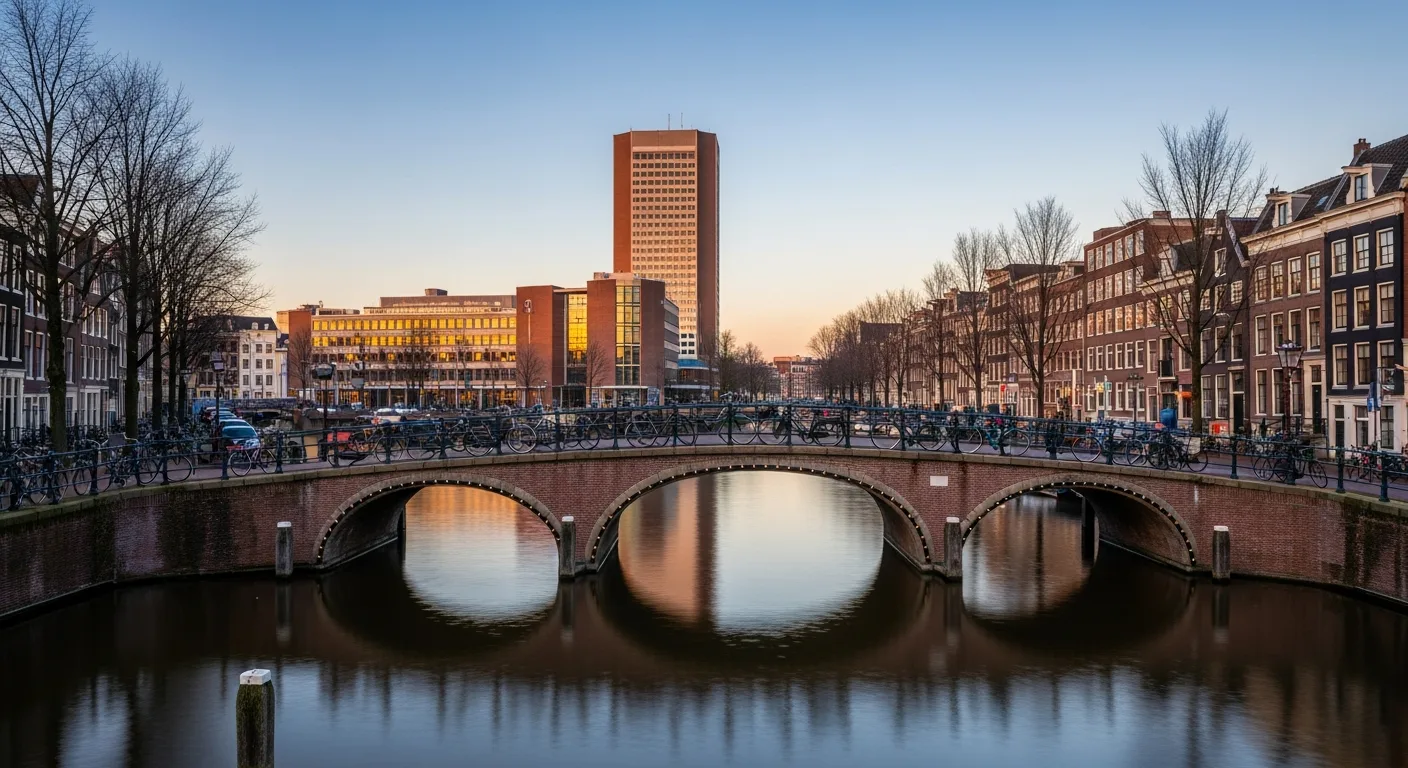
You’re standing on a bridge over the Singel canal in the morning. Dozens of bikes whiz past you – students with backpacks, coffee cups in handlebar holders, laptops and textbooks in their baskets. To your left, you see the Munttoren tower from 1620; to your right, the floating Bloemenmarkt flower market, the only one of its kind in the world. Just around the corner, in the Bushuis building on Kloveniersburgwal, a Communication Science lecture is about to begin – a program that ranks first in the world in the QS rankings. This isn’t a postcard from a tourist guide. This is an ordinary Monday at the University of Amsterdam.
UvA is a university seemingly full of paradoxes. It’s one of Europe’s oldest universities – founded in 1632 as the Athenaeum Illustre when Amsterdam was a global trade hub – yet simultaneously one of the continent’s most progressive and innovative research centers. It’s home to over 39,000 students, making it the largest university in the Netherlands, yet its campuses, spread along the canals, maintain a human scale and intimacy often lacking in many mega-universities. As a member of the prestigious LERU (League of European Research Universities – alongside Cambridge, Oxford, and ETH Zurich), UvA offers top-tier research, but tuition fees for EU citizens are just €2,601 per year – a fraction of what you’d pay in the UK.
In this guide, I’ll walk you through everything you need to know about UvA: from the admissions system via Studielink and the matching procedures, to the requirements for the Polish Matura exam, the cost of living in Amsterdam (let’s be honest – it’s not a cheap city), scholarships, and the Dutch student finance system (Studiefinanciering), all the way to student life amidst canals, bikes, and brown cafes. If you’re also interested in other Dutch universities, check out our guide to studying in the Netherlands with SAT. And if you’re weighing Amsterdam against other European destinations, you’ll find comparisons with Maastricht University, KU Leuven, and Copenhagen Business School later in this article.
University of Amsterdam – Key Data 2025/2026
Source: University of Amsterdam, QS World University Rankings 2025, THE World University Rankings 2025
UvA Rankings and Reputation
The University of Amsterdam consistently maintains its position among the top European research universities. In the QS World University Rankings 2025, UvA ranks 53rd globally – making it the highest-ranked general university in the Netherlands (TU Delft, with its engineering focus, is the only Dutch university ranked higher overall). In the Times Higher Education World University Rankings 2025, UvA is in the top 65, and in the Shanghai Academic Ranking of World Universities (ARWU), it consistently holds a spot in the top 100 – confirming its global research strength.
However, it’s the subject rankings that truly showcase UvA’s dominance. In Communication and Media Studies, UvA has consistently ranked first in the world in the QS by Subject rankings for years – surpassing USC, LSE, and Stanford. This is no coincidence – the Amsterdam School of Communication Research (ASCoR) is one of the most important media research centers on the planet. In Linguistics, UvA ranks in the top 20 globally, in Sociology – top 25, in Psychology – top 30, and in Economics and Econometrics – in the top 50. The rising position of the Computer Science and Artificial Intelligence department (top 75 and rapidly improving) reflects Amsterdam’s status as a European AI hub – home to Google DeepMind, Qualcomm AI Research, and hundreds of tech startups.
Membership in LERU (League of European Research Universities) – a network comprising Europe’s strongest research universities, alongside Cambridge, Oxford, Heidelberg, and ETH Zurich – further confirms UvA’s position in the academic premier league. This is not a university resting on historical reputation – UvA consistently invests in new buildings (the Roeterseiland Campus has undergone extensive modernization), young researchers, and English-taught programs that attract increasing talent from around the globe.
UvA Admissions Timeline 2026/2027
Two types of programs – numerus fixus and open enrollment
Source: Studielink.nl, University of Amsterdam Admissions 2025/2026
UvA Admissions – Studielink and Matching Step-by-Step
Admissions to the University of Amsterdam are processed through the central Dutch platform Studielink (studielink.nl) – it’s similar to centralized application systems in other countries, but it covers all universities in the Netherlands. The system is relatively straightforward, provided you understand two key concepts: matching and numerus fixus. Unfamiliar with these terms? Everything will become clear shortly.
On Studielink, you can apply for a maximum of 4 programs simultaneously – at different universities or at the same one. After submitting your application on Studielink, you must also complete the required documents on the UvA admissions portal (this is a separate step – Studielink itself does not collect all necessary documents). The Dutch system is two-tiered: registration on Studielink plus a full application directly on the university’s website.
Most programs at UvA use a matching procedure (studiekeuzecheck). This is not an entrance exam and does not eliminate candidates – it’s a mandatory informational event where you participate in a trial lecture, complete a motivational questionnaire, and receive advice (binding or non-binding) on whether the program suits your profile. Matching is mandatory – if you do not participate, your application will not be considered. However, the matching outcome itself usually does not eliminate candidates. It’s more of an orientation tool to help you make an informed decision.
The situation is quite different for numerus fixus programs – those with a limited number of places and a full selection procedure. At UvA, numerus fixus applies to PPLE (Politics, Psychology, Law and Economics – approx. 300 places), Psychology (English-taught track), Medicine, and Dentistry, among others. For these programs, the deadline is January 15, and selection involves academic grades, motivational tests, essays, and/or interviews. Competition is real – PPLE receives several thousand applications for 300 places.
The practical path for an EU candidate looks like this:
- Create a Studielink account – as an EU citizen, you can log in via eIDAS or create an account directly.
- Choose your programs (max. 4) and submit your application on Studielink.
- Complete your documents on the UvA portal – Matura certificate (or predicted results), language certificate, motivation letter (for selective programs).
- Participate in the matching procedure or selection procedure (numerus fixus).
- Submit your Matura results once received.
- Confirm your acceptance and sign up for UvA Intro Week.
A language certificate is a crucial element: UvA requires IELTS Academic 6.5 (min. 6.0 in each component) or TOEFL iBT 92 (min. 22 in each component) for most programs. Some – such as Communication Science – have a higher threshold: IELTS 7.0 or TOEFL 100. Prepare with prepclass.io, which offers full practice tests with AI feedback. You can find more about choosing between TOEFL and IELTS in our TOEFL vs IELTS guide.
Also, remember to check our guide on converting Polish Matura exam results – our separate guide explains how your grades translate to foreign systems, including the Dutch one.
UvA Admission Requirements – System Comparison
Polish Matura | IB | A-levels – indicative requirements for 6 popular programs
| Program | Polish Matura (extended level) | IB (points) | A-levels | Mathematics | Difficulty |
|---|---|---|---|---|---|
| PPLE | 80–95% from extended level | 36–38 | AAB–AAA | Extended Math recommended | High |
| Psychology (EN) | 75–90% from extended level | 34–36 | ABB–AAB | Math A (basic OK) | High |
| Economics & Business Econ. | 70–85% from extended level | 32–35 | BBB–ABB | Math B (extended level) | Medium |
| Communication Science | 70–80% from extended level | 32–34 | BBB–ABB | Not required | Medium |
| Artificial Intelligence | 75–90% from extended level | 34–36 | ABB–AAB | Math B (extended level) + Physics | Medium-High |
| Political Science | 65–80% from extended level | 30–34 | BBC–BBB | Not required | Achievable |
Source: UvA Admissions 2025/2026. Indicative equivalents – requirements may change annually. PPLE and Psychology are numerus fixus programs with full selection.
UvA Programs – What to Study?
The University of Amsterdam offers over 30 English-taught Bachelor’s programs – one of the broadest selections in continental Europe. This isn’t a single-specialty university – UvA has seven faculties covering humanities, social sciences, natural sciences, law, economics, medicine, and computer science. However, a few programs stand out and deserve detailed discussion.
PPLE – Politics, Psychology, Law and Economics is UvA’s flagship interdisciplinary program, modeled after the PPE programs known from Oxford and LSE, but expanded to include psychology and law. Over three years, you study four disciplines simultaneously, choosing one main specialization in your second year. PPLE attracts students from dozens of countries – with approximately 300 places and several thousand applications, this program is one of the most competitive in the Netherlands. Graduates go into consulting, international organizations, think tanks, law firms, and public administration. If you’re comparing it to PPE at Sciences Po, remember the cost difference – UvA is €2,601/year versus Sciences Po with higher tuition and higher living costs in Paris.
Communication Science is UvA’s absolute pride – number 1 in the world in the QS by Subject rankings. The Amsterdam School of Communication Research (ASCoR) is one of the most important media and communication research centers on the planet. The program examines the impact of media on society, persuasive communication, journalism, digital marketing, and UX research. Language requirements are elevated (IELTS 7.0 or TOEFL 100), reflecting the intensive nature of the program. Graduates work in media, marketing, public relations, research, and UX design – for companies ranging from Philips and Heineken to advertising agencies and international newsrooms.
Economics and Business Economics combines solid economic theory with business applications. UvA has one of the strongest economics departments in continental Europe, with a particular emphasis on econometrics, behavioral finance, and economic policy. The program requires mathematics at an advanced level (Dutch Math B). Graduates go into banking, consulting, financial institutions, and the public sector – with Amsterdam Zuidas (the Dutch Wall Street, literally around the corner) serving as a natural pool of employers.
Artificial Intelligence at UvA is one of Europe’s oldest and most recognized AI programs – launched even before artificial intelligence became a buzzword. Amsterdam is a European AI hub: Google DeepMind, Qualcomm AI Research, Booking.com, and hundreds of startups create an ecosystem where UvA graduates are sought after from day one. The program covers machine learning, computer vision, natural language processing, robotics, and the philosophy of AI. It requires mathematics and physics at an advanced level.
Psychology (English-taught track) is one of the largest and best psychology programs in Europe, with an emphasis on a scientific and methodological approach. Specializations include clinical psychology, social psychology, developmental psychology, brain and cognition, and work psychology. As a numerus fixus program, it requires passing a selection procedure – but EU candidates with good academic results and strong motivation have a realistic chance.
Computational Science combines computer science, mathematics, and scientific modeling – ideal for those interested in data science, computer simulations, and computational sciences. Political Science offers an international perspective on political relations, and Actuarial Science is one of the few programs of its kind in Europe – excellent for mathematicians interested in finance and insurance.
Top 6 English-Taught Programs at UvA
Source: University of Amsterdam, program catalog 2025/2026, QS World University Rankings by Subject 2025
Cost of Studying and Living in Amsterdam
Let’s be honest upfront – Amsterdam is not a cheap city. It’s one of the most expensive in Europe, comparable to Copenhagen and Munich, though still more affordable than London or Zurich. However, tuition fees for EU citizens are surprisingly accessible, and the Dutch allowance system can significantly lighten your financial burden.
Statutory tuition fees (wettelijk collegegeld) for EU/EEA citizens are €2,601 per year for the academic year 2025/2026. This is one of the most attractive tuition levels in Western Europe – for comparison, a year of study in the UK costs over £9,250 (approx. €11,000), and in the USA, $30,000–$60,000. As an EU citizen with a valid passport or ID card, you are entitled to the EU rate – this is the only document required.
For non-EU/EEA students, institutional tuition fees range from €11,400 (humanities and social sciences programs) to €17,900 (AI, Computational Science, exact sciences) per year. The exact amount depends on the chosen program and faculty.
Where’s the real challenge? In living costs – specifically, rental prices. A room in a shared apartment is €700–€950/month, a studio €950–€1,200. UvA dorms (if you get a spot – and competition is fierce) cost €450–€750. The housing market in Amsterdam is extremely tight, and frankly, it’s the biggest stress factor when studying here. I’ll write more about housing search strategies in the student life section.
Groceries and food will cost €250–€350/month if you cook at home and use discount supermarkets (Albert Heijn Basic, Lidl, Aldi). Student canteens (mensa) offer inexpensive lunches for €5–€8. Transport? The bicycle is king – you can buy a used one for €50–€150, and it will cover 90% of your needs. An OV-chipkaart for tram and metro is about €100/month, but most students simply cycle. Mandatory health insurance costs about €130/month – but if you work (even part-time), you can reclaim most of this through the zorgtoeslag allowance.
Annual Cost of Studying – UvA vs European Alternatives
Tuition + living costs for EU students (academic year 2025/2026)
Source: Official university websites 2025/2026. Living costs – averaged estimates. £1 ≈ €1.17 (February 2026). PLN exchange rate: €1 ≈ PLN 4.28.
Scholarships and Funding
Studiefinanciering – The Dutch Student Support System
This information could change your budget by €200–€300 per month. As an EU citizen working in the Netherlands for at least 56 hours per month (approx. 14 hours per week), you qualify for the Dutch Studiefinanciering (DUO) system. This includes: a free OV public transport card (studenten OV-chipkaart – unlimited public transport on weekdays or weekends, your choice), a student loan on preferential terms (with very low interest, repayment after studies), and a potential supplementary grant depending on income.
But that’s not all. By working legally, you can apply for zorgtoeslag – a healthcare allowance of up to approx. €120/month (which practically covers the cost of mandatory health insurance). If your rent doesn’t exceed approx. €880 and your income is low, huurtoeslag (housing allowance) can provide an additional €100–€200/month. In total, these allowances can reduce your actual living costs by €250–€400 per month – a difference that makes Amsterdam, from being expensive, become achievable.
Amsterdam Merit Scholarship
The most accessible UvA scholarship for EU students is the Amsterdam Merit Scholarship – partial tuition coverage (€1,000–€5,000) or, in exceptional cases, full tuition. It is awarded based on academic results and a motivation letter. The number of scholarships is limited – a few dozen per year – but it’s worth applying, as the EU tuition cost is relatively low, and even a partial scholarship makes a difference.
Amsterdam Excellence Scholarship (AES)
A prestigious scholarship intended exclusively for non-EU students – full tuition + €12,500 for living costs annually. EU candidates (as EU citizens) do not qualify, but it’s worth knowing about if you have non-EU friends interested in UvA.
Holland Scholarship
A national Dutch scholarship for non-EEA students – €5,000 one-time for the first year. Similar to AES, it’s intended for non-EU students. EU students do not qualify.
Other Options for Polish Students
Beyond Studiefinanciering and the Amsterdam Merit Scholarship, Polish candidates may consider: NAWA (National Agency for Academic Exchange) – mobility programs and scholarships for studying abroad (for Polish citizens); Fundacja Edukacyjna Przedsiębiorczości (FEP) – scholarships for talented Polish students; Erasmus+ programs – if you start at a Polish university, you can undertake an exchange at UvA. However, for most Polish students at UvA, the key source of funding is a combination of part-time work + Studiefinanciering + allowances – this realistically covers the lion’s share of costs.
Student Jobs in Amsterdam
As an EU citizen, you have the full right to work in the Netherlands without any time restrictions. The minimum hourly wage in the Netherlands is one of the highest in Europe – approx. €13.68/hour (for those 21+, data for 2025). Popular student jobs include: barista, waiter, shop assistant, office assistant, tutoring, call center work (for those with Dutch language skills). Many AI and computer science students find paid internships at tech companies – Amsterdam has a huge advantage here over smaller cities.
UvA vs Leiden vs Erasmus Rotterdam
Three top Dutch research universities – key differences
| Criterion | UvA Amsterdam | Leiden University | Erasmus Rotterdam |
|---|---|---|---|
| QS Ranking 2025 | #53 | #67 | #176 |
| EU Tuition | €2,601/year | €2,601/year | €2,601/year |
| Number of students | ~39,000 | ~33,000 | ~30,000 |
| English-taught BSc programs | 30+ | 15+ | 10+ |
| Strengths | Media, AI, PPLE, Psychology | Law, Political Science, Archaeology | Economics, Business (RSM), Medicine |
| City | Amsterdam – cosmopolitan, expensive | Leiden / The Hague – intimate, cheaper | Rotterdam – modern, cheaper |
| Cost of living (monthly) | ~€1,300 | ~€1,000 | ~€1,050 |
| Atmosphere | Big-city, international, liberal | Academic, intimate, historical | Modern, business-oriented, practical |
| Graduate job market | Very strong (tech, media, consulting) | Strong (law, government, diplomacy) | Very strong (finance, business, logistics) |
| LERU Membership | Yes | Yes | No |
Source: QS World University Rankings 2025, official university websites, data for 2025/2026
UvA vs Leiden: Leiden University is the oldest university in the Netherlands (1575) and holds undeniable prestige in law, political science, and archaeology. If your goal is a career in diplomacy, government administration, or international institutions – The Hague (where Leiden has a campus) is a natural environment. UvA wins on Amsterdam’s big-city atmosphere, a broader English-taught offering, and its standing in media, communication, and AI. Living costs in Leiden are significantly lower, which is important for a three-year budget.
UvA vs Erasmus Rotterdam: Rotterdam School of Management (RSM) is an absolute leader in business and economics in the Netherlands – if you dream of a career in finance or consulting, RSM is a direct competitor. UvA offers a wider range of programs and life in Amsterdam, which is a decisive argument for many students. Rotterdam is cheaper and has a more “business-oriented” atmosphere.
UvA vs Maastricht University: Maastricht is renowned for its Problem-Based Learning (PBL) method – learning in small groups instead of traditional lectures. If you prefer an interactive teaching style and a smaller city near the Belgian and German borders, Maastricht is an excellent choice – with lower living costs. UvA offers a traditional lecture-based model (with elements of group work) and the unparalleled offerings of a big city.
Student Life in Amsterdam
Amsterdam is a city that will change your perception of daily life. Let’s start with the foundation that defines this metropolis more than canals, tulips, or museums: the bicycle. In Amsterdam, there are 881,000 bicycles for 900,000 residents – and these numbers don’t lie. Bike paths are wide, smooth, with separate traffic lights. When you cycle along Herengracht to the Roeterseiland Campus in the morning, passing 17th-century canal houses and boats moored along the quays, you begin to understand why people simply don’t want to leave. You can buy a used bike for €50–€150 on Marktplaats (the Dutch equivalent of eBay Classifieds) – and it will be your best investment for three years of study.
UvA’s campuses are scattered throughout Amsterdam, giving studies here an urban rather than a claustrophobic campus feel. Roeterseiland – a modern complex after extensive renovation – is the main center for social sciences, with a library, cafes, and group study spaces. Science Park Amsterdam – east of the city center – is a hub for exact sciences, computer science, and AI, directly adjacent to Google, Booking.com, and dozens of startups (AI and computer science students won’t have to look far for internships). The humanities buildings at Bushuis and Oudemanhuispoort (with a 16th-century cloister where students sit with laptops among antique stalls) blend history with daily learning in a way you won’t experience anywhere else.
Studieverenigingen – The Heart of Student Life
Every program at UvA has its own studievereniging – a student association that organizes guest lectures, orientation trips, career fairs, parties, and academic excursions. Joining a studievereniging is absolutely crucial – it’s where you make friends, build your network, and meet the people you’ll spend the next three years with. For economists, there’s SEFA; for psychologists, ASVA; for political science students, Machiavelli; for communication scientists, Negen Maanden Tijd. Membership fees are usually €15–€30/year – definitely the best investment in your social life.
ESN Amsterdam (Erasmus Student Network) organizes events for international students: trips around the Netherlands, cultural evenings, quiz nights, and weekend trips to Bruges, Brussels, or Cologne. The Polish student community in Amsterdam is active – it’s worth joining Facebook groups even before you arrive.
Sports at UvA are a separate category – USC (University Sports Centre) offers memberships for approx. €150–€200/year for the gym, swimming pools, team sports, yoga, dance, martial arts, and dozens of other activities. The Dutch are crazy about field hockey, rowing, and football – but you’ll find a team for practically every discipline here.
Accommodation – The Biggest Challenge and How to Tackle It
I won’t sugarcoat it – finding accommodation in Amsterdam is the most challenging part of the entire process. The rental market is one of the toughest in Europe. Here are a few proven strategies:
Firstly, apply for UvA dorms immediately after receiving your acceptance – UvA reserves places for international students, but the pool is limited. Secondly, register on ROOM.nl (a student room platform) as early as possible – waiting times can be months. Thirdly, consider areas surrounding Amsterdam – Diemen, Amstelveen, Zaandam offer lower prices and good transport links (15–20 minutes by metro or bike). Fourthly, join Facebook and Reddit groups dedicated to accommodation hunting. And fifthly – absolutely never pay rent before personally viewing the apartment. Rental scams in Amsterdam are unfortunately common – if an offer looks too good to be true, it most likely isn’t.
Amsterdam Beyond Campus
Neighborhoods worth exploring: De Pijp – bohemian, with Albert Cuyp Market (the cheapest street food in the city), bars, and cafes; Jordaan – charming, with narrow canals and vintage shops; Oost – multicultural, with Oosterpark and increasingly popular among students; Noord – a former peripheral industrial area across the IJ, now a hipster hub with NDSM Wharf, film festivals, and lofts; Centrum – touristy, but with iconic spots like Vondelpark (Amsterdam’s Central Park), the Rijksmuseum, and the Van Gogh Museum.
Amsterdam is a city that encourages exploration – canals (400 km!), hidden courtyards (hofjes), brown cafes (bruine kroegen) with hundreds of years of history, and the Waterlooplein antique market. Within a two-hour train ride, you have Rotterdam, The Hague, Utrecht, Delft, and Den Bosch. Low-cost airlines from Schiphol can get you to Warsaw in 2 hours, and a weekend in Barcelona or Berlin is a matter of €100–€150.
Where Do UvA Graduates Go?
Top employment sectors and key employers
Source: UvA Career Services, graduate employment reports. Indicative data based on alumni surveys and LinkedIn.
Amsterdam Zuidas – the financial district, home to the Dutch “Wall Street” – is literally a 15-minute bike ride from UvA’s campuses. ING, ABN AMRO, Adyen, Flow Traders, Optiver – these are companies that actively recruit from UvA. In the tech sector, Google, Booking.com, Uber, Netflix, and hundreds of startups create a job market where computer science and AI graduates have the luxury of choice. And if you want to stay in the Netherlands after your studies, the orientation year visa (zoekjaar) gives you 12 months to find a job after graduation.
If you’re planning exam preparation before applying, check out prepclass.io for TOEFL and IELTS practice with AI feedback, and if you need the SAT – okiro.io offers practice tests and exercises. Although UvA does not require the SAT from EU candidates, a good score can strengthen your profile for selective programs.
Summary – Who is UvA For?
The University of Amsterdam is a university for those who want to combine world-class academics with life in one of Europe’s most fascinating cities. UvA is not the most expensive option, nor the cheapest – it’s optimal. For €2,601 in annual tuition, you gain access to a top 55 QS university, a global leader in communication and media, one of Europe’s oldest AI programs, and over 30 English-taught Bachelor’s degrees. Add to that the Dutch allowance system, which genuinely lowers living costs, the right to work without restrictions, and a job market where there’s a shortage of labor from Zuidas to Science Park – and you get an offer that’s hard to beat in terms of value for money.
UvA isn’t for everyone. If you’re looking for an intimate, smaller university with a university town atmosphere – Maastricht or Leiden would be a better fit. If your goal is exclusively top-tier business and finance – RSM Rotterdam or CBS Copenhagen (with free tuition and Danish SU!) deserve consideration. If you dream of British prestige – UCL or Edinburgh are options, though at a significantly higher price. But if you’re looking for a comprehensive research university in a city that never gets boring – with programs ranging from AI to PPLE, from psychology to actuarial science, in an environment where the bicycle is king, canals are your route to campus, and multiculturalism isn’t just a slogan but a daily reality – UvA is one of the best choices you have in Europe.
Next Steps
- Check the requirements at uva.nl/en/programmes – pay attention to the January 15 deadline for numerus fixus programs.
- Register on Studielink and begin the application process – studielink.nl.
- Take IELTS (6.5+) or TOEFL (92+) – prepare with prepclass.io, which offers full practice tests with AI feedback. More about choosing a test can be found in our TOEFL vs IELTS guide.
- Read our guide on converting Polish Matura exam results – you’ll learn how your grades translate to the Dutch system.
- Compare UvA with Maastricht University and other universities in our guide to studying in the Netherlands.
- Start looking for accommodation immediately after acceptance – register on ROOM.nl and apply for UvA dorms.
- Buy a bike upon arrival – it will be your best investment in Amsterdam.
Also check out our other guides to European universities: Copenhagen Business School, KU Leuven, Sciences Po Paris, Trinity College Dublin, and ETH Zurich. Good luck!
Last updated: February 8, 2026. Information on tuition fees, requirements, and deadlines may change – always verify the data on the official University of Amsterdam website (uva.nl).