
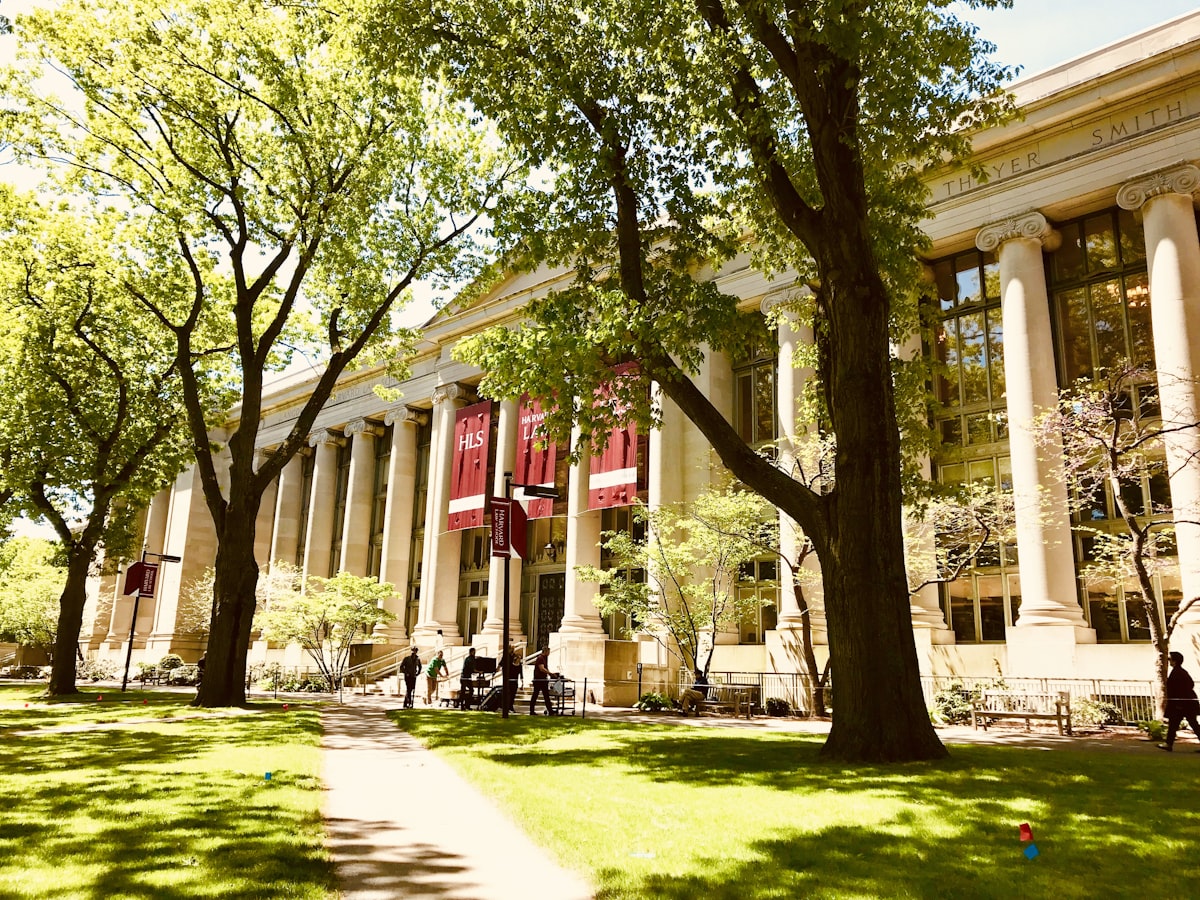
An October morning in Cambridge, Massachusetts. The leaves on the trees along the Charles River have transformed into an explosion of red, gold, and brown – the kind of autumn you’ve seen in American movies but never truly believed existed. Through a brick archway, you enter Harvard Yard, the oldest quadrangle of America’s oldest university, founded in 1636, just sixteen years after the Mayflower landed in Plymouth. Next to the statue of John Harvard, a group of Japanese tourists takes photos. A student in a “Veritas” hoodie passes you with a coffee cup and a stack of books. Soon, a lecture will begin in Sanders Theatre, a hall where Winston Churchill and Martin Luther King Jr. once spoke, but today it’s led by an economics professor who won the Nobel Prize three years ago. This is Harvard. The most recognizable academic brand in the world and simultaneously one of the most challenging to get into.
Let’s be honest from the first sentence: your chances of getting into Harvard as an international applicant are extremely low. In the 2024/2025 admissions cycle, Harvard accepted 1,937 students from a pool of 56,937 applications, resulting in an acceptance rate of 3.6%. Among those admitted, the vast majority are Americans, with international students making up only 12.4% of the class. While students from certain countries are more frequently recruited, the competition is fierce for everyone. If your plan is solely Harvard, you need a Plan B, C, and D. But if you still want to understand how the academic system works at one of the world’s best universities, what concentrations are, why liberal arts isn’t just a “general studies” program, and what truly makes a Harvard degree open doors that other institutions don’t even see, this guide is for you.
In the following sections, I’ll guide you through the key programs (concentrations) at Harvard College, from economics and computer science to government. I’ll explain how the liberal arts system works, what the real costs are, and if there’s a chance for financial aid. I’ll also show you career prospects for graduates and compare Harvard with MIT and Stanford. If you’re planning to apply, be sure to also read our detailed admissions guide and analysis of costs and financial aid.
Harvard University: Key Data 2025/2026
Source: Harvard Office of Institutional Research, QS Rankings 2025, Common Data Set 2024/2025
Rankings and Academic Reputation
Harvard is a university whose reputation needs no introduction, but it’s worth seeing how that reputation translates into hard data. In the QS World University Rankings 2025, Harvard ranks 4th globally (behind MIT, Imperial, and Oxford), while in the prestigious U.S. News & World Report Best National Universities 2025, Harvard holds the 1st position in the USA – a position it has maintained virtually uninterrupted for decades. In the Times Higher Education (THE) 2025 ranking, Harvard secures the 4th global position.
But general rankings are just the tip of the iceberg. What truly sets Harvard apart is its dominance in rankings for individual disciplines. In QS by Subject 2025, Harvard is #1 globally in: Life Sciences & Medicine, Social Sciences & Management, and Arts & Humanities, and ranks in the top 10 for Natural Sciences and Engineering. In the Academic Ranking of World Universities (ARWU/Shanghai), which many academics consider the most objective, Harvard has been consistently #1 globally for over twenty years.
Harvard isn’t a university that’s merely good at a few things. It’s an institution that is the best or close to the best in virtually every field of study. Economics – #1 (by a significant margin). Law – #1. Medicine – #1. Biology – #1. History – #1. Computer Science, top 5. Political Science – #1. This is a fundamental difference compared to MIT (dominance in STEM, weaker humanities) or Stanford (outstanding in tech and business, but a narrower profile). If you’re interested in comparing these three giants, we have a separate article on the topic.
Beyond this, there’s something immeasurable by rankings: the alumni network. Harvard has produced 8 U.S. presidents, 188 billionaires (more than any other university), 162 Nobel laureates (among alumni and faculty), and countless leaders in every field, from politics and business to science and culture. This network is a real career asset: Harvard alumni help each other in ways that far exceed what European universities offer.
Harvard Admissions Timeline 2026/2027
Restrictive Early Action (REA) and Regular Decision (RD)
Source: Harvard College Admissions, Common Application, data 2025/2026
Admissions: What Prospective Students Need to Know
Applying to Harvard is done through the Common Application platform (commonapp.org), supplemented by the Harvard Supplement – additional essays and questions specific to the university. The system is radically different from European admissions: there are no ranked lists, standardized exam thresholds, or automatic GPA calculators. Harvard employs holistic admissions – each application is read by at least two admissions officers, and the decision is based on the candidate’s entire profile.
What does Harvard want to see? Outstanding grades (GPA in the top 5% of your school), top test scores (the median SAT for admitted students is 1520–1580, the median ACT is 34–36), teacher recommendations (2 academic + 1 from a counselor), essays (Common App essay + Harvard-specific supplements), and, crucially, depth of extracurricular achievements. Harvard isn’t looking for individuals who do “a little bit of everything.” It seeks those who have achieved something truly exceptional in one or two areas, at a national, international, or unprecedented level.
For international applicants, key challenges include: your national high school diploma may not be universally recognized (you’ll need scores close to 100% on advanced subjects), your school system might not produce standard American-style recommendations (your teacher must write a personal, detailed letter in English), and the SAT exam requires dedicated preparation. Practice on okiro.io, which offers full diagnostic tests with results analysis. A TOEFL iBT score of at least 100 (realistically 110+) is necessary; prepare with prepclass.io.
The crucial, brutal truth: the chances for any applicant, even with a perfect profile, are realistically around 0.5–1%. This doesn’t mean it’s not worth trying, but it does mean you need a solid list of other universities. Check out our guide to the entire Ivy League to explore alternatives, and our article on how to get into Harvard for a detailed admissions strategy.
The Liberal Arts System: Why Harvard Doesn’t Have “Majors” in the European Sense
This is probably the most challenging concept for many international candidates to grasp. At Harvard, you don’t “enroll in economics” in the same way you might choose a specific program at a European university. At Harvard College, the undergraduate division of Harvard, all students begin the same program: a Bachelor of Arts (A.B.) within the liberal arts and sciences system. You don’t declare your major (called a concentration here) until the end of your first year or the beginning of your second.
Throughout your first year, you study what interests you, with the mandatory requirement of completing courses from several different areas (General Education requirements). You must complete one course from each of four categories: Aesthetics & Culture, Ethics & Civics, Histories Societies Individuals, and Science & Technology in Society. This compels a future computer scientist to read moral philosophy and a future historian to understand statistics. Sounds like a waste of time? Harvard alumni argue that this is the most valuable part of their education, as it teaches thinking beyond the confines of a single discipline.
After choosing your concentration, you still have enormous flexibility. You can combine fields into joint concentrations (e.g., Mathematics and Economics), add a secondary field (equivalent to a minor) from a completely different area, or design a Special Concentration – a custom program you develop and get approved by a faculty member. The system operates on the premise that an 18-year-old shouldn’t close the door to 90% of human knowledge just because they chose “management” in May. At Harvard, you can start with biochemistry, move through philosophy, and end up with a concentration in computer science, and no one will look at you strangely. On the contrary: such interdisciplinarity is actively rewarded.
One caveat: the liberal arts system is typically American. European universities – Oxford, Cambridge, ETH Zurich – offer earlier specialization, a deeper dive into a single discipline from day one. Both models have their advantages. But if, at 18, you’re not sure what exactly you want to do with your life – and honestly, most of us aren’t – Harvard’s liberal arts system gives you the time and space to discover it.
Most Popular Concentrations at Harvard
Profile, Required Courses, Typical Paths, Class of 2028
| Concentration | % of Class of 2028 | Key Requirements | Harvard's Strengths | Popularity |
|---|---|---|---|---|
| Economics | 14.1% | Ec 10 (intro), Stat 104, Math 1b, 10 econ courses | Ranked #1 globally (QS), 30+ Nobel laureates | Most Popular |
| Computer Science | 12.3% | CS 50, CS 51, CS 121, Math 21a/b, 12 CS courses | CS 50, the world's most famous CS course | #2 |
| Government | 6.8% | Gov 10, Gov 20, 10 gov courses (incl. methodology) | Harvard Kennedy School, 8 US Presidents | #3 |
| Human Evolutionary Biology | 5.2% | Intro Biology, Chemistry, Statistics, 12 HEB courses | Pre-med track: HMS collaboration | #4 |
| Mathematics | 4.5% | Math 55 (legendary), Algebra, Analysis, Topology | Fields Medal factory (6 medalists) | Top 5 |
| History | 3.8% | Seminar + 12 courses, senior thesis | Widener Library (3.5 million volumes) | Classic |
Source: Harvard Crimson Class of 2028 Survey, Harvard College Handbook for Students 2025/2026
Concentrations: What to Study at Harvard
Economics, Harvard’s Flagship Concentration
Economics is consistently the most popular concentration at Harvard, chosen by 12–15% of each class annually. And for good reason. Harvard’s economics department is #1 globally in the QS and Shanghai ARWU rankings, with faculty including Nobel laureates (Claudia Goldin, 2023), former Federal Reserve chairs, and presidential advisors. The program begins with the iconic course Ec 10 (Principles of Economics), taught by Professor N. Gregory Mankiw, author of the world’s most popular macroeconomics textbook. Ec 10 is not a “basic introduction to economics” like you might find in high school; it’s a 600-person lecture in Sanders Theatre that provides you with the foundations of micro and macroeconomics in a single semester.
After Ec 10, the path leads through econometrics, game theory, finance, development economics, behavioral economics, and dozens of specialized seminars with 5–15 students. Many of these seminars are led by professors whose work has reshaped global economic policy, such as Raj Chetty (income inequality and social mobility) or Lawrence Summers (former U.S. Treasury Secretary and Harvard President). Unique among other universities is that Harvard Economics collaborates closely with Harvard Business School and Harvard Kennedy School – as an undergraduate student, you can take courses at both of these divisions.
Harvard economics graduates primarily go into: consulting (McKinsey, BCG, Bain: Harvard is a top target school for these firms), finance (Goldman Sachs, JP Morgan, D.E. Shaw), tech (Amazon, Google, Meta), and grad school (PhD economics, MBA, JD). The median starting salary for an economics graduate is approximately $85,000 annually.
Computer Science, from CS 50 to Silicon Valley
CS 50: Introduction to Computer Science is not just a course; it’s a cultural phenomenon. Taught by Professor David Malan, CS 50 is the most frequently chosen course at Harvard (over 900 students) and one of the most popular online courses globally (millions of participants on edX). The lecture takes place in Sanders Theatre, complete with special effects, music, and live coding – what might be a dry “introduction to programming” elsewhere is an event at Harvard.
But CS at Harvard is much more than CS 50. Harvard SEAS (School of Engineering and Applied Sciences) offers advanced courses in AI and machine learning, distributed systems, cryptography, robotics, and computational biology. CS 121 (Introduction to Theoretical Computer Science) and CS 124 (Data Structures and Algorithms) are among the most challenging courses on campus, but also among the best for preparing for technical interviews in Big Tech.
What distinguishes Harvard CS from MIT or Stanford? Interdisciplinarity. Many CS students at Harvard combine computer science with philosophy (ethics of AI), linguistics (NLP), biology (bioinformatics), or economics (computational economics). Harvard is not a “coding bootcamp”; it’s a place where you learn to think about technology in social, ethical, and humanistic contexts. This approach is increasingly valued in Silicon Valley, where companies are looking not just for programmers, but for product thinkers who understand technology’s impact on society.
Government, a Forge for Politicians and Leaders
Government (political science) is a concentration with the longest tradition of prestige at Harvard. 8 U.S. presidents studied at Harvard (John Adams, John Quincy Adams, Theodore Roosevelt, Franklin D. Roosevelt, John F. Kennedy, George W. Bush, Barack Obama, and, arguably, Rutherford B. Hayes), and the Harvard Kennedy School of Government is the best public policy school in the world.
The undergraduate government program covers American politics, comparative politics, international relations, political theory, and methodology. What makes it exceptional is access: the Harvard Institute of Politics (IOP) organizes weekly meetings with politicians, diplomats, and journalists from around the world. As a student, you can have lunch with a former UK Prime Minister, listen to the Chinese ambassador, and in the evening, participate in a debate led by a CNN correspondent. This level of contact with political practitioners doesn’t exist at any other university, not even Sciences Po or LSE.
Biology and Pre-Med, the Path to Harvard Medical School
Human Evolutionary Biology (HEB) and related biological concentrations (Molecular and Cellular Biology, Chemical and Physical Biology, Neuroscience) are paths chosen by students dreaming of medicine. Harvard Medical School (HMS) is #1 among medical schools in the USA according to U.S. News and one of the most challenging medical faculties to get into globally. Undergraduate students who complete the required pre-med courses (biology, chemistry, organic chemistry, physics, biochemistry, statistics) and pass the MCAT have excellent chances of admission to top medical schools, although HMS accepts only ~3.5% of applicants.
What distinguishes Harvard in biology is its research infrastructure: collaboration with the Broad Institute (genomics), Massachusetts General Hospital, Dana-Farber Cancer Institute, and the Wyss Institute for Biologically Inspired Engineering. Undergraduate students can get involved in research from their first year; it’s not textbook theory, but real laboratory work on the world’s most cutting-edge equipment.
History, and the Strength of the Humanities
While history is sometimes perceived as a “major without prospects” at some European universities, at Harvard, it is one of the most prestigious concentrations, and its graduates go into law, consulting, journalism, diplomacy, and politics. The tutoring system, small groups of 3–5 students with a professor, and the required senior thesis (a 70–100-page capstone project based on original research) cultivate analytical, writing, and research skills at a level unmatched by any other educational system. Access to the Widener Library (3.5 million volumes, the second-largest academic library in the USA) and the Harvard University Archives means history students work with primary source materials that students at other universities can only dream of.
Top 6 Concentrations at Harvard
Source: QS World University Rankings by Subject 2025, Harvard College Handbook 2025/2026
Cost of Study and Living in Cambridge, MA
Let’s be frank: Harvard is absurdly expensive on paper. Tuition for the 2025/2026 academic year is $57,261, to which you add room & board – $22,040, mandatory fees – $4,807, and personal expenses (books, transportation, miscellaneous) – estimated at $4,500–6,000. The total Cost of Attendance (COA) is officially $88,108 annually. Over four years of study, this amounts to ~$352,000.
But, and this is a huge “but” – Harvard operates one of the most generous financial aid policies in the history of higher education. 55% of undergraduate students receive need-based financial aid, and the average scholarship is over $76,000 annually – covering tuition, room, and board almost entirely. Families with an income below $85,000 annually pay nothing – zero tuition, zero for housing, zero for food. Families with an income of $85,000–$150,000 pay 0–10% of their income. Harvard has an endowment of $50.7 billion – the largest in the world – and actively uses it to ensure that for admitted students, financial concerns are not a barrier.
For international candidates, this means: if your family’s income is below approximately $85,000 annually (which applies to many families globally), Harvard is potentially cheaper than studying at many private European universities. The catch, however, is that you first have to get in – and that’s the 3.6% barrier I mentioned earlier. Harvard maintains a need-blind admissions policy for international students, meaning your financial situation does not influence the admission decision. A detailed analysis of costs and financial aid can be found in our dedicated article on Harvard’s costs.
Cambridge, Massachusetts, itself is an expensive city, but smaller and more student-oriented than New York or San Francisco. Harvard’s campus is located in Harvard Square, surrounded by cafes, bookstores, and shops. First-year students live in historic dormitories in Harvard Yard (mandatory), and from their second year, they are assigned to one of 12 residential Houses: mini-communities with their own dining halls, libraries, gyms, and traditions. The House system is one of the foundations of the Harvard student experience; your housemates become your family for three years.
Annual Cost of Study: Harvard vs. Alternatives
Full Price vs. With Typical Financial Aid (2025/2026)
Source: Harvard Financial Aid Office, official university websites. Currency conversions for reference only.
Financial Aid: Can International Students Study at Harvard for Free?
The short answer: yes, theoretically. Harvard employs a 100% need-met policy, meaning that if you are admitted, the university will cover 100% of your demonstrated financial need. There are no merit-based scholarships (for academic performance) – Harvard believes that every admitted student is exceptional by definition (the 3.6% acceptance rate guarantees this), so financial aid is based solely on the family’s financial situation.
The process is straightforward, though it requires a fair amount of paperwork: you complete the CSS Profile (College Scholarship Service) and the Harvard Financial Aid Application. Based on income, assets, and family circumstances, Harvard calculates your Expected Family Contribution (EFC) – the university covers the rest. For a typical international family earning, for example, $24,000–$45,000 annually, the EFC will be close to zero, meaning a full scholarship covering tuition, housing, food, and even flights home and a stipend for personal expenses.
Sounds too good to be true? There’s one catch: you have to get in first. And with an acceptance rate of 3.6% and fewer than 900 international students in the entire class, the chances are statistically microscopic. There are no shortcuts: a perfect academic profile, outstanding extracurricular achievements, compelling essays, and strong recommendations are the absolute minimum. We describe a detailed financial strategy for international candidates in our analysis of Harvard’s costs and financial aid.
It’s worth adding that Harvard also offers Summer Research Fellowships, PRISE (Program for Research in Science and Engineering), and BLISS (Budget for Living Independently during Summer Study) – grants covering the costs of summer research and internships, allowing students on financial aid to pursue academic development rather than needing to work during the summer. This is another level of support that distinguishes Harvard from most universities worldwide.
Harvard vs. MIT vs. Stanford
Three Giants of American Higher Education: Key Differences
| Criterion | Harvard | MIT | Stanford |
|---|---|---|---|
| QS Ranking 2025 | #4 | #1 | #6 |
| Acceptance rate | 3.6% | 3.9% | 3.7% |
| Tuition/year | $57,261 | $61,990 | $62,484 |
| Endowment | $50.7 billion (largest) | $27.4 billion | $36.3 billion |
| Strongest in | Economics, Law, Medicine, Government, Humanities | Engineering, CS, Physics, Mathematics | CS, Business, AI, Entrepreneurship |
| Study System | Liberal arts (50+ concentrations) | STEM-focused (but with humanities) | Liberal arts (flexible) |
| Location | Cambridge, MA (Boston metro) | Cambridge, MA (next to Harvard!) | Palo Alto, CA (Silicon Valley) |
| Atmosphere | Prestige, tradition, exclusivity, politics | Nerdy, intense, "hacker culture" | Sunny, startup-oriented, laid-back |
| Need-blind intl? | Yes | Yes | Yes |
| Most Famous Course | Ec 10 (Economics), CS 50 | 6.042 (Math for CS) | CS 106A (Intro to CS) |
Source: QS Rankings 2025, official university websites, Common Data Sets 2024/2025
Student Life in Harvard Yard
Harvard isn’t just a campus; it’s a town within a city. With over 450 student organizations, traditions dating back to the 17th century, and infrastructure that many European universities would envy, the student experience at Harvard is something hard to compare with anything else in the world.
First-year students live in Harvard Yard – a historic quadrangle surrounded by 18th and 19th-century brick buildings, right in the heart of campus. Dining in Annenberg Hall, a monumental dining hall modeled after the Great Hall at Christ Church, Oxford (or, if you prefer, Hogwarts), is a daily ritual that reminds you where you are. After your first year, the Residential Houses system assigns you to one of 12 houses: Adams, Cabot, Currier, Dunster, Eliot, Kirkland, Leverett, Lowell, Mather, Pforzheimer, Quincy, or Winthrop. Each House has its own dining hall, library, game room, gym, and unique traditions – House Formals, intramural sports, tutoring groups. Your House becomes your community, a mix of students from different concentrations, countries, and backgrounds with whom you live, eat, and experience life for three years.
Student organizations cover everything from The Harvard Crimson (America’s oldest daily student newspaper) and the Harvard Debate Council to the Hasty Pudding Theatricals (the oldest theatrical group in the USA, founded in 1795). The Final Clubs are iconic – elite, secret societies with traditions dating back to the 19th century, whose members have included politicians, billionaires, and presidents. Sports at Harvard are not an add-on; they are an institution: Harvard has 42 varsity teams, and the annual Harvard–Yale football game (“The Game”) is an event that brings the entire campus to a halt.
Cambridge and Boston offer everything you need as a student: Harvard Square is an epicenter with cafes, bookstores, and bars; MIT is literally across the river (and you can take courses there through cross-registration); Boston has a vibrant music scene, restaurants with cuisines from all over the world, and South Station, from which you can reach New York in 4 hours. Winters in Boston are harsh – snow, frost, ocean winds – but for many international students, it’s nothing they haven’t experienced before.
Where Do Harvard Graduates Go?
Top Employment Sectors for the Class of 2024, First Year After Graduation
Source: Harvard Office of Career Services, First Destination Survey Class of 2024. Indicative data.
Career Prospects: Why Harvard Opens Every Door
The median starting salary for a Harvard graduate is approximately $85,000–$95,000 annually, but this number is misleading because it hides a huge disparity across sectors. Graduates in finance and consulting start at $100,000–$120,000 (with bonuses reaching $30,000–$50,000), in tech – $120,000–$160,000, while those entering the public sector or academia earn $45,000–$60,000. But money isn’t the only metric. What truly sets a Harvard graduate apart is options. With a Harvard degree, you have access to every career path, from Wall Street to the White House to a lab at CERN. The alumni network opens doors that would otherwise be closed: one email to the Harvard Alumni Association and you’re connected with people in every position across every industry worldwide. This is an advantage that doesn’t stem from skills (because you can acquire those at many universities), but from belonging to the network – and that network works for life.
Summary: Who is Harvard For?
Harvard University is an institution that needs no recommendation. It is the best or one of the best in the world in virtually every discipline, offering a liberal arts system that provides unparalleled flexibility, generous financial aid covering 100% of demonstrated financial need, research and library infrastructure beyond compare, an alumni network that opens doors worldwide, and a student experience that shapes you as a person as much as it does a professional.
But Harvard is not for everyone – not because you “don’t deserve it,” but because statistically, 96.4% of applicants don’t get in, and many of them are absolutely outstanding. If your sole goal is Harvard, reframe it. Apply to Harvard, but also apply to other universities in the Ivy League, to MIT and Stanford, to Cambridge and Oxford, to ETH Zurich, and Imperial College London. Build a list of 10–15 universities where you would be happy: let Harvard be at the top, but don’t let it be the only option.
Next Steps
- Read our Harvard admissions guide: a detailed step-by-step application strategy
- Take the SAT (goal: 1550+): practice on okiro.io with full diagnostic tests and results analysis
- Take the TOEFL iBT (goal: 110+): prepare with prepclass.io, which offers practice tests with AI feedback
- Plan your essays: Common App essay + Harvard Supplement. Start 6 months before the deadline
- Secure your recommendations: ask 2 teachers and your counselor before the summer break
- Submit the CSS Profile: so Harvard can calculate your financial aid. Details in the cost analysis
- Prepare a Plan B: check out the Ivy League, Oxford, Cambridge, and other top universities. Also, explore our guides to other outstanding institutions: ETH Zurich, LSE, Sciences Po Paris, and Imperial College London. Good luck, and remember that even if Harvard says “no,” the application process itself at this level will make you a stronger candidate everywhere else.