TU München - Complete Guide for International Applicants
Apply to TU München in 2026 - free tuition, Numerus Clausus rules, German vs English programmes, scholarships, Anabin recognition and engineering careers.
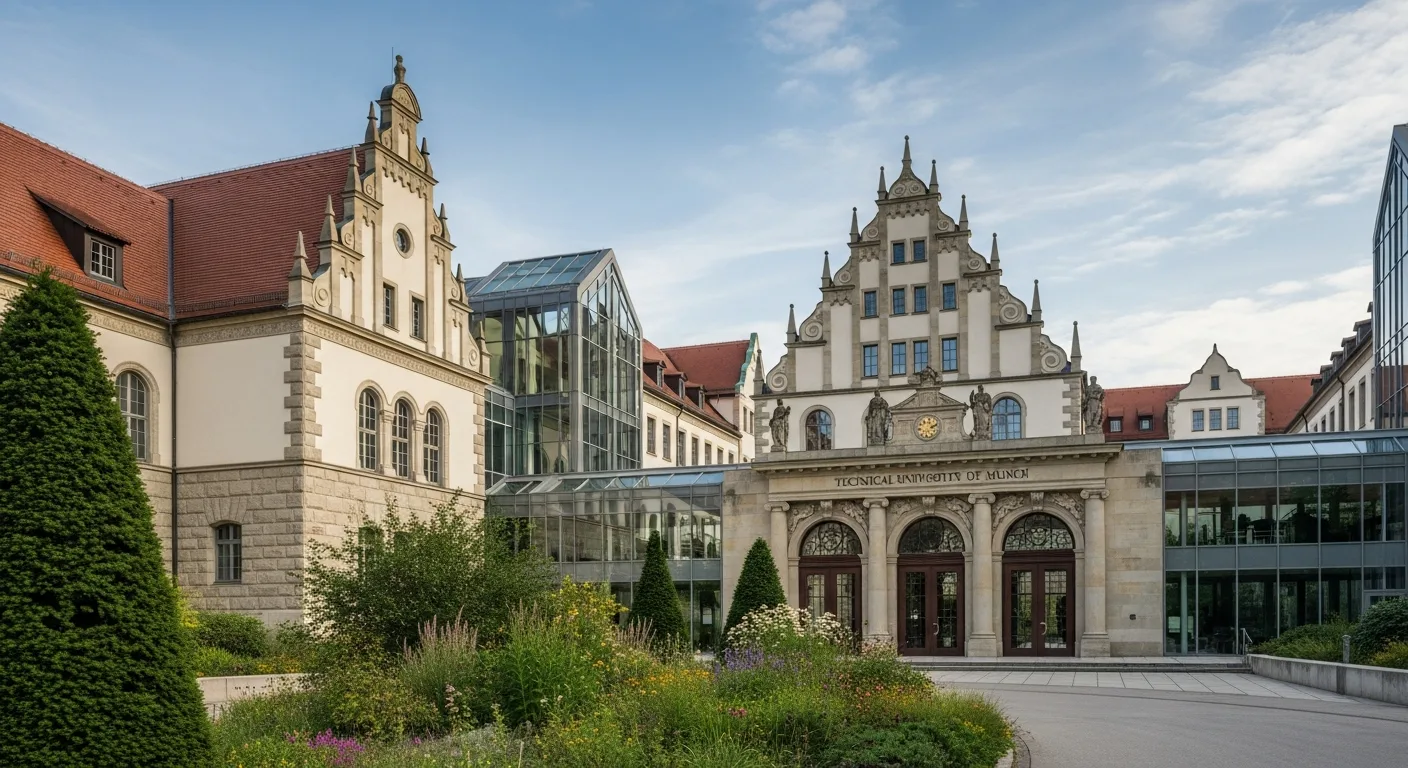
Lead image: Wikimedia Commons
You are standing on the platform at Garching-Forschungszentrum, the last station on Munich’s U6 underground line, fifteen kilometres north of the city centre. Beyond the glass doors of the U-Bahn a campus unfolds that looks like a science-fiction film set: concrete and glass laboratory blocks stretch toward the horizon, and rising above them is the dome of the FRM II research reactor, one of the most powerful neutron sources in Europe. Students in T-shirts emblazoned with the WARR Hyperloop logo pass doctoral candidates wearing Max Planck Institute lanyards. Someone on a bench is debugging code on a laptop covered with a TUM.ai sticker; someone else is cycling toward the mensa for a €3.50 lunch. This is not a campus of the past. This is Technische Universität München - the institution that has educated the founders of Celonis, FlixBus and Lilium, the home of 17 Nobel laureates, and the only German university that consistently sits in the global top 40.
TUM - full name Technische Universität München, the Technical University of Munich - is the answer to a question every internationally minded STEM applicant should ask themselves: how do I get an engineering education comparable to MIT, Cambridge or ETH Zürich without taking on six figures of debt? The answer, since Bavarian tuition reform in 2013, is straightforward: TUM charges €0 in tuition for everyone - EU citizens, EFTA citizens, non-EU citizens. The only payment is a €144 per semester Semesterbeitrag that bundles a Munich-wide public-transport pass, the Studentenwerk welfare contribution and registration. Add roughly €1,100-1,500 per month in Munich cost of living, and you arrive at an annual all-in budget of €14,000-18,000 - a fraction of what Imperial College London, ETH Zürich or any US peer charges in tuition alone.
This guide walks international applicants through everything you need to know to apply to TU München from outside Germany: how the Anabin equivalence framework and uni-assist Vorprüfungsdokumentation work, what Numerus Clausus actually means, the difference between German-medium Bachelor programmes and the dozens of English-medium Master programmes, the TestDaF / DSH language requirements, scholarships such as Deutschlandstipendium and DAAD, the TUM Asia Singapore campus, the 18-month Job-Seeker visa and EU Blue Card post-graduation pathway, and the realities of life in Munich. For comparison with the Swiss alternative, see our ETH Zürich guide for international applicants.
Why TU München is exceptional
TU München is not a university that “occasionally cracks the global top 50”. It is the #1 university in Germany without interruption - across QS, Times Higher Education, Shanghai’s ARWU and CHE national rankings - and it has held that position consistently for over a decade. In QS World University Rankings 2025, TUM sits at #37 globally, ahead of the University of Toronto, McGill, Karolinska Institute and most Continental European peers outside ETH Zürich. Times Higher Education 2025 places TUM in the global top 30, again as the only German university in that band. THE rates TUM particularly highly on research impact and industry collaboration - the two pillars on which the institution has built its identity.
Subject rankings are even more striking. QS Computer Science 2025 places TUM in the global top 25 - the highest-ranked CS department in continental Europe outside ETH Zürich and EPFL Lausanne, ahead of every other German, French, Italian and Scandinavian university. Mechanical Engineering ranks in the global top 20, drawing on the proximity of BMW Group, Audi (in nearby Ingolstadt), Airbus (Munich production sites), MTU Aero Engines and Knorr-Bremse. Electrical Engineering sits in the global top 25, with Siemens, Infineon and Rohde & Schwarz as immediate corporate neighbours. The TUM School of Management holds the Triple Crown accreditation (AACSB, EQUIS, AMBA) - the only business school attached to a German technical university to do so - and ranks in the global top 30 in Business & Management.
These rankings translate to weight in absolute terms: 17 Nobel laureates, including engineering pioneer Carl von Linde (whose refrigeration patents underpin modern industrial cooling), Rudolf Diesel (the eponymous engine), and Klaus von Klitzing (Nobel in Physics 1985 for the integer quantum Hall effect). The legacy is not abstract - Diesel and von Linde literally invented the technologies that shaped the 20th-century industrial economy, and TUM has maintained that engineering-first identity through to today.
What sets TUM apart from other top-40 universities
Three features distinguish TUM from peer Anglo-American institutions and even from European competitors. First, total focus on STEM and applied research with industry: TUM’s research budget of approximately €1.7 billion per year flows almost entirely into engineering, the natural and life sciences, medicine, and applied management - not into theology, classics or English literature.
Second, deep integration with the Munich industrial cluster: BMW, Siemens, BASF, Allianz, SAP, Munich Re, Airbus, MTU and a dense ring of mid-sized Bavarian Mittelstand firms employ TUM graduates in numbers no comparable Anglo-American institution can match for engineering specifically.
Third, the UnternehmerTUM ecosystem - Europe’s largest university-affiliated entrepreneurship centre, repeatedly ranked the #1 university incubator in Europe, and the soil from which Celonis (process mining, valued at over USD 13 billion at peak), FlixBus (the dominant European long-distance bus operator), Personio (HR software unicorn), Lilium (electric VTOL aircraft) and dozens of others have grown.
The numbers that matter
- #37 globally, #1 in Germany (QS World University Rankings 2025)
- 17 Nobel laureates affiliated with TUM across physics, chemistry, medicine and engineering legacy figures
- 42% international student body drawn from over 130 countries
- €1.7 billion annual research budget
- 52,000+ students: ~25,000 Bachelor, ~21,000 Master, ~6,000 doctoral, plus continuing education
- 8 academic schools spanning the full STEM, life-sciences and applied-management spectrum
- #1 university incubator in Europe (UnternehmerTUM) - Celonis, FlixBus, Personio, Lilium, Konux, Isar Aerospace
- Median graduate starting salary: €55,000-70,000 in Germany; up to €85,000+ in management consulting and Big Tech
Common misconception: “TUM is just engineering”
This is incomplete. The TUM School of Medicine, anchored at Klinikum rechts der Isar, is one of the leading medical faculties in Germany, with a near-perfect Numerus Clausus threshold and direct affiliation with Helmholtz Munich and the German Cancer Consortium. The TUM School of Life Sciences at Weihenstephan combines biotechnology, nutritional science, brewing science (yes - the world’s leading brewing science programme, with German DLG accreditation) and agricultural systems on the campus where Bavarian agriculture has been studied since the 1850s. The TUM School of Sport & Health Sciences runs the largest sport-science research programme in Bavaria. The School of Management delivers business and economics. The School of Social Sciences & Technology is the newest addition - a deliberately interdisciplinary unit looking at AI ethics, computational social science and policy. TUM is monothematic only in the sense that everything connects to science and engineering - but the perimeter is wider than the term “polytechnic” suggests.
That said, TUM is academically severe. Dropout rates in first-year engineering Bachelor programmes can reach 30-40%, and the workload at year one - particularly in mathematics for engineers (Höhere Mathematik) - is the principal selection filter that the entrance bar does not catch. Strong secondary-school preparation in mathematics and physics is the floor, not the ceiling.
How TU München admissions work - by qualification path
TUM admissions diverge fundamentally from US, UK and most non-German European systems. There is no Common App, no holistic essay review, no SAT or ACT requirement, no demonstrated interest. The framework rests on three pillars: diploma equivalence (Anabin / VPD), grade conversion (Bayerische Formel), and programme-specific admission mechanism (Numerus Clausus or Eignungsverfahren aptitude assessment).
Step 1: Determine your qualification path
TUM applies the Anabin / KMK equivalence framework. Your secondary-school diploma falls into one of three categories:
Category A - Direct equivalence: German Abitur, Austrian Reifeprüfung, Swiss Matura, French Baccalauréat (with appropriate options), the International Baccalaureate (IB) Diploma, A-Levels (with strong combinations including Mathematics and one science), European Baccalaureate, Italian Maturità Scientifica, the Spanish Bachillerato + EvAU/Selectividad, and most EU national matriculations. Holders of these diplomas, with grades meeting the published Numerus Clausus threshold for the chosen programme, are admitted directly.
Category B - Conditional equivalence: Diplomas formally recognised by Anabin but lacking sufficient breadth or depth (for example, two-year secondary diplomas where Germany expects three) require either a year of completed university study in the home country or a one-year Studienkolleg preparatory course in Germany before Bachelor admission. The Studienkolleg specialises in T-Kurs (technical), M-Kurs (medical/biological) and other tracks, ending with the Feststellungsprüfung qualifying examination.
Category C - No direct equivalence: Diplomas not on the Anabin recognition list require either the Studienkolleg + Feststellungsprüfung route or a recognised international qualification on top of the home-country diploma.
A fourth alternative exists for any category: complete one full year of university-level study in a relevant subject in your home country with strong grades, then apply to TUM. The Bachelor programme treats this as equivalent to direct admission for grade-conversion purposes.
Step 2: The Bayerische Formel - converting your grades
Germany ranks secondary diplomas on a 1.0-4.0 scale where 1.0 is the highest (essentially perfect) and 4.0 is the minimum pass. International grades are converted using the Bayerische Formel (Bavarian formula):
N = 1 + 3 × (Nmax − Nd) / (Nmax − Nmin)
where Nmax is the maximum achievable score on your home diploma, Nmin is the minimum passing score, and Nd is your achieved score. uni-assist applies this formula automatically and prints the resulting German equivalent on your Vorprüfungsdokumentation.
For Numerus-Clausus-restricted programmes - Medicine at TUM has historically required German equivalents around 1.0-1.2 - the conversion matters in tenths of a grade. Practical implication: for most national diplomas, a top Medicine offer at TUM requires near-perfect performance on extended/honours-level subjects.
Step 3: The admission mechanism - Numerus Clausus or aptitude assessment
TUM Bachelor programmes use one of two admission mechanisms.
Numerus Clausus (NC) restricted programmes - most prominently Human Medicine, Dentistry, Architecture, Psychology - admit ranked by converted German grade. The previous-cycle threshold (Auswahlgrenze) is published; for Medicine it consistently sits between 1.0 and 1.2. Bonus points apply for service years (Bundeswehr, Bundesfreiwilligendienst, Au-pair, prior vocational training in healthcare); these do not apply to most international applicants but are worth noting for those with German-recognised equivalents.
Eignungsverfahren (aptitude assessment) programmes - most TUM engineering and computer-science Bachelor programmes - combine grade with subject-specific assessment, in some cases including a written test or interview. The CS BSc programme has used a two-stage aptitude assessment and reached effective acceptance rates around 8% in recent intakes. Engineering Bachelors typically admit a higher fraction with an Abitur-equivalent of 1.5-2.0 plus strong showing in the assessment.
Open-admission (zulassungsfrei) programmes exist for selected Bachelors and most Masters at TUM, in which case the formal threshold is meeting the language and academic prerequisites; competitive Master programmes still rank applicants by Bachelor GPA, motivation letter, references and where applicable a subject test (GRE Quantitative for some quant-heavy MSc).
Step 4: Language certification
For German-medium Bachelor programmes (the majority), DSH-2 or TestDaF 4×4 is the floor. Acceptable certificates: TestDaF (overall and per-section score 4 minimum, 4×4 means 4 in each of the four sections), DSH-2 (TUM-administered or external), Goethe-Zertifikat C2, telc Deutsch C1 Hochschule, or Deutsches Sprachdiplom DSD II. Native-speaker exemption applies to applicants who completed at least four years of secondary education in a German-medium school.
For English-medium Master programmes, English at C1 level is required: IELTS Academic 6.5+ (with no band below 5.5) or TOEFL iBT 88+ (with section minimums on most programmes). Some Master programmes accept Cambridge C1 Advanced or proof of a Bachelor degree taught entirely in English. For TOEFL or IELTS preparation, a structured prep platform like PrepClass - full practice tests with AI-generated feedback on speaking and writing tasks - saves weeks of unfocused study and is particularly useful for non-native speakers targeting the IELTS 7.0 / TOEFL 100 thresholds preferred by the most competitive English-taught programmes.
Step 5: The application file - TUMonline + uni-assist
The TUM application is a two-track process.
Track 1: TUMonline (campus.tum.de). Create an account, select your programme, fill out the application form online, and upload required documents.
Track 2: uni-assist (uni-assist.de). As an international applicant with a non-German secondary or Bachelor diploma, you must send certified copies of your documents to uni-assist, which issues the Vorprüfungsdokumentation (VPD). The VPD certifies academic equivalence and provides the Bayerische Formel German-grade conversion. Cost: €75 for the first university, €30 for each additional. Once you receive the VPD, upload it to TUMonline alongside the rest of your file.
Required documents: certified translations of your secondary diploma and final-year transcript (or Bachelor degree and full transcript for Master applications), language certificate (TestDaF/DSH or TOEFL/IELTS depending on programme language), passport copy, CV, motivation letter (Master only), two academic references (most Master programmes), and the uni-assist VPD.
Application fee: none on the TUM side, but uni-assist charges €75 + €30 per programme.
Deadlines:
- Bachelor applications (winter semester start): typically 15 July.
- Master applications (winter semester): typically 31 May for non-EU applicants, 31 May to 15 July for EU applicants depending on programme.
- Master applications (summer semester, where offered): typically 30 November of the previous year, with a small subset closing 15 January.
Programme-specific deadlines vary - always verify on the TUMonline catalogue page for your chosen programme.
TUM does not interview Bachelor applicants. A minority of Master programmes (notably Robotics Cognition Intelligence, Quantitative Finance and selected MSc tracks) interview shortlisted candidates by video call. Selection rests on academic record, language certification, motivation letter and - where applicable - the Eignungsverfahren outcome.
Timeline at a glance
- September - November (year before): verify your Anabin category, register on uni-assist, request transcripts, begin language preparation.
- November - February: submit documents to uni-assist, await VPD (typical processing 4-8 weeks).
- March - May: open TUMonline application, submit before programme deadline.
- By 31 May (most Master programmes) or 15 July (most Bachelor programmes): final submission.
- June - August: admission decisions issued (Zulassungsbescheid).
- August - September: enrol, register with Munich municipality, find accommodation, organise health insurance.
- Mid-October: Wintersemester begins - orientation week, course registration.
Language requirements - German at Bachelor, English at Master
Here is the fact most international applicants need to internalise: the majority of TUM Bachelor programmes are taught in German. Engineering, computer science, mathematics, physics, chemistry, biology, medicine and law at Bachelor level are all German-medium, with a small number of English-medium exceptions (Information Engineering, selected Bachelor programmes at TUM Asia in Singapore). The required level is DSH-2 or TestDaF 4×4 - practical C1 in academic and technical contexts.
For an international applicant without prior German, this means two to three years of intensive language preparation before applying - unless you attended a German-medium school abroad, completed the DSD II at a partner school, or studied German at extended secondary level. It is a serious commitment, but TUM does not compromise on it for German-medium programmes.
If German is the binding constraint, two alternatives are worth weighing. English-medium Master programmes: roughly 70% of TUM Master programmes have English-medium options, and many run entirely in English - Informatics, Data Engineering and Analytics, Robotics Cognition Intelligence, Mechanical Engineering, Management & Technology, Aerospace Engineering, Communications Engineering, Quantum Science & Technology. TOEFL iBT 88+ or IELTS Academic 6.5+ unlocks all of them. Many international students complete a Bachelor in their home country and use the English-medium TUM Master as the entry route.
TUM Asia (Singapore campus): TUM operates a satellite campus in Singapore offering English-medium Master programmes in Aerospace Engineering, Industrial Chemistry, Integrated Circuit Design, Rail and Transit Systems Engineering and similar fields, jointly with the National University of Singapore (NUS) and Nanyang Technological University. Tuition is not free at TUM Asia - programmes charge SGD 30,000-55,000 - but the degree is awarded by TUM and counts identically. For applicants who want a TUM degree without German and without Munich cost of living, TUM Asia is the underrated option.
Even for English-medium Master students in Munich, practical German remains a major asset for life in the city - for navigating the private rental market, dealing with municipal authorities (Anmeldung, Bürgerbüro), securing internships at German Mittelstand firms, and integrating into local social life. Munich, unlike Berlin or Amsterdam, is not a city where everyone defaults to English in everyday interactions; the regional Bavarian dialect adds another layer. Most Master students invest in at least A2 - B1 German alongside their studies, often through TUM’s free language centre courses.
Programmes and schools - what to study at TUM
TUM reorganised in 2021-2022 into 8 schools (replacing the older 14-faculty structure). Each school groups closely related departments under a single dean.
TUM School of Engineering & Design (ED) is the largest school and the historical heart of TUM: mechanical engineering, aerospace, civil engineering, automotive, mechatronics, materials science, architecture and industrial design. Direct connections to BMW Group, Audi, Airbus, MTU Aero Engines, Siemens, Knorr-Bremse, Krauss-Maffei and the broader Bavarian engineering Mittelstand. Mechanical Engineering at TUM consistently ranks global top 20.
TUM School of Computation, Information and Technology (CIT) combines computer science, mathematics, electrical engineering, information engineering and informatics in business contexts. Computer Science ranks global top 25 - the highest-placed CS department in Germany - and feeds Google Munich, Apple, Microsoft, Amazon AWS, Nvidia, SAP, Siemens and the Munich startup ecosystem. The CIT structure makes interdisciplinary degrees (Mathematics in Data Science, Information Engineering, Robotics) particularly strong.
TUM School of Natural Sciences (NAT) covers physics, chemistry, biochemistry and the physics/chemistry teaching tracks. Physical proximity to Max Planck Institute for Physics, Max Planck Institute for Quantum Optics, Max Planck Institute of Biochemistry and the FRM II research reactor is unmatched in continental Europe. The Garching campus is effectively a single research cluster, with TUM students doing thesis work in MPI labs as standard practice.
TUM School of Life Sciences (LS) at Weihenstephan in Freising combines biotechnology, nutritional sciences, agricultural sciences, forestry, landscape architecture, brewing science (the world-leading programme on this niche) and food science. The campus has been the centre of Bavarian agricultural research since 1852 and runs working farms, breweries and food-technology pilot plants.
TUM School of Medicine and Health (MH), anchored at the Klinikum rechts der Isar university hospital, runs the Medicine programme (highest Numerus Clausus at TUM, 1.0-1.2 thresholds), Health Sciences and Medical Engineering. Affiliated with Helmholtz Munich and the German Cancer Consortium (DKTK).
TUM School of Sport & Health Sciences (SG) at the Olympia campus delivers Bachelor and Master programmes in Sport Science, Health Science, and Sport Management - Bavaria’s largest sport-science research base.
TUM School of Management (MGT) is the only business school in Germany attached to a technical university with Triple Crown accreditation (AACSB, EQUIS, AMBA). Programmes include the well-known Management & Technology BSc/MSc (the technology-management hybrid), Finance & Information Management (with the University of Augsburg), Consumer Affairs, and the Executive MBA.
TUM School of Social Sciences & Technology (SOT) is the newest school (2021), built around politics, sociology, governance and education studies - but with a deliberately technical lens (AI ethics, computational social science, technology policy, science & technology studies).
In addition, the TUM-NUS Joint Master Programme and the TUM-Imperial College Joint MSc offer dual-degree pathways for selected high-performing students. For applicants benchmarking against Switzerland, see the ETH Zürich guide.
Costs of studying and living in Munich
TUM is a financial paradox: tuition is zero, but Munich is one of the most expensive cities in Germany. Understanding the duality is essential to budget realistically.
Tuition is €0 per semester for everyone. The mandatory Semesterbeitrag is approximately €144 per semester (~€288 per year). It bundles:
- the MVV Semesterticket (Munich-wide public transport for the entire semester - buses, trams, U-Bahn, S-Bahn within the network zone);
- the Studentenwerk München contribution (subsidising student housing, mensa meals, psychological counselling, financial aid administration);
- the basic registration fee.
The Executive MBA (EMBA) and selected Professional Master programmes run by the TUM School of Management charge separate commercial tuition (€39,000+ for the EMBA); these are aimed at mid-career professionals and are not relevant for the standard international Bachelor or Master applicant.
Cost of living in Munich is the other side of the coin. Munich is the most expensive city in Germany - comparable with Frankfurt for housing and ahead of Hamburg, Berlin and Cologne. Realistic monthly figures for an international student:
- Accommodation - Studentenwerk München student residence: €280-450/month (heavily subsidised, 3-12 month waitlist, apply on day one of admission); WG (Wohngemeinschaft, shared flat) on the private market: €600-900/month; one-bedroom apartment: €1,100-1,600/month, more in central districts. Munich rents have grown 7-10% year-on-year, faster than wages. Read “warm” versus “kalt” carefully on listings - Warmmiete includes utilities, Kaltmiete does not.
- Food - €250-400/month with home cooking and discount supermarkets (Aldi, Lidl, Penny, Edeka). Mensa lunch: €3.50-5.50.
- Health insurance - mandatory; statutory student rate (TK, AOK, Barmer): €115-125/month including long-term care contribution.
- Mobile + internet + miscellaneous: €60-120/month.
A realistic monthly budget for a student in shared accommodation is €1,100-1,500 per month, putting the annual total - tuition included - at €14,000-18,000 (~USD 15,000-19,500). That is substantially lower than studying in the UK (Imperial College London GBP 38,000-47,000 per year in tuition alone) or Switzerland (ETH Zürich ~CHF 30,000+ all-in), and even cheaper than studying at TUM Asia in Singapore (where tuition adds SGD 30,000+).
Working during studies
EU and EFTA students may work without restriction under EU free movement. Non-EU students may work up to 120 full days or 240 half days per year without additional permits, plus unrestricted hours during semester breaks. Most non-EU students stay below 20 hours per week during the semester to retain the favourable student-rate health insurance - above this threshold, statutory contributions jump significantly.
Hourly wages in Munich for student-level work run €13-18/hour in retail and hospitality, €15-22/hour as a HiWi (Hilfswissenschaftler) - research assistant within your department - and €25-45/hour as a Werkstudent at firms like BMW, Siemens, Allianz, BASF or the UnternehmerTUM startup cluster. The Werkstudent route is strategically valuable: it builds CV-grade industry experience in parallel with the degree, often converts to a thesis project, and frequently leads to a graduate offer at the same firm. Annual income up to roughly €11,600 (Grundfreibetrag) is income-tax-free, though social-security contributions still apply.
Scholarships at TU München
A realistic statement first: most TUM students do not hold a formal scholarship, because TUM tuition is already €0 and the cost-of-living gap is smaller than at most foreign peers. But several stackable funding sources exist.
Deutschlandstipendium is the federal-state-private hybrid award: €300/month for 12 months, jointly funded by the German federal government and private corporate sponsors. Open to all nationalities. Selection is based on academic merit and social engagement; the application is short and processed within the university. Many TUM students hold a Deutschlandstipendium for one or two years across their Bachelor or Master.
DAAD (German Academic Exchange Service) runs dozens of country-specific and topic-specific scholarships. Headline programmes include:
- DAAD Master Scholarships: monthly stipend of approximately €934, plus tuition coverage where applicable, health insurance subsidy and travel allowance. Open to graduates of universities in over 150 countries. Application via the DAAD office in your home country (or directly through the DAAD portal), typically 12-15 months before intended start.
- DAAD Research Grants for doctoral candidates (~€1,200/month).
- DAAD - EPOS programmes for development-relevant Master programmes.
- DAAD Helmut Schmidt Programme for public-policy Master applicants.
TUM Study & Internship Scholarship is an internal one-off award of €500-1,000 for outstanding international students, particularly those completing a thesis or research internship abroad.
Bavarian Ministry of Science scholarships (BayBIDS) are aimed at graduates of German Schools Abroad (Deutsche Auslandsschulen), which forms a major pipeline of international students into Bavarian universities.
Erasmus+ funds intra-EU mobility periods (one or two semesters at TUM for students enrolled at another European university, or vice versa). Stipends vary by host country tier; for Munich the standard rate is approximately €350-500/month.
Max Planck Society and Helmholtz Association fellowships fund doctoral candidates - full salary positions (E13 TV-L, ~€2,300-2,700/month net for first-year doctoral candidates) rather than scholarships, which is the standard German doctoral funding model.
External and home-country awards stack on top of TUM funding: Fulbright (US citizens), Chevening (Commonwealth nationals), Vanier (Canadians), country-specific Erasmus+ national supplements (EU nationals on mobility), and bilateral cultural-exchange schemes administered by individual countries’ education ministries.
A realistic financial strategy for a non-EU international student combines: €0 tuition + part-time Werkstudent or HiWi work (€8,000-14,000 per year) + Deutschlandstipendium or DAAD support to close the cost-of-living gap. For EU/EFTA students the calculus is even simpler - full work rights from day one make TUM straightforwardly affordable on a part-time-job income alone, especially if combined with subsidised Studentenwerk housing.
Visas and residence permits
EU and EFTA citizens do not need a visa to study at TUM under EU free-movement rules. On arrival in Munich, register with the municipal Bürgerbüro (Anmeldung) within 14 days, presenting your TUM admission letter, proof of accommodation, and proof of health insurance. No additional residence permit is required for the duration of studies.
Non-EU/EFTA citizens need a student visa (D-visa) issued by the German embassy or consulate in your home country before travel. The application requires:
- the TUM admission letter (Zulassungsbescheid);
- proof of financial means - currently approximately €11,904 per year in a blocked account (Sperrkonto) at a German bank, with monthly disbursement of ~€992 to the student;
- proof of health insurance;
- accommodation evidence;
- a motivation letter and CV.
Processing takes 6-12 weeks - apply as soon as your TUM admission is confirmed. On arrival, register with the Bürgerbüro within 14 days, and within the first three months convert the D-visa into a residence permit for study purposes (Aufenthaltserlaubnis zum Studium) at the Ausländerbehörde / KVR Munich. This permit is valid one to two years and is renewed for the duration of your programme.
After graduation, EU/EFTA graduates retain full work rights in Germany under free movement. Non-EU graduates receive - automatically - an 18-month Job-Seeker Residence Permit that lets you remain in Germany to look for work in your field. Once you receive a qualified employment offer, you can convert the permit to:
- an EU Blue Card (Blaue Karte EU) - the standard high-skill route. 2025 thresholds: gross annual salary at or above €48,300 for general professions, €43,759 for shortage occupations including IT, mathematics, natural sciences, engineering and medicine (most TUM graduate fields). The Blue Card grants 4-year residence with full work rights, and after 33 months (or 21 months with B1 German) you become eligible for permanent residence (Niederlassungserlaubnis); or
- a regular employment-based residence permit for graduate roles below the Blue Card threshold.
Family reunification is straightforward on the Blue Card - spouses receive immediate work rights without separate language requirements. This combination - 18-month Job-Seeker visa + Blue Card + accelerated permanent residence - is one of the most graduate-friendly post-study migration regimes in Europe and is a major reason international students choose Germany over the UK or US.
TU München versus ETH Zürich versus Imperial College London
Three institutions dominate the conversation for international STEM applicants weighing Continental Europe against the Anglo-American pathway. Each occupies a different niche.
TU München: QS #37, German-medium Bachelor, English-medium Master broadly available, €0 tuition + €144/semester Semesterbeitrag, Munich (€1,100-1,500 monthly cost of living), strongest in computer science, mechanical engineering, electrical engineering, physics, brewing science. Selection filter: Numerus Clausus on competitive programmes, Eignungsverfahren elsewhere, plus first-year academic intensity. Startup ecosystem: UnternehmerTUM - Europe’s #1 university incubator (Celonis, FlixBus, Personio, Lilium). Atmosphere: large, internationally diverse, Bavarian, industry-integrated.
ETH Zürich: QS #7, German-medium Bachelor, English-medium Master, CHF 1,460 tuition, Zürich (CHF 2,000-2,500 monthly cost of living), strongest in computer science, physics, architecture, mathematics. Selection filter: entrance examination for non-equivalent diplomas, plus the brutal Basisprüfung at the end of year one. Startup ecosystem: 500+ active spinoffs (Climeworks, GetYourGuide, Scandit). Atmosphere: intensive, Germanic-precise, internationally prestigious.
Imperial College London: QS #2, English-medium throughout, post-Brexit international tuition GBP 38,000-47,000/year (~€45,000-55,000), London (£1,500-2,200 monthly cost of living), strongest in computer science, engineering, medicine and the natural sciences. Selection filter: UCAS process with strong A-Levels / IB, supplementary tests for some programmes (MAT for Mathematics, BMAT/UCAT for Medicine before 2025 reforms). Startup ecosystem: well-developed (Imperial Enterprise Lab, White City Innovation District). Atmosphere: international, fast-paced, finance-and-tech adjacent.
TUM versus ETH: ETH ranks ~30 places higher in QS and carries marginally stronger global brand recognition outside Europe. But TUM is free while ETH costs ~CHF 30,000+ all-in per year, and Munich cost of living is roughly 35-50% lower than Zürich. For a budget-constrained applicant or one targeting the German-speaking industrial labour market, TUM is the higher-leverage investment. For a student targeting global consulting, US Big Tech recruitment outside the EU, or pure rankings prestige, ETH may justify its cost.
TUM versus Imperial: Imperial’s English-medium teaching is the decisive factor for non-German-speaking applicants who do not want to invest 2-3 years in DSH-2 preparation - though TUM’s English-medium Master programmes remove this constraint at the postgraduate level. On total cost, TUM wins by a factor of 5-8x against post-Brexit Imperial fees. On rankings, Imperial sits in the top 5; TUM in the top 40. For STEM at minimum financial risk: TUM. For prestige + English-medium throughout: Imperial.
Student life in Munich
Munich is a city that recalibrates what “high quality of life” means. Mercer and the EIU regularly rank it in the global top 5 for quality of life alongside Vienna, Zürich and Auckland. Tap water comes straight from the Bavarian Alps and is cleaner than most bottled water; the U-Bahn, S-Bahn, tram and bus network is dense and runs on time; the violent crime rate is among the lowest in Western Europe. The English Garden - the largest urban park in Europe, larger than Central Park - runs through the centre, with a year-round surfing wave on the Eisbach river. From the Garching campus you can be on a Bavarian lake (Starnberger See, Tegernsee) in 45 minutes and at a ski resort in the Alps in 90 minutes.
TUM operates three principal campuses plus several specialised sites.
Garching - the engineering, computer science and natural sciences hub fifteen kilometres north of the city centre, accessible by U6. Modern laboratory architecture, the FRM II research reactor, and direct integration with adjacent Max Planck Institutes.
Weihenstephan - the life-sciences campus in Freising, north of Munich, where Bavarian agricultural and food-science research has been based since the 1850s.
City centre / Stammgelände - the historic main campus on Arcisstrasse near the Pinakothek museums, hosting architecture, mathematics, the School of Management and central administration. The free TUM bus / shared U-Bahn corridors connect the sites efficiently.
Studentische Vereinigungen - student organisations - are dense and varied. Each programme has its own Fachschaft (departmental student council) handling peer support and orientation. Beyond that are the project societies that put real engineering on display: WARR Hyperloop (twice-winning SpaceX Hyperloop competitions, world record in pod speed); TUM.ai (one of the largest student-led AI societies in Europe, running hackathons with industry partners); TUM Boring (Elon Musk’s Not-a-Boring Competition winners, building micro-tunnel boring machines); Akaflieg (gliding and aircraft design, founded 1924); EuroAvia (aerospace student exchange); Roborace TUM (autonomous racing). Participation in these is more than a hobby - it is direct CV-grade engineering experience and an early gateway into the deep-tech startup ecosystem.
Sport is woven into Munich student life. TUM Sportzentrum runs hundreds of low-cost courses - climbing, sailing on Starnberger See, skiing trips to the Alps, martial arts, football, basketball. Munich’s Olympic Park (1972) is on TUM’s doorstep, complete with the Olympic swimming pool open for student use at €4 per visit. Beer-garden culture is real - the Augustiner Keller, Hofbräukeller and Englischer Garten Chinesischer Turm are practical Friday-evening student venues, with Maß (litre of beer) at €11-13 alongside €8 obatzda and pretzel.
International student communities are organised, active and easy to find. TUM International Center runs orientation weeks tailored to new arrivals, and most national diasporas have informal Munich networks reachable through Facebook groups before you arrive. Bavarian social culture is initially formal - closer to Austrian or Czech reserve than to Mediterranean exuberance - but Fachschaften, project societies and shared accommodation break the ice quickly. Munich is not Berlin or Barcelona; nightlife is moderate, orderly, and skewed toward beer gardens, jazz clubs and the Glockenbachviertel rather than rave scenes. If you value precision, order, and access to the Alps over urban chaos, you will find Munich suits you.
Career outcomes after TU München
A TUM diploma is among the strongest signals on the German and European technical labour market. According to QS Graduate Employability Rankings, TUM sits in the global top 30 for graduate employment outcomes and #1 in Germany. Median starting salary in Germany is €55,000-70,000 gross per year for engineering Bachelor + Master graduates, rising to €80,000-100,000+ in management consulting (McKinsey, BCG, Bain Munich offices), Big Tech (Google Munich, Apple, Microsoft, Amazon, Nvidia) and quantitative finance (Allianz Global Investors, Munich Re, Citadel Frankfurt).
Where TUM graduates go:
- Automotive and mobility (~22%): BMW Group (Munich headquarters; the largest single TUM graduate employer), Audi (Ingolstadt), Mercedes-Benz, Porsche, MAN Truck & Bus, Knorr-Bremse, MTU Aero Engines, Continental, Bosch.
- Industrial and electrical engineering (~18%): Siemens (Munich-headquartered), Infineon (Munich), Rohde & Schwarz, Airbus, Thales, Linde plc.
- Big Tech and software (~16%): Google Munich, Apple Munich, Microsoft, Amazon AWS, Nvidia, SAP (Walldorf), plus TUM spinoffs.
- Strategy consulting (~12%): McKinsey, BCG, Bain, Roland Berger (Munich-headquartered), Strategy&. All maintain Munich offices and recruit heavily on the Stammgelände campus.
- Pharmaceuticals and chemicals (~9%): BASF (Ludwigshafen), Bayer, Merck KGaA, Roche Munich, plus the Helmholtz Munich biotech network.
- Insurance and finance (~8%): Allianz (Munich-headquartered), Munich Re (the world’s largest reinsurer), Allianz Global Investors, Deutsche Bank.
- Founding own startup (~10%): UnternehmerTUM and TUM Venture Labs cohorts. Notable companies founded or co-founded by TUM graduates: Celonis (process mining), FlixBus (long-distance bus marketplace), Personio (HR software), Lilium (electric VTOL aircraft), Konux (industrial AI), Isar Aerospace (small-launch rockets), NavVis (indoor mapping).
- Academia and research (~5%): TUM, Max Planck Institutes, Helmholtz centres, Fraunhofer Institutes, ETH, MIT, Stanford.
The TUM startup ecosystem is among the strongest in Europe: UnternehmerTUM has been ranked #1 university incubator in Europe repeatedly by the UBI Global rankings, with over 80 startups founded annually by TUM graduates and €11 billion+ in cumulative valuations of TUM-affiliated firms. TUM Venture Labs clusters specialised incubators by sector (AI/Robotics, Aerospace, Built Environment, BioTech, ChemTech, FinTech, Quantum, Sustainability). The TUM-NUS Joint Engineering programmes and TUM-Imperial joint MSc broaden the network further.
The TUM alumni network (TUM Alumni & Career) spans 17 Nobel laureates (the headline figure) plus dozens of CEOs at major German DAX 40 firms, automotive engineering leaders, and a long tail of deep-tech founders. TUM alumni events run quarterly in Munich, Berlin, San Francisco, New York, London, Singapore, Beijing and Tokyo.
For non-EU graduates, Germany’s 18-month Job-Seeker Residence Permit + EU Blue Card pathway (described above) makes the post-graduation transition into the German labour market unusually smooth - among the most graduate-friendly migration regimes in Europe. Combined with €0 tuition, the total economic case for TUM is one of the strongest on the continent.
TU München admissions FAQ - long-form
Conclusion - is TU München right for you?
TU München is for international students who want top-tier European STEM education - and want to make it economically rational. Not a “test the waters” institution, because Bavarian academic standards are demanding and the German Bachelor system rewards systematic preparation rather than last-minute heroics. But once you commit to it, TUM is one of the most economically rational choices in global higher education. The combination is genuinely rare: #1 university in Germany, top 40 globally, €0 tuition, the strongest STEM industrial corridor in continental Europe (BMW, Siemens, BASF, Allianz, SAP, Munich Re, Airbus), Europe’s #1 university incubator (UnternehmerTUM), and a graduate-friendly post-study migration regime (18-month Job-Seeker visa + EU Blue Card).
The trade-offs are real. Bachelor teaching is overwhelmingly in German - this is a 2-3 year language commitment for non-German speakers. Munich is the most expensive German city, with rents climbing 7-10% per year and a tight rental market. Numerus-Clausus-restricted programmes (Medicine, Architecture) require near-perfect grades. First-year academic intensity is high, and dropout rates in some engineering Bachelors reach 30-40%.
But if the profile fits you - if you are mathematically and scientifically strong, if you can accept the German language commitment (or are aiming directly at an English-medium Master), if BMW, Siemens, Allianz or the Munich startup ecosystem is the kind of post-graduation environment you want - TUM may be the highest-leverage educational investment available in continental Europe. A diploma that opens doors across the strongest engineering economy in Europe; a campus next door to Max Planck Institutes and Bavaria’s most demanding industrial firms; €0 tuition; a 17-Nobel-laureate legacy stretching from Carl von Linde and Rudolf Diesel to Klaus von Klitzing.
Next steps
- Begin German preparation - if you are targeting a Bachelor, you need DSH-2 or TestDaF 4×4. Invest in an intensive course at the Goethe-Institut, a TUM-recognised external provider, or a Studienkolleg if your diploma requires it. Plan for 2-3 years.
- Verify your equivalence category on Anabin (anabin.kmk.org) - and submit your documents to uni-assist (uni-assist.de) for the Vorprüfungsdokumentation (VPD) at least 6 months before your application deadline.
- If you target an English-medium Master - sit TOEFL iBT 88+ or IELTS Academic 6.5+; the most competitive programmes prefer 100+ or 7.0+. A structured prep platform like PrepClass - with full practice tests and AI feedback on speaking and writing - accelerates preparation significantly. For more on choosing between TOEFL and IELTS, our TOEFL versus IELTS comparison walks through the trade-offs.
- Submit the application through TUMonline (campus.tum.de) by 15 July (Bachelor) or 31 May (most non-EU Master applications).
- Begin the accommodation search immediately on acceptance - register on Studentenwerk München waitlists the day your offer arrives, and start scanning wg-gesucht.de listings.
- Plan your budget - €1,100-1,500 per month for living, plus €144 per semester Semesterbeitrag, plus the uni-assist fees (€75 + €30 per additional programme).
- For non-EU applicants - initiate the D-visa process at your home-country German embassy as soon as TUM admission is confirmed; processing takes 6-12 weeks. Open the blocked account (Sperrkonto) in parallel.
- Plan the post-study trajectory early - line up Werkstudent positions at BMW, Siemens, Allianz or UnternehmerTUM startups during your studies; these convert disproportionately into graduate offers and qualify directly for the EU Blue Card threshold.
For the broader Swiss higher-education comparison, see our ETH Zürich guide for international applicants. For the UK STEM alternative, the Imperial College London guide is a parallel resource. For TOEFL or IELTS preparation aligned to the latest 2026 specifications, PrepClass offers full-length practice tests and AI-driven speaking and writing feedback.
Good luck - and bis bald in München.


