

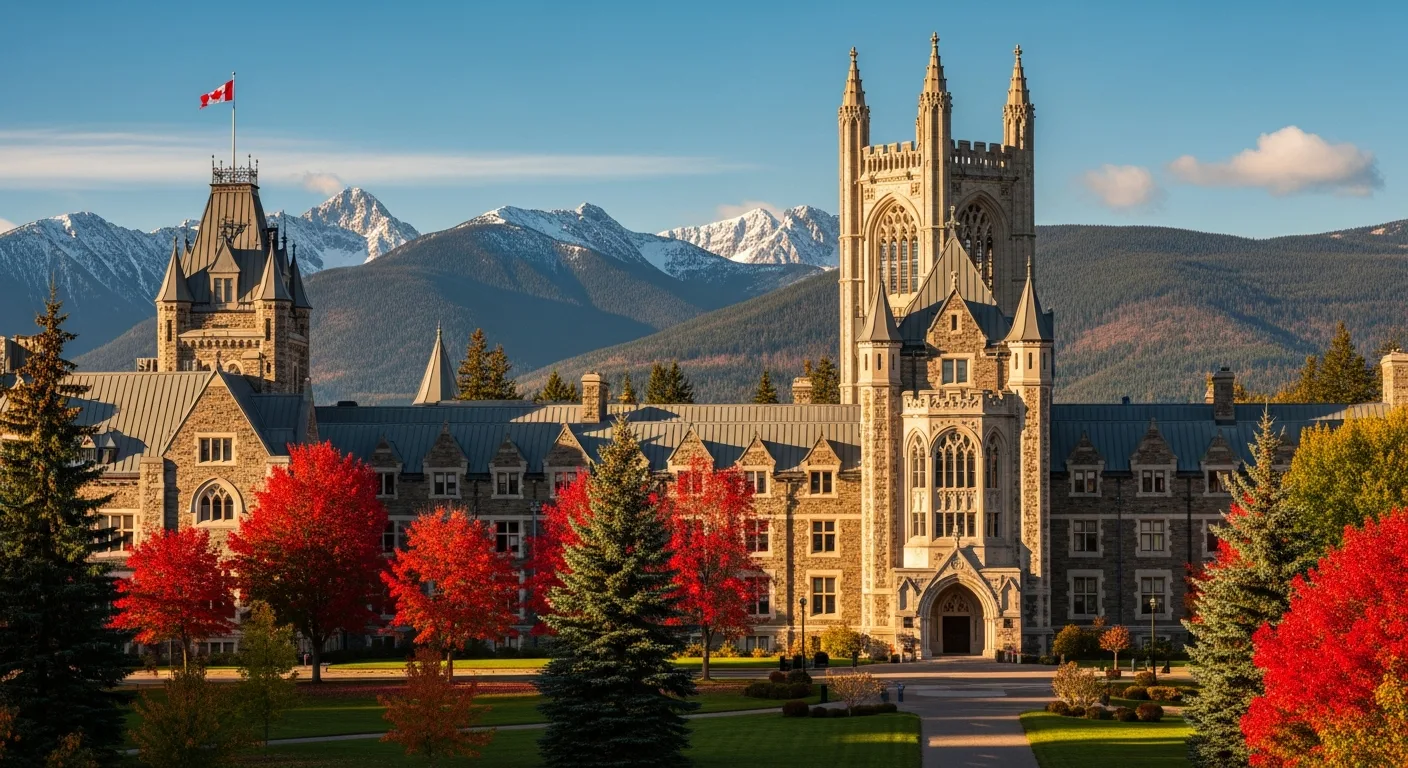
It’s Monday morning in Toronto. On King Street, a streetcar passes beneath the glass skyscrapers of Bay Street – Canada’s Wall Street – while on the sidewalk, a UofT student with a Tim Hortons cup in hand walks past a guy in a McGill jacket who just exited the subway. On the University of Toronto campus, in the shadow of the neo-Gothic University College Hall, a group of students from five different continents discusses a computer science project, as maple leaves above them slowly turn spring green. In the Robarts Library – a brutalist behemoth students call “Fort Book” – someone is writing an essay on immigration policy, because in Canada, immigration isn’t a taboo subject, but a pillar of national identity. On the notice board by the entrance: co-op offers from Amazon, Shopify, and RBC, an invitation to a Polish film screening as part of “Multicultural Week,” and a poster for a hackathon organized by the Waterloo CS Society.
This isn’t an exceptional day. It’s an ordinary Monday in a country that has quietly and consistently become one of the most attractive study destinations in the world – especially for those who think not just about a diploma, but about a whole life path: education, career, and perhaps a new home.
Canada in 2026 is a phenomenon. The third most chosen country by international students globally (after the USA and UK), with over 800,000 foreign students attracted by a unique combination: universities in the global top 50, tuition fees lower than in the USA or UK, a three-year post-graduation work permit (PGWP), and a realistic pathway to permanent residency. Add to that a country where multiculturalism is state policy (not a marketing slogan), where Toronto boasts more nationalities than New York, and where it snows on the mountains in Vancouver while cherry blossoms bloom in the city – and you begin to understand why Canada attracts the best.
In this guide, I’ll walk you through everything you need to know about studying in Canada: from the provincial system, top universities (University of Toronto, McGill, UBC, Waterloo), the application process, requirements for international high school graduates, costs and scholarships, through the study permit, all the way to the legendary PGWP and the immigration pathway that makes Canada unique among its competitors. If you’re also considering the USA, compare costs with our guide to the costs of studying in America, and if you’re just starting to think about studying abroad, begin with our comprehensive guide to studying abroad.
Study in Canada: Key Statistics 2025/2026
Source: QS World University Rankings 2025, Immigration, Refugees and Citizenship Canada (IRCC), Statistics Canada 2025
Why Canada? Five Reasons That Change the Equation
Canada isn’t the obvious first thought for an international high school graduate considering studying abroad. That spot usually belongs to the USA, UK, or the Netherlands. But when you look closer, Canada turns out to be a country that combines the advantages of all these destinations, without many of their drawbacks.
First: world-class quality education. Canada has 4 universities in the global QS 2025 top 50 – University of Toronto (#21), McGill University (#29), University of British Columbia (#38), and University of Alberta (#96 in QS, but top 5 in THE Impact Rankings). In fields such as computer science (Waterloo, UofT), engineering (UBC, McGill, Waterloo), business (Ivey, Rotman, Sauder), and medicine (UofT, McGill), Canada competes directly with the best universities in the USA (but at a fraction of the cost).
Second: an immigration pathway unmatched by any other country at this level. This is the advantage that truly changes the equation. After completing your studies in Canada, you receive a Post-Graduation Work Permit (PGWP), an open work permit valid for up to 3 years, without needing a job offer in advance. After one year of work, you can apply for Permanent Residency through the Canadian Experience Class program. In the USA, a student after graduation gets OPT for one year (3 years in STEM), then must win the H-1B visa lottery with a ~30% chance. In the UK, there’s a 2-year Graduate Route, but the path to permanent residency is long and complicated. In Canada, the journey from student to permanent resident is clear, predictable, and realistic.
Third: lower costs than in the USA and UK. Tuition fees for international students in Canada range from 20,000–55,000 CAD annually (approximately 14,600–40,150 USD or 13,600–37,400 EUR), depending on the university and program. This is a significant amount – but compare it to the USA, where comparable universities cost 50,000–65,000 USD (approximately 46,500–60,450 EUR) annually, or post-Brexit UK, where tuition for international students has risen to 25,000–40,000 GBP (approximately 31,500–50,400 USD or 29,250–46,800 EUR). You can find a detailed comparison of American costs in our guide to the costs of studying in the USA.
Fourth: a country built on multiculturalism. Canada is the only country in the world where multiculturalism is enshrined in its constitution (Canadian Multiculturalism Act, 1988). In Toronto, over 50% of residents were born outside Canada. In Vancouver, the Richmond district is 54% Chinese-speaking. In Montreal, you’ll converse in French and English, sometimes in the same sentence. For an international student, this means one thing: you won’t be treated as a “foreigner”; you’ll be one of many who have chosen Canada. Canada’s multicultural fabric means you’ll find vibrant communities from around the world, including a significant Polish diaspora of over 1 million people, with cultural organizations and networks in cities like Toronto, Mississauga, and Winnipeg.
Fifth: safety and quality of life. Canada consistently ranks in the top 10 for quality of life worldwide (UN Human Development Index, Global Peace Index). Public healthcare is available in every province, and the crime rate is significantly lower than in the USA. As a student, you’ll experience a sense of security, both physical and systemic, that is hard to find in many other countries.
Top 10 Canadian Universities – An Overview for International Applicants
The Canadian university system is decentralized, with each province managing its higher education independently, but certain names consistently appear in all rankings and on all employer lists. Here are ten universities you should consider.
Top 10 Canadian Universities: QS 2025 Ranking and Specializations
Source: QS World University Rankings 2025, official university websites. Tuition fees are for the 2025/2026 academic year; rates may vary depending on the program.
The University of Toronto is Canada’s equivalent of Harvard, a university that dominates all rankings, across all fields, with a research budget exceeding 1.5 billion CAD annually. Its three campuses (St. George in downtown Toronto, Mississauga in the suburbs, and Scarborough in the east) collectively educate over 97,000 students, making it one of the largest universities in North America. UofT is a particular powerhouse in artificial intelligence; it’s home to Geoffrey Hinton, the “godfather of deep learning” and a Turing Award laureate. The Rotman School of Management is a top 10 business school in Canada, and the Temerty Faculty of Medicine is the best medical school in the country. Tuition is the highest in Canada (58,000–65,000 CAD depending on the program), but the level of research, network of contacts, and proximity to Bay Street (Canada’s financial hub) compensate for this cost.
McGill University in Montreal is a gem of Canadian education, an English-speaking university in a francophone city, with 12 Nobel laureates and a reputation comparable to the Ivy League. McGill has one of the biggest cost advantages among top universities: thanks to Quebec’s educational policy, tuition for international students is significantly lower than in Ontario. Montreal itself is one of the most affordable major cities in Canada, with rent 30–40% lower than in Toronto or Vancouver. If you’re looking for global top 30 prestige at a reasonable price, McGill is one of the best choices worldwide.
The University of British Columbia in Vancouver is a university whose campus is an argument in itself. Located on the Point Grey Peninsula, with views of the North Shore mountains and the Pacific, UBC’s campus regularly appears on lists of the world’s most beautiful campuses. But UBC isn’t just about the views; the university is in the global top 40, strong in environmental sciences, engineering, medicine, and business (Sauder School of Business). Vancouver is a city where you can ski in Whistler in the morning and surf in Tofino in the afternoon, and where the film industry (Hollywood North) and tech sector (Amazon, Microsoft have offices here) create a dynamic job market.
The University of Waterloo deserves a separate explanation, as it’s a global phenomenon. While Waterloo isn’t ranked in the QS top 50, in computer science and engineering, it’s considered one of the best universities in North America, on par with MIT, Stanford, or Carnegie Mellon. Why? The answer is one word: co-op. Waterloo runs the largest employer partnership program in the world – students alternate between studying and working (4 months of study + 4 months of co-op), completing a total of 6 paid internships over their 5-year degree. Employers? Google, Meta, Apple, Amazon, Jane Street, Citadel, Goldman Sachs. Waterloo CS graduates earn an average of over 130,000 CAD in their first year after graduation. If you’re aiming for tech – Waterloo is one of the best places on the planet.
How the Canadian Higher Education System Works
The Canadian higher education system differs fundamentally from the European one in one key aspect: there is no federal ministry of education. Education is a provincial responsibility, with each of the 10 provinces and 3 territories managing its universities independently.
The U15 Group of Canadian Research Universities is the Canadian equivalent of the UK’s Russell Group or Australia’s Group of Eight, comprising the 15 strongest research universities in Canada, which collectively conduct over 80% of the country’s scientific research. The U15 includes UofT, McGill, UBC, Alberta, Waterloo, McMaster, Queen’s, Western, Ottawa, Dalhousie, Manitoba, Saskatchewan, Calgary, Laval, and Montreal. Membership in the U15 is a mark of quality; these universities have the largest research budgets, the strongest faculty, and the best prospects for graduates.
Undergraduate studies in Canada typically last 4 years (with the exception of Quebec, where after a 2-year CEGEP program, university studies last 3 years). Master’s degrees are 1–2 years, and doctoral degrees are 4–6 years. The system is similar to the American one: in the first years, you choose courses from various fields (a liberal arts approach at many universities), specializing from the second or third year (declaring a major and optionally a minor). This offers flexibility – you can start undeclared and decide on a major after a year of exploration.
A key difference compared to the European system: in Canada, grades are calculated on a GPA (Grade Point Average) scale, usually out of 4.0. Most universities use a percentage system (A+ = 90–100%, A = 85–89%, etc.) converted to GPA. International high school grades and exam percentages are converted individually by admissions committees; you can find details in our guide to converting high school leaving exam results.
How to Apply to Canadian Universities – Step-by-Step
The application process for Canadian universities is simpler than in the USA (no Common App with dozens of essays) and more decentralized than in the UK (no central UCAS). But it has its specificities that you need to understand.
Canadian University Application Timeline
Admissions for the 2026/2027 Academic Year: Key Steps and Deadlines
Source: OUAC, official admissions websites of UofT, McGill, UBC, Waterloo (2025/2026)
In Ontario, OUAC (Ontario Universities’ Application Centre) is the central application system for all universities in Ontario, including UofT, Waterloo, McMaster, Queen’s, Western, and Ottawa. As an international student, you apply through OUAC 105 (the equivalent of UCAS in the UK). Through OUAC, you can apply for up to 3 programs at one university and to multiple universities simultaneously. Fee: approx. 150 CAD for the first choice + 50 CAD for each subsequent one.
Provinces outside Ontario – McGill (Quebec), UBC (British Columbia), Alberta, Montreal – have their own application systems. You apply directly through the university’s website. This is less convenient than the central OUAC, but also simpler – each application is independent.
Supplemental applications are additional elements that many universities require beyond the standard form. UBC requires a Personal Profile – a series of questions about your experiences, values, and goals. UofT Engineering and Waterloo CS/Engineering require an Admission Information Form (AIF) – answers to questions about motivation, activities, and life circumstances. Some programs (especially business and arts) require Kira Talent – a platform for recording video responses to admissions questions. Be prepared for these – these elements have a real impact on the decision.
Requirements for International High School Graduates
The Polish high school leaving exam is officially recognized by Canadian universities – but requirements vary between institutions and programs. Here’s what you can expect.
High school grades – most top universities expect advanced-level results in subjects related to your chosen program. For UofT Engineering or Waterloo CS, you should aim for 85%+ in advanced mathematics, and ideally 90%+. McGill expects an overall average of 85%+ from your advanced high school leaving exam. UBC and Alberta are slightly more flexible – 80%+ may suffice for some programs. Key point: Canadian universities look at your predicted grades at the time of application – final high school leaving exam results confirm your conditional offer. You can find more about converting Polish high school leaving exam results in our guide to converting high school leaving exam results.
Language proficiency tests – IELTS Academic and TOEFL iBT are standard tests accepted by all Canadian universities. Minimum requirements:
- UofT: IELTS 6.5 (min. 6.0 in each component) or TOEFL 100 (min. 22 in writing)
- McGill: IELTS 6.5 or TOEFL 90 (min. 21 in each section)
- UBC: IELTS 6.5 (min. 6.0) or TOEFL 90 (min. 22 reading, 21 writing, 21 listening)
- Waterloo: IELTS 6.5 (min. 6.0 in writing, 6.0 speaking) or TOEFL 90 (min. 25 in writing)
Not sure which test to choose? Read our TOEFL vs IELTS guide, and if you decide on IELTS, use our complete IELTS guide.
SAT – unlike in the USA, the SAT is not required by Canadian universities. However, some programs (especially at UofT and Waterloo) accept it as an additional element to strengthen your application. If you have a score of 1400+, it’s worth including – it won’t hurt and might help. But it’s not a priority – Canadian universities focus primarily on high school grades and language proficiency tests.
Letters of recommendation – most Canadian universities at the undergraduate level do not require letters of recommendation (unlike in the USA). Exceptions: artistic programs, some scholarship programs, and graduate studies.
Costs – Tuition and Living Expenses
Canada is not cheap – but it is significantly more affordable than comparable universities in the USA and UK. Tuition varies dramatically between provinces and programs, so it’s worth understanding the cost structure.
Annual Study Costs in Canada – Provincial Comparison
Tuition (International Students) + Living Costs, 2025/2026
Source: Statistics Canada, official university websites (2025/2026). Tuition varies significantly between programs; the ranges provided are indicative.
Quebec is the most affordable – and significantly so. Thanks to Quebec’s educational policy, McGill offers tuition for international students ranging from 20,000–50,000 CAD (depending on the program), while comparable programs at UofT cost 55,000–65,000 CAD. Add lower living costs in Montreal (rent 30–40% lower than in Toronto), and the difference becomes substantial. Over a 4-year undergraduate program, choosing McGill instead of UofT could save you 80,000–120,000 CAD (approximately 58,400–87,600 USD or 54,400–81,600 EUR).
Alberta is the second most affordable option; both tuition is lower than in Ontario and BC, and living costs in Edmonton are reasonable. An added bonus: Alberta has no provincial sales tax (PST); you only pay the federal 5% GST instead of 13% HST in Ontario. This represents real savings on daily purchases.
What does this mean in USD/EUR? Over 4 years of study in Canada, the approximate costs are:
- Quebec (McGill): 132,000–214,000 CAD → approx. 96,360–156,220 USD or 89,760–145,520 EUR
- Alberta: 164,000–228,000 CAD → approx. 119,720–166,440 USD or 111,520–155,040 EUR
- Ontario (UofT): 236,000–336,000 CAD → approx. 172,280–245,280 USD or 160,480–228,480 EUR
- For comparison, USA (top university): 280,000–320,000 USD → approx. 260,400–297,600 EUR
Canada is more expensive than European public universities, but it offers something Europe doesn’t: a three-year post-graduation work permit and a realistic immigration pathway. When you factor in post-graduation earnings (UofT CS graduates earn an average of 95,000 CAD in their first year, Waterloo graduates over 130,000 CAD), the investment starts to pay off very quickly.
Scholarships and Financial Aid for International Students
Canadian universities do not have a financial aid system comparable to the most generous universities in the USA (Harvard, MIT, Stanford – need-blind admissions), but they do offer genuinely accessible scholarships that can significantly reduce costs.
Entrance scholarships – awarded automatically based on grades:
- UofT: President’s Scholars of Excellence – up to 10,000 CAD/year. Scholars Program – 7,500 CAD. Lester B. Pearson International Scholarship – full coverage of costs (tuition, accommodation, books, incidental fees) for 4 years – one of Canada’s most prestigious scholarships
- McGill: Entrance Scholarships, 3,000–12,000 CAD/year, awarded automatically based on grades. Major Entrance Scholarships, up to full tuition coverage
- UBC: International Major Entrance Scholarship (IMES), up to full cost coverage. Outstanding International Student Award, up to 10,000 CAD/year, renewable for 4 years
- Waterloo: International Master’s Award of Excellence – 2,500 CAD. President’s Scholarship – 10,000 CAD. Schulich Leader Scholarship – up to 120,000 CAD over 4 years (STEM)
The Schulich Leader Scholarship deserves special mention. It’s one of Canada’s largest private scholarship programs, covering up to 120,000 CAD (STEM) or 100,000 CAD (other fields) over 4 years of study. Nominations are submitted by schools, and criteria include outstanding academic achievement + leadership + community involvement. If your school is on the partner list, ask your counselor about a nomination.
Working during studies – as a study permit holder, you can legally work up to 20 hours per week during the semester and full-time during breaks (summer, winter break). The minimum hourly wage is 15.50–17.40 CAD (depending on the province) – Ontario: 16.55 CAD, BC: 17.40 CAD. At 20h/week, this amounts to approximately 1,300–1,400 CAD/month gross – which covers a significant portion of living costs.
Co-op programs are a form of paid internships integrated into the study program, especially popular at Waterloo, but also available at UBC, McMaster, Ottawa, and many other universities. Co-op in the tech industry can pay 4,500–8,000 CAD/month; in finance, up to 10,000 CAD/month. At Waterloo, students collectively earn 50,000–100,000+ CAD during 6 co-op terms, which significantly offsets the cost of tuition.
PGWP – The Three-Year Post-Graduation Work Permit
This is the game changer that makes Canada unique among its competitors. Regardless of your citizenship, upon completing a study program of at least 2 years at a designated learning institution (DLI), you automatically qualify for a Post-Graduation Work Permit (PGWP) – an open work permit valid for up to 3 years.
From Student to Permanent Resident – The Pathway in Canada
A unique path unmatched by any other English-speaking country at this level
Source: Immigration, Refugees and Citizenship Canada (IRCC), Express Entry 2025. Conditions may change – always verify on the official IRCC website.
What does this mean in practice? If you’re 18 and starting an undergraduate degree in Canada, a realistic timeline looks like this:
- 18–22 years old: studies (study permit, work up to 20h/week)
- 22–25 years old: work on PGWP (full-time, any employer)
- 23–24 years old: apply for Permanent Residency (after 12 months of work)
- 24–25 years old: receive PR
- 27–28 years old: qualify for Canadian citizenship
By age 28, you have two passports (your original and Canadian), professional experience in North America, a degree from a global top 50 university, and full access to the Canadian and American job markets (Canadians can work in the USA on a TN-1 visa – significantly easier to obtain than an H-1B). This is a pathway unmatched by any other English-speaking country in the world.
Compare with the USA: after a 4-year bachelor’s, you get OPT (1 year, 3 in STEM), then you must win the H-1B lottery (chance ~25–30%), and employer-sponsored permanent residency (green card) takes 5–15 years depending on your country of origin. Compare with the UK: the Graduate Route grants 2 years, but the path to Indefinite Leave to Remain requires 5 years on an employer-sponsored visa with an earnings threshold. Canada is the only country where the pathway is clear, fast, and does not depend on a lottery or sponsorship.
Study Permit – Your Student Visa Step-by-Step
To study in Canada, you need a study permit – a document issued by Immigration, Refugees and Citizenship Canada (IRCC). Here’s what you need to know.
Required documents:
- Letter of acceptance from a designated learning institution (DLI)
- Valid passport
- Proof of sufficient financial support (min. 20,635 CAD annually for living expenses + tuition, known as proof of financial support)
- Biometrics (photo and fingerprints – at a VFS Global center in your home country or nearest location)
- Police certificate (if required)
- Medical examination (for certain countries – your country may not be on the list, but it might still be required)
- Study plan (Study Plan / Letter of Explanation, describing why you chose this university and program)
- Fee: 150 CAD
Processing time: for most international applicants, usually 8–16 weeks. Apply as early as possible after receiving your letter of acceptance – ideally in May–June, to have your permit before the September start of the academic year.
Guaranteed Investment Certificate (GIC): Many universities recommend (and IRCC accepts) purchasing a GIC from a Canadian bank for approximately 20,635 CAD as proof of financial means. The bank pays you this money in monthly installments upon your arrival in Canada. This serves as both financial proof for your visa and a practical way to transfer funds.
Health insurance: Each province has its own system. In Ontario, international students do not qualify for OHIP (public insurance) and must purchase university health insurance (UHIP, approximately 756 CAD/year). In BC, after 3 months of residency, you qualify for MSP (public insurance – free). In Quebec – RAMQ requires 3 years of residency. Check the conditions in the province you are going to.
Student Life – Co-op, Campus, and Canadian Winter
Student life in Canada differs from European student life in several fundamental aspects – and it’s worth knowing about them before you go.
Co-op programs are a form of paid internships integrated into the study program, especially popular at Waterloo, but also available at UBC, McMaster, Ottawa, and many other universities. Co-op is an integral part of the program – you alternate between studying and working, and your co-op grades count towards your degree. At Waterloo, the standard format is 4 months of study + 4 months of work, repeated 6 times over 5 years. Employers treat co-op students as junior employees – you get real projects, genuine responsibility, and a salary of 4,000–8,000 CAD/month (even more in tech and finance). Co-op is simultaneously a way to finance your studies, build your CV, and network – many students receive job offers from their co-op employers even before graduating.
Campuses in Canada are vast and self-sufficient – the University of Toronto St. George Campus is a mini-city in downtown Toronto, with its own libraries, cafes, gym, health clinic, career center, and hundreds of student clubs. UBC in Vancouver is a campus surrounded by forest and ocean, with its own beach (Wreck Beach – famously “clothing optional”). Canadian campuses have residence halls (on-campus dorms) – in the first year, almost every university guarantees on-campus housing, which facilitates adaptation.
Clubs and organizations: UofT alone has over 1,000 student organizations, ranging from Model UN debates and robotics clubs to wine tasting societies and quidditch teams. Many universities also have international student associations or cultural groups. For example, in Toronto, Vancouver, and Montreal, Polish student organizations host film nights, social gatherings, and connect with the Polish diaspora. This provides a real support network when homesickness sets in.
Canadian winter – let’s be honest. It’s no joke. In Toronto, temperatures drop to -15°C, and in Edwardville or Winnipeg, to -30°C and lower. Snow falls from November to March (in some cities, until April). But Canadians don’t treat this as an obstacle – campuses have underground tunnels connecting buildings (UofT has a tunnel system, McMaster has a whole indoor walkway system), cities have heated sidewalks in downtown areas, and winter culture (hockey, skiing, skating, snowboarding) is an integral part of Canadian life. Buy a good down coat (Canada Goose is no coincidence), sturdy boots, and warm gloves – and the Canadian winter will become part of the adventure.
Canada vs. USA vs. UK – A Comparison for International Students
If you’re considering several countries simultaneously – here’s a synthetic comparison to help you make your decision.
Canada vs. USA vs. UK: A Comparison for International Students
| Criterion | Canada | USA | UK |
|---|---|---|---|
| Top University (QS) | UofT #21 | MIT #1 | Oxford #3 |
| Annual Tuition | 20,000–65,000 CAD | 50,000–65,000 USD | 25,000–40,000 GBP |
| BA Degree Length | 4 years | 4 years | 3 years |
| Post-Graduation Work | PGWP up to 3 years | OPT 1 year (3 STEM) | Graduate Route 2 years |
| Path to PR | CEC after 1 year of work – clear and fast | H-1B (lottery) + Green Card (5–15 years) | Skilled Worker visa 5 years → ILR |
| Work during studies | 20h/week + full-time during breaks | 20h/week (on-campus only) | 20h/week |
| Safety | Very high | Varied | High |
| Financial Aid Availability | Moderate | Best (need-blind at top 20) | Limited post-Brexit |
| Multiculturalism | Constitutional policy | Strong, but varied | Large cities yes, smaller ones no |
| Required Exams | IELTS/TOEFL (SAT optional) | SAT + TOEFL + AP | IELTS/TOEFL + entrance tests |
College Council's own analysis based on university and government data (2025/2026).
In summary: the USA has the best universities and the most generous financial aid at top institutions, but the most expensive default path and the most challenging immigration route. The UK has the shortest degrees (3 years), but tuition has increased post-Brexit, and the path to permanent residency is complicated. Canada offers the best balance: universities in the global top 50, reasonable costs (especially in Quebec and Alberta), the best immigration pathway, and the highest safety. If you’re thinking not just about a diploma, but about your entire life path, Canada is hard to beat.
How College Council Can Help You
Applying to Canadian universities requires strategic planning – from choosing a province and program, through preparing supplemental applications (Personal Profile for UBC, AIF for Waterloo), to navigating the financial pathway. This is not a process to go through blindly.
College Council assists international students at every stage:
- Strategic consultation – we’ll help you choose universities and programs that align with your academic, financial, and immigration goals. We’ll compare Canada with the USA and Europe so you can make an informed decision.
- IELTS/TOEFL preparation – language coaching with experienced tutors, full practice tests, and a personalized preparation plan.
- Supplemental applications – assistance with writing your Personal Profile (UBC), Admission Information Form (Waterloo, UofT), motivation essays, and Kira Talent video responses.
- Financial review and strategy – we’ll help you identify scholarships you have a realistic chance of securing and prepare scholarship applications.
Check out our services on the study abroad preparation page or contact us via the contact form. Your first orientation call is free.
FAQ – Frequently Asked Questions About Studying in Canada
Frequently Asked Questions
Conclusion – Is Canada Right for You?
Canada is a country that offers something you won’t find anywhere else in a single package: universities in the global top 50, affordable costs (especially in Quebec and Alberta), a three-year pathway to the job market after graduation, a realistic route to permanent residency and citizenship, safety, multiculturalism, and a quality of life in the top 10 worldwide. No other English-speaking country combines all these elements.
Canada isn’t perfect. Tuition is higher than at European public universities. Winters can be harsh. The distance from your home country might be greater than to the Netherlands or the UK. The visa process requires planning. But if you think about your life not in terms of 3–4 years of study, but 20–30 years of career, Canada is one of the best choices you can make at 18.
Next Steps
- Choose a province and universities – compare Quebec (more affordable), Ontario (UofT, Waterloo), and BC (UBC, Vancouver). Consult with College Council for a free orientation call.
- Take IELTS (6.5+) or TOEFL (90+) – prepare early, scores are valid for 2 years. Our IELTS guide will help you plan your study.
- Check high school leaving exam conversion – our guide to converting results will explain how your grades translate to Canadian requirements.
- Prepare supplemental applications: Personal Profile (UBC), AIF (Waterloo, UofT); these elements significantly influence the decision.
- Plan your finances – calculate the full 4-year cost, check scholarships (Pearson, Schulich Leaders, university entrance scholarships).
- Apply early – the deadline for most programs is January–February. Submit your study permit application by May at the latest.
- Think about PGWP and PR – this isn’t a distant future; it’s an integral part of the plan.
Read Also
- How much do studies in the USA cost (detailed guide) – cost comparison with Canadian universities
- Study Abroad: A Comprehensive Guide – a general overview of options for international high school graduates
- TOEFL vs. IELTS (Which Certificate for Studies?) – help in choosing a language test
- The IELTS Exam: A Complete Guide – everything about preparing for IELTS
- International High School Leaving Exam and Studying Abroad: Converting Results – how your grades translate to international standards
Good luck, and bonne chance, as they would say in Montreal!